
GameCentral reminisces about the many video games that were hampered by ill thought-out marketing schemes… or were barely advertised at all.
In a perfect world, putting in the effort to create a top quality video game (or any kind of product) should guarantee success, but that’s sadly not the case.
Too often a video game’s sales performance hinges not on its quality, but how it’s advertised. Even terrible games can enjoy strong launches if the trailers and general hype are doing their job right.
Sometimes, publishers such as EA and Activision will put plenty of effort into marketing new games but focus on the wrong areas. They’ll try and broaden a game’s appeal in the advertising and instead completely misrepresent why people should play it.
Other times, they’ll pull ridiculous marketing stunts that do little to inspire confidence in what they are selling or they simply won’t even bother with marketing if they think a game won’t do well, dooming such games to rely entirely on good word of mouth.
Today, we want to remember the video games that suffered from absent, misguided, or just plain bizarre marketing and whether they managed to thrive in spite of it.
Expert, exclusive gaming analysis
Sign up to the GameCentral newsletter for a unique take on the week in gaming, alongside the latest reviews and more. Delivered to your inbox every Saturday morning.
Yoshi And The Mysterious Book
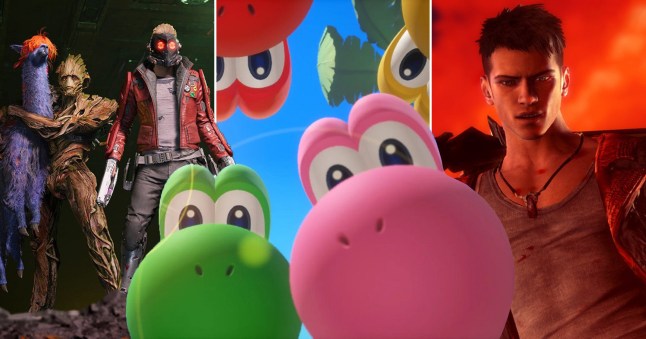
The game that inspired this list, Yoshi And The Mysterious Book initially looked like it would be another overly simplistic platformer for kids and hardly a good justification for purchasing a Nintendo Switch 2.
Turns out Nintendo severely undersold it, because Yoshi And The Mysterious Book’s levels are delightful toy boxes full of unique gimmicks that could easily have been the focus of entire games; ones that lend themselves perfectly to fun puzzle solving.
Nintendo’s marketing completely ignored the game’s best qualities, to the point where they still haven’t shared any sales figures, which is unusual for them. Despite being one of the best games of the year, and coming out shorty after Yoshi played a starring role in the Super Mario Galaxy movie, It’s believed to have not even cracked a million sales.
Marvel’s Guardians Of The Galaxy
After Square Enix’s extremely middling Avengers live service game, there was little enthusiasm for the company’s announcement of a Guardians Of The Galaxy game, even though it promised to be a purely single-player experience.
If anything, it was more bizarre that there were no co-op options for a game about Marvel’s gang of galactic outcasts, as trailers focused too much on Star-Lord’s (admittedly fantastic) mixtape of nostalgic 80s tunes, making the whole thing seem like a desperate recreation of the movies.
So, imagine our surprise when the game turned out to have some real ambition, boasting consistently entertaining tactical combat and, amidst the jokes, a sincerely heartfelt story about grief and coping with loss.
Despite developer Eidos-Montréal’s best efforts, and strong word of mouth, Guardians Of The Galaxy was branded a flop by Square Enix and contributed to the company’s decision to avoid future Marvel games and sell off its Western studios.
The only silver lining is that, quite unexpectedly, the game is getting re-released on Switch 2, after being announced during this month’s Nintendo Direct.
Onrush, Split/Second: Velocity, and Blur
We’re bundling these three together since they’re all British-made arcade racing games that suffered from poor marketing decisions, which contributed to their awful sales.
Onrush by Codemasters was enjoyably unique, as it was more of a hero shooter with cars than a standard racer, and all four of its gameplay modes worked wonderfully. Unfortunately, it was barely advertised and some trailers made it seem very generic.
Black Rock Studio’s Split/Second: Velocity also saw little advertising, despite having a great hook where you could trigger destructible environments mid-race to interfere with opponents and change the layout of the track. It also made the mistake of launching in May 2010, the same month as Red Dead Redemption and Super Mario Galaxy 2.
Bizarre Creations and Activision fell into a similar trap with Blur, as they tried to position the game as an adult rival to Mario Kart, complete with a trailer clearly meant to mock Nintendo’s racer as a stupid baby game, without explaining why Blur was supposed to be better.
Titanfall 2
Titanfall 2 is still revered to this day as having one of the best first person shooter campaigns and deservedly so. Even if very few people played it at the time.
Unfortunately, EA did it no favours by barely marketing the game and what marketing it did have didn’t do enough to emphasise that it had a proper campaign, compared to the first game’s multiplayer focus.
EA also made the baffling decision to launch Titanfall 2 between two other multiplayer shooters for far bigger franchises – EA’s own Battlefield 1 and the similarly sci-fi themed Call Of Duty: Infinite Warfare – thus dooming it to lacklustre sales.
DmC Devil May Cry
Capcom’s decision to reboot Devil May Cry and try to make it more appealing to Western audiences, by using British developer Ninja Theory and turning protagonist Dante into an unlikable git, was a bad call – especially with stuff like this joke, that seemed tailor made to antagonise long time fans.
And yet DmC Devil May Cry was a good game, with more complex combat than it’s given credit for, while fulfilling Capcom’s aim to be a more accessible entry point for the series.
Had Capcom not tried too hard in rebooting the world and characters, the game may not have generated such undeserved hate for developer Ninja Theory. To its credit, Capcom didn’t sweep the game under the carpet immediately and launched a fantastic next gen upgrade that added a number of new features and options.
Regardless, Capcom did end up reverting to the original continuity with the next game, Devil May Cry 5, and considering that’s now the series’ best-selling entry, it’s safe to say the reboot will remain a one-off.
Kirby
We’re including the Kirby series as a blanket case and long-time fans already know exactly why that is. For years, Nintendo of America seemed to think the best way to market Kirby in the West was by, and we’re not exaggerating here, giving him angry eyes.
Look up any box art comparisons of Kirby games and you’ll see the pink puffball’s joyful smile on the Japanese covers replaced with a furrowed brow and steely determination on the US covers, clearly done to make Kirby seem more hardcore than cute.
Maybe the tactic worked, because the game is bigger in the US than Europe, but nowadays the box art for Kirby games remains the same across regions, as Nintendo of America instead relies on nostalgia and leans into the cuteness.
God Of War 2
Before God Of War was about the contemplations of fatherhood and Kratos overcoming his anger issues, to be a kinder and wiser person, the series was primarily sold on its ultra violence and its hero being an amoral tryhard.
As one of the poster children for the 2000s era of video games, where a lot of the industry sold itself on being offensively edgy, Sony wound up rocking the boat by inviting press to a God Of War 2 event that involved shoving your hand into a dead, headless goat’s carcass and eating its insides.
Sony did clarify that the goat’s insides were filled with normal Greek food, but the dead goat was real and caused enough outrage among the mass media and animal rights activists for Sony to apologise for the debacle.
They may have been convinced to go to such lengths because the original God Of War wasn’t a big hit in Europe, as it came at the height of the rivalry between Sony Computer Entertainment America and Europe. The latter put purposefully little effort into pushing the first game, back when they had a lot more autonomy than they do now.
The Legend Of Zelda: Ocarina Of Time
The Legend Of Zelda: Ocarina Of Time has a lasting legacy as one of the best and most important video games ever made, but it has one small blight on that legacy and it’s an infamous UK ad that asked fans, ‘Willst thou get the girl? Or play like one?’
Aside from being uncharacteristically antagonistic for the family friendly Nintendo, it fed into the stereotype that video games are only for boys. It felt like a weirdly old-fashioned form of sexism even at the time and seems even more unforgivable nowadays.
This did spark a small controversy and an attempt to have the ad removed, which didn’t work, but it didn’t hurt Ocarina Of Time’s launch and is now more of an odd curio, since the ads weren’t run in other countries.
Dead Space 2/Dante’s Inferno
We should just put EA’s entire tenure during the Xbox 360 era on this list because the publisher was constantly guilty of relying on shock value and deliberately stirring up controversies to market its games.
For Dead Space 2, EA ran a Your Mum Hates Dead Space 2 campaign for the former, where it essentially put together a focus group of mothers and recorded their horrified and outraged reactions to some of Dead Space 2’s more violent moments.
Clearly, the goal was to make the game look cool and edgy to rebellious youths (EA even encouraged fans to post their own mums’ reactions on social media), but it was tasteless and lame even at the time and didn’t help the stereotype of video games being childish and exploitative. The strategy didn’t even work since, according to one of the game’s developers, EA branded Dead Space 2 a commercial failure.
As for Dante’s Inferno, which was a God Of War clone based on The Divine Comedy, EA tried to capitalise on religious backlash to promote the game and staged a protest to make it look as if devout church goers found the game offensive.
The company later confessed the protest was fake and, much like Dead Space 2, EA’s efforts were for naught as Dante’s Inferno underperformed, prompting EA to cancel a planned sequel.
Burnout 2
Acclaim rose from the dead last year, to get back into video game publishing, and we hope for its sake that it doesn’t repeat the same marketing snafus it pulled before it closed its doors.
We could write a whole article about Acclaim’s ill-thought-out ideas to promote its games here in the UK, which only ever earned it controversy and a poor reputation.
For example, to advertise racing game Burnout 2, Acclaim offered to pay for peoples’ speeding tickets, which unsurprisingly made the UK government very angry, since it came across as Acclaim encouraging speeding.
Acclaim filed for bankruptcy two years after it came out. EA, however, saw the potential in both the series and developer Criterion, as it acquired both and went on to release plenty more Burnout games.
Sadly, Burnout nowadays languishes in EA’s vaults (the last game was in 2018) and is unlikely to ever return now that Criterion has been reworked into a Battlefield 6 studio.
Shadow Man 2
Another infamous Acclaim promotion was for action adventure sequel Shadow Man 2… or Shadow Man: 2econd Coming to use its actual, much stupider name.
If you thought the speeding ticket scenario was bad, you’ll be amazed to learn that Acclaim’s marketing plans included buying advertising space on tombstones.
We don’t mean bespoke tombstones either. We mean Acclaim was offering families money to have Shadow Man 2 billboards placed on their dead relatives’ tombstones.
Billed as ‘deadvertising,’ Acclaim argued that it fit the game’s dark and gory tone and even said the offer would ‘particularly interest poorer families,’ describing it as ‘a subsidy to burial costs to give their loved one a good send-off.’
As far as we can tell, nobody took Acclaim up on the offer and, much like Burnout 2, Shadow Man 2’s sales weren’t strong enough to save Acclaim from bankruptcy, proving that there is such a thing as bad publicity.
To our surprise, there is a new Shadow Man game in the works, though, called Shadowman: Darque Legacy from Australian developer Blowfish Studios. But it was only announced with a vague teaser trailer in 2023 and has seen no updates since.
Email [email protected], leave a comment below, follow us on Twitter.
To submit Inbox letters and Reader’s Features more easily, without the need to send an email, just use our Submit Stuff page here.
For more stories like this, check our Gaming page.
Comment now
Comments
Add Metro as a Preferred Source on Google
Add as preferred source