
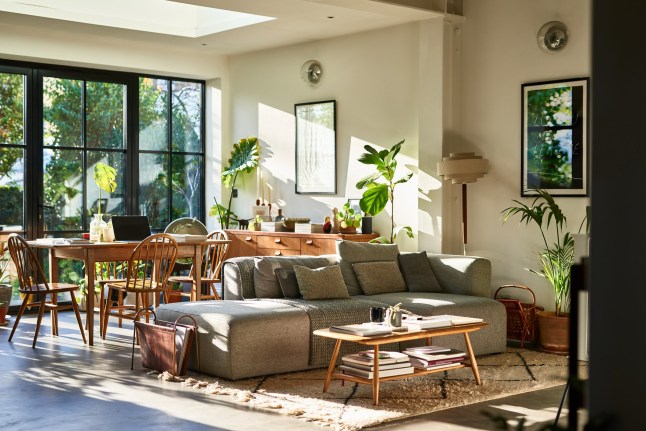
For those obsessed with scrolling through Rightmove or looking at interiors on Pinterest, an airy, open-plan living space is the dream.
A big kitchen island to gather around, comfy sofas and a table to eat dinner with the family.
But not-so-long ago, it was all about the dining room.
The concept peaked during the Victorian era, and then became a mainstay of middle-class homes during the 1920s and 1930s.
But according to new research, nearly a quarter (23%) of homeowners with dining rooms have now repurposed them completely, swapping them for things like a gym or an extra living room.
There are several reasons for the switch-up.
Ready to start your homebuying journey?
You can access completely fee-free mortgage advice with London & Country (L&C) Mortgages, a partner of Metro. Customers benefit from:
– Award winning service from the UK’s leading mortgage broker
– Expert advisors on hand 7 days a week
– Access to 1000s of mortgage deals from across the market
Unlike many mortgage brokers, L&C won’t charge you a fee for their advice.
Find out how much you could borrow online
Mortgage service provided by London & Country Mortgages (L&C), which is authorised and regulated by the Financial Conduct Authority (registered number: 143002). The FCA does not regulate most Buy to Let mortgages. Your home or property may be repossessed if you do not keep up repayments on your mortgage.
Almost a quarter of homeowners (24%) say working from home has prompted them to make changes to the layout, making way for home offices.
One in five say parenthood influenced their decision, while 16% said it was due to getting a pet.
Adam Day, head of estate agents eXp UK and Europe, tells Metro that the death of the dining room has been a ‘slow and painful’ one. RIP.
He says: ‘In many respects, it started with open-plan living.
‘As kitchens became larger and more social spaces, the traditional boundaries between cooking, eating and relaxing began to blur and the need for a separate room purely for dining naturally diminished.’
Adam says dining rooms used to carry a ‘certain sense of formality and status, with different rooms reserved for different parts of domestic life.’
He adds: ‘Many of us will remember visiting our grandparents, where there was often a “good” front room or dining room that was kept pristine and barely used unless guests were coming over or there was a special occasion.
‘We’ve now come almost full circle. Rather than keeping an entire room aside for occasional use, households increasingly want every part of the home to earn its keep.’
Finances play a factor too. As the cost of buying a home has risen, families have had to compromise on the amount of space they can afford. Without a spare bedroom upstairs, the dining room has had to adapt.
According to the latest ONS figures, the average home in the UK now costs £293,000, and amid spiralling renting costs, it’s becoming increasingly difficult for Gen Zs to get on the ladder.
One 2026 study from the House of Lords finds the average age of a first-time buyer has risen steadily, as in 2003/2024, it was 31. By 2024/2025, it was 34.
POLL
Poll
Do you still have a dining room?
-
Yes, and I use it oftenCheck
-
Yes, but I either don’t use it or I’ve repurposed itCheck
-
No, I can’t afford oneCheck
‘Does anyone use a dining room these days?’
It’s a debate that’s been scattered across the internet, as those who can afford the space, have admitted they don’t even use it.
Posting on the r/homeowners Subreddit, @RainbowSherbert99 moved into a large terraced home five years ago, and said their dining room is now a ‘dumping ground for washing.’
In the comments, @BellLopsided2502 said their last home had a dining room, and they only really used it when they ‘had guests or it was a special occasion.’ They added: ‘We did use the table for puzzles and crafts.’
‘We turned ours into a [bar]’ @therealfinagler shared. ‘Got rid of the table and now have a small cocktail corner and a tiny table for card games and drinks.’
However, as Adam says, there is a some hope for the dining room yet.
Adam explains: ‘Monday to Saturday dining habits may look very different to those of previous generations, but there is still something almost religious about the British Sunday lunch or dinner.
‘That tradition of bringing everyone together around a table remains deeply ingrained and, for that reason, I don’t think the dining room is completely dead.
‘It has simply evolved from being a room with one very specific purpose into a space that modern families expect to do considerably more.’
Do you have a story you’d like to share? Get in touch by emailing [email protected]
Comment now
Comments
Add Metro as a Preferred Source on Google
Add as preferred source