
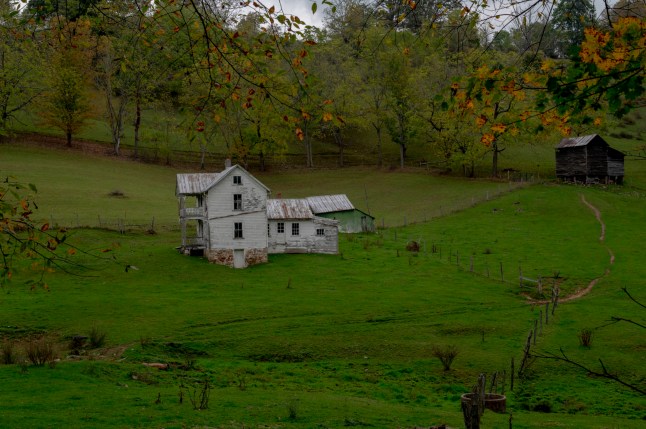
In the rugged, Appalachian Mountain state of West Virginia lies the tiny pinpoint town of Green Bank, Pocahontas County.
It’s a vast sea of vivid green, known as ‘Nature’s Mountain Playground’ but as you drive towards the 148 person settlement, it gets eerily quiet.
No radio stations play. The phone and wireless device is strictly limited. The whirring of microwaves is strongly discouraged.
It sounds like a yesteryear world, a far cry from the ultra-connected, always-on wireless society you find in major cities, and even other towns and villages.
The unnatural silence is all thanks to the federal government’s NRQZ, or National Radio Quiet Zone – a 13,000 square mile region between Green Bank and Sugar Grove.
Government ordered quiet is imposed in Green Bank for one simple reason: The Robert C. Byrd Green Bank Telescope.
Travel through Green Bank West Virginia with me 😊 #westvirginia #wv #travel #greenbank #fyp
Completed in 2001, the giant white structure features a 2.3 acre dish which acts like a giant bowl, collecting weak radio waves from space, picking up activity at the very edge of the universe.
These signals are so faint, in fact, that they equate to about billionth of a billionth of a millionth of a watt. This means it needs radio-quiet skies to operate effectively.
While it was built in the sheltered valley to take advantage of the mountain bowl protecting it from man-made radio interference, other measures still need to be taken.
Any radio transmissions are limited by law, as are any devices that use radio frequencies like wireless doorbells, baby monitors and mobile phone signals.
Staff at the National Radio Astronomy Observatory, which operates the telescope, even bought a farmer a new heater when his old one was leaking interfering radio waves.
Even energy waves coming from battery-operated fans sold in the facility’s gift shop were found to be causing the telescope problems.
Within a mile of the telescope you can only drive a diesel car, too, given that spark plugs can disrupt the sounds from distant galaxies.
But it doesn’t mean there aren’t exceptions to the rule. Emergency services are allowed to use one particular frequency, while staff working at the telescope site have a microwave in a special cage that prevents the radio waves causing disruption.
How does a radio station operate in one of the quietest places in America? 📻 WVMR is the local station serving Green Bank, West Virginia, inside the National Radio Quiet Zone, where radio interference is tightly controlled to protect the massive telescope nearby. But for the people who live here, this little station is much more than music. It shares emergency alerts, school closures, community updates, and even lost pets. In a town where staying connected looks completely different, one local radio station means a whole lot. The full story from Green Bank is on our YouTube channel!
WVMR is the lone radio station that is allowed to operate because its equipment and transmission paths were designed to comply with the quiet zone rules, as well as operating on a shielded link.
It’s not a technology desert, for locals either. They have broadband internet at their homes, but the difference is they can’t access it unless they’re at a computer – many won’t be available on a mobile phone.
This little hamlet is the type of place locals say isn’t ruled by an addiction to screens. They stop and chat in the street, and they’re present in conversations that aren’t interrupted by notifications.
‘The pace of living reminds me of a kid in the 80’s,’ wrote one frequent visitor on Reddit.
‘I never lived there, but my relatives had a house in Green Bank and we all kind of shared it as a get away spot,’ added another. ‘They didn’t get internet/landline at the place because the point of going was to get away.
‘We had a TV and some DVDs, puzzles, board games, etc for rainy days. Most of the time we would spend out hiking or exploring nearby. We typically went to Trent’s General Store for food stuff.’
The nearest bustling towns – like Staunton, Elkins and Harrisonburg – are at least an hour or hour-and-a-half drive while major cities like Pittsburgh and Washington are more than 140 miles away.
In short, Green Bank is an off-grid paradise for those who shy away from an uber-connected world.
It’s always been a peaceful place. The name Green Bank apparently comes from the effect of the natural springs which the hillside in town to remain green most of the year.
Legend has it that people from across West Virginia would schedule meetings at the ‘green bank’, so the name simply stuck.
Just south-west of Green Bank, Native Americans had a visiting camp where they set up an arrowhead production site due to how much shale and flint was available.
A town of discoveries
But in the modern age, this quiet zone has been responsible for numerous scientific discoveries in outer space.
Locals and scientists who work at the observatory can map asteroids, moons, planets, and comets to a level of accuracy that is often better than spacecraft.
Tiny delays in a pulsar’s pulse arrival, can show a warp in the fabric of space caused by a heavy object. Physicists can calculate the weights of the objects, even if the delays are only a ten-millionth of a second long.
And, astronomers using The Green Bank Telescope discovered a huge ‘superbubble’ of hydrogen gas nearly 10,000 light-years above the plane of our Milky Way Galaxy.
Do you have a story you’d like to share? Get in touch by emailing [email protected]
Comment now
Comments
Add Metro as a Preferred Source on Google
Add as preferred source