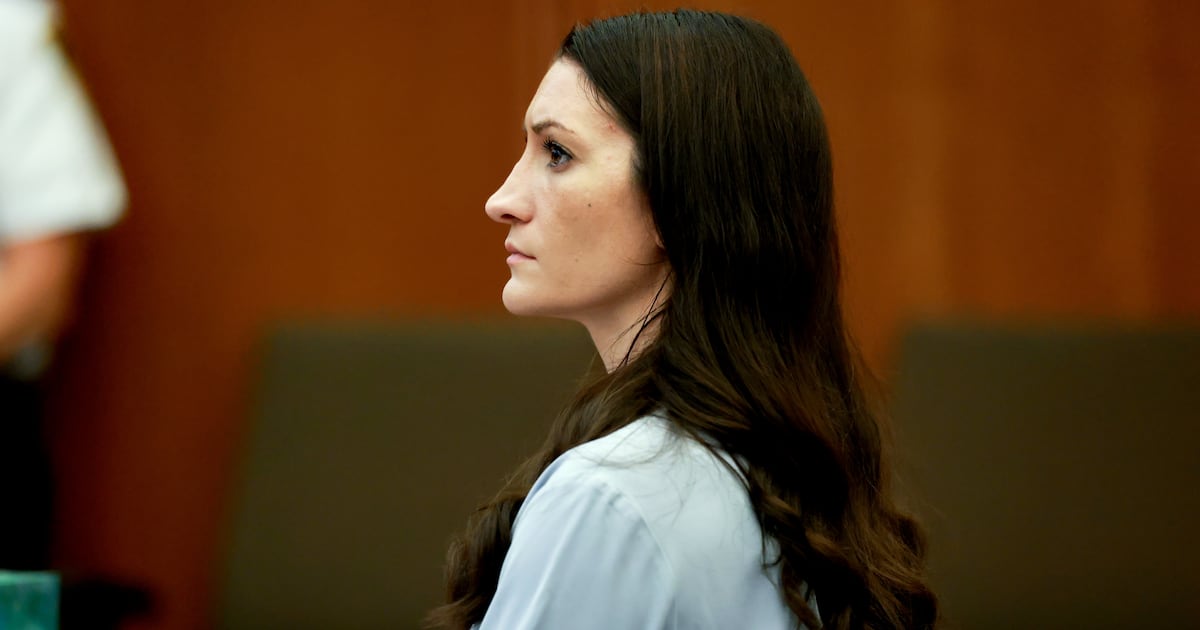
A third day of jury deliberations concluded with no verdict on Monday in the trial of Lindsay Clancy, the Massachusetts mother charged with murder for strangling her three children before attempting to take her own life.
Jurors began to deliberate the high-profile case on Thursday after more than four weeks of testimony. They deliberated for about 10 hours across two days at the courthouse in Plymouth, Massachusetts, before the judge, William Sullivan, sent them home for the weekend.
Discussions began again just after 9am on Monday, and the judge dismissed the jury at 4pm. The jurors were not brought into court at any point during the day, though there was a lunch break.
Kevin Reddington, Clancy’s defence lawyer, said that on Friday the jury had asked to look at a knife and prescription pill bottles, which are thought to be connected to Clancy’s suicide attempt.
READ MORE
Welcome to the new Global Briefing newsletter
Violent scenes in Ceuta as Madrid struggles with migrant crisis
A wickedly inventive political ad is airing in Texas as midterm elections loom
António Guterres: ‘Superpowers need to understand things have changed’
Clancy (36), does not deny killing her children with exercise bands in 2023, but she has pleaded not guilty, and her lawyers have argued that she should not be held legally responsible because she was suffering from post-partum psychosis.
Reddington argued that Clancy had been overmedicated for severe post-partum mental illness and thought a male voice had commanded her to kill her children and then herself.
Jennifer Sprague, a prosecutor, told jurors that Clancy made a series of premeditated choices before killing Cora (5), Dawson (3) and Callan (8 months). They included asking her husband to leave the house and strangling the older children first because they were more likely to resist.
“You know, to a moral certainty, she is guilty,” Sprague said.
For a guilty verdict, the prosecution must prove beyond a reasonable doubt that Clancy both committed the crime and was criminally responsible for it. If jurors find Clancy guilty, they must choose among first-degree murder, second-degree murder and manslaughter.
The option of a manslaughter verdict could potentially help jurors reach consensus sooner and make the prospect of a hung jury less likely.
The judge instructed jurors that Clancy would not be criminally responsible if she had a mental disease or defect that prevented her from controlling her actions, or from understanding that they were legally or morally wrong.
In the months leading up to the killings, Clancy was reporting persistent, disturbing and intrusive thoughts.
She was prescribed a plethora of psychiatric medications. At the beginning of January 2023, she self-admitted to a psychiatric hospital, where she stayed for five days.
On the evening the children were strangled, Clancy’s then-husband, Patrick Clancy, said that he found her lying injured in the backyard. Clancy had cut her wrists and neck and jumped from a second-story window of their home, leaving her partially paralysed.
The last week of trial testimony came from rebuttal witnesses brought by the prosecution to respond to claims made by the defence.
The expert witnesses provided their assessments about Clancy’s state of mind at the time of the killings. They said the killings were not necessarily the result of psychosis.
Reddington, however, said during closing arguments that Clancy had repeatedly sought help for her deteriorating mental illness but that doctors had failed her.
Sprague countered, saying that the case was “not about our mental health system or how it treats women.” – This article originally appeared in The New York Times.