
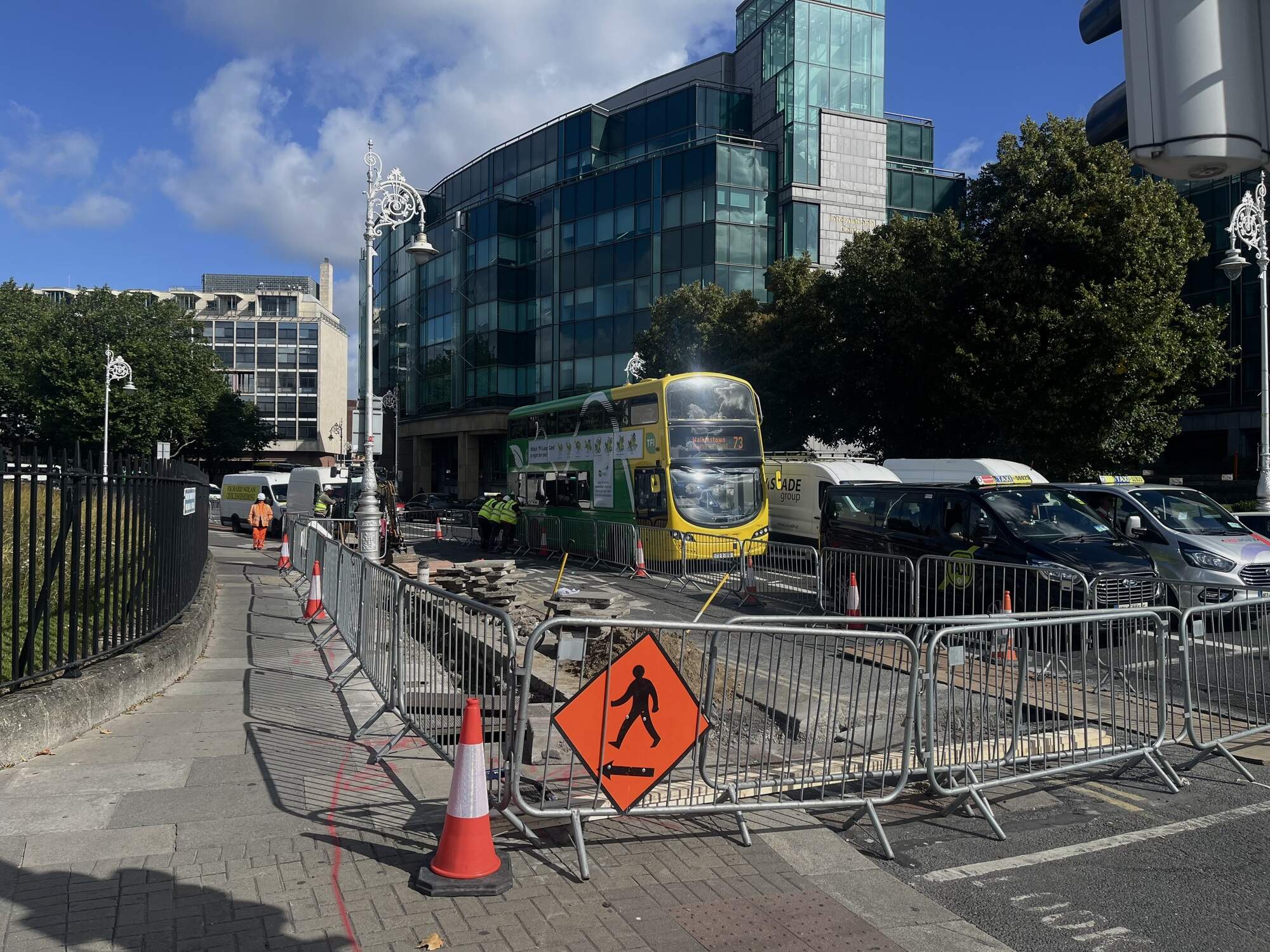
Works have begun to install a cycle lane down the middle of Amiens Street, in a first for Irish active travel infrastructure.
Contractors from Richard Nolan Civil Engineering have appeared in recent days along the roadway, and the majority of the planned route has now been cordoned off.
Traffic in both directions is free flowing, although one southbound lane on Amiens Street has been fenced off to allow for its conversion to a bi-directional cycle path.
Once complete, the lane will be protected on either sides by planters. The street’s three northbound traffic lanes are unaffected by the change.
It will be the first Irish cycle route to be installed between traffic lanes, as opposed to alongside them, an approach Dublin City Council (DCC) said was “innovative” for this location.
It is expected to take around six weeks to construct, with a permanent design requiring “significant civil works”, according to the council, necessitating a temporary solution for now.
This section of Amiens Street is suitable due to “traffic volumes, the absence of right turns along the route, and the significant width of the road”, reads a DCC briefing note on the scheme.
However, it said this layout is not appropriate for most locations in the city.
When complete, it will provide a long-awaited connection between the Clontarf-City Centre route and the Liffey Cycle Route at George’s Quay.
Cyclists will join the cycle route from the existing Amiens Street cycling infrastructure via a signalised junction, which allows them to cross into the central reservation containing the new lanes.
Once on the infrastructure, it will take them down Beresford Place on the west side of the roadway, adjacent to the bus lane, before crossing Talbot Memorial Bridge and connecting up with the Liffey route.
The bridge’s existing footpath-level cycle track will also be removed, allowing the footpath to be widened.
DCC engineers say the primary reason for the unusual layout is about avoiding conflict between buses pulling into Connolly Station, cyclists and pedestrians.
Claire French of the council’s engineering department previously told councillors that the design was “something new.”
“We’re not putting big, permanent civil works in. If it doesn’t work, if cyclists don’t use it, we can take it out. I think it will work, but that’s why we’re going down the planter route,” she said.
Funded by the Local Democracy Reporting Scheme