
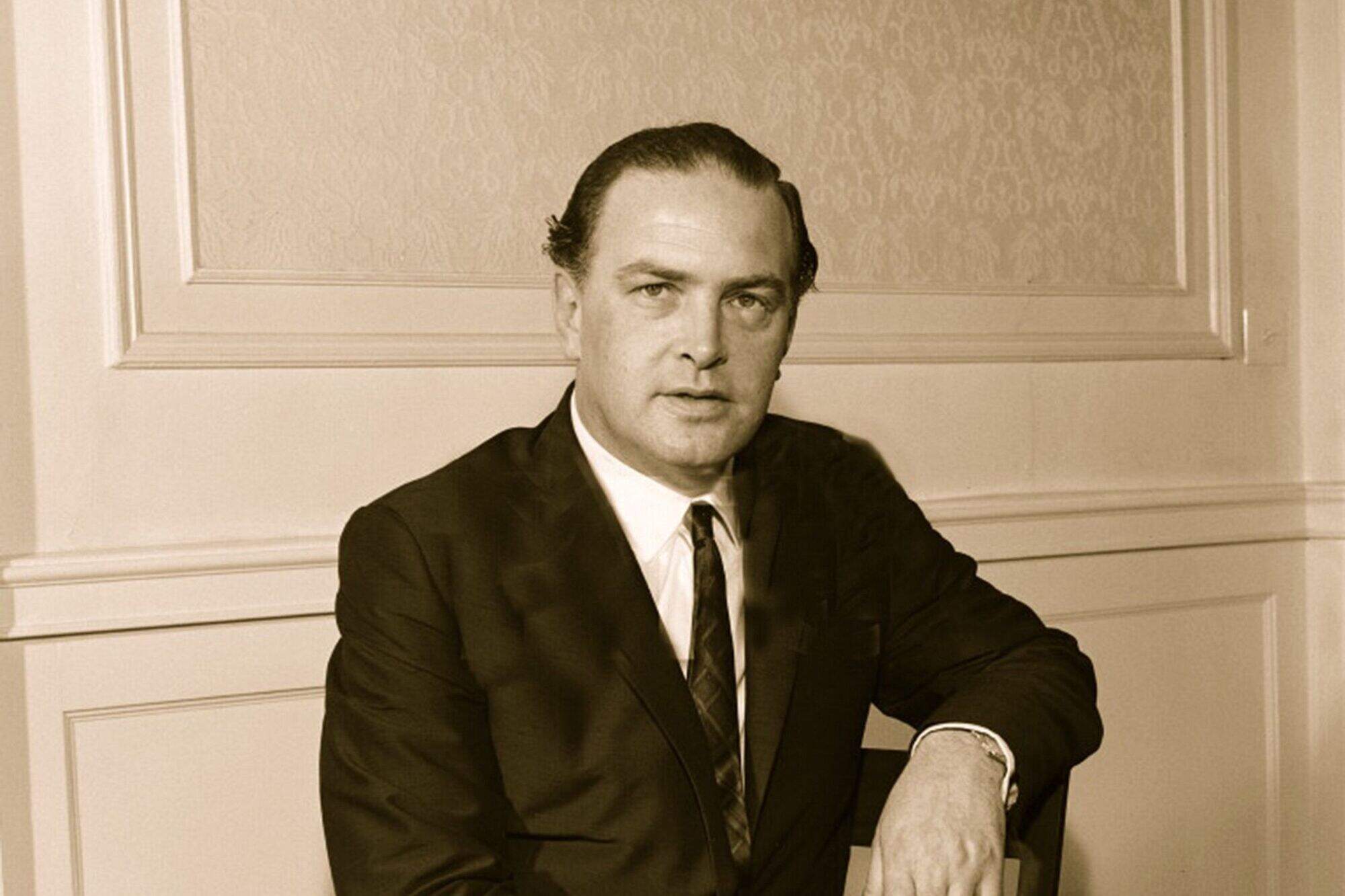
Plaque paying tribute to visionary former minister unveiled in Co Clare
Donogh O’Malley’s determination that a person’s origins should not limit their life’s chances led to his successful crusade to introduce free secondary education, his son Daragh has said.
The actor was speaking at the unveiling of a commemorative plaque to his father, the former education minister, at Sixmilebridge, Co Clare, on Sunday.
It is the beginning of a series of events to honour the neglected political figure, who announced free secondary schooling 60 years ago in September 1966.
Daragh O’Malley recalled that his father, who was just 47 when he died, “felt a deep sense of shame” that in the mid-1960s, one-third of Irish children – and up to 50pc in rural areas – left school with just a primary education. He believed this condemned them to labouring work and a high risk of unemployment, and increased emigration.
“This is not ancient history – we’re talking about the 1960s,” Daragh O’Malley said.
He further argued that the arrival of free secondary education could not be taken for granted, adding: “It was not inevitable. Somebody had to argue for it, somebody had to get approval and somebody had to pay for it.”
Mr O’Malley thanked Sixmilebridge Historical Society for becoming the first Irish organisation to honour his father’s innovative work, which also included other initiatives such as free school transport and establishing a countrywide network of regional colleges.
It was at Sixmilebridge’s “Little Church” that Donogh O’Malley suffered a fatal heart attack while speaking at a by-election meeting in March 1968.
The plaque was unveiled by Education Minister Hildegarde Naughton, who said the introduction of free secondary education was central to Ireland’s subsequent economic progress.
Professor Gearóid Ó Tuathaigh, of the University of Galway, said the pioneering minister’s privileged background did not prevent him from seeing shame in “the thousands of bright youngsters being deprived of the chance to realise their potential”.
Prof Ó Tuathaigh said O’Malley was both fearless and pragmatic in his approach to politics. This allowed him to work with taoiseach Seán Lemass in getting around opposition from the Department of Finance, as well as others who were reluctant to introduce free secondary education.
“Some saw him as a comet who burned brightly, but too briefly. But it was his achievements which marked his life,” Prof Ó Tuathaigh said.
Event co-organiser Michael O’Dwyer said Donogh O’Malley was among the most significant figures of 20th-century Ireland.
He said Mr O’Malley had served just 20 months as education minister but drove through some huge changes while setting others in train for the future.
More than 1,000 people attended the event, which included tributes to Mr O’Malley’s late widow, Hilda, the woman who inspired poet Patrick Kavanagh to write the haunting song On Raglan Road.
Daragh O’Malley explained her influence on his father’s work for equality in education.