
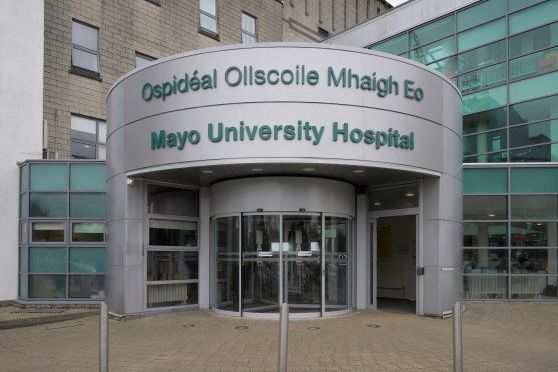
Mayo University Hospital say ‘every effort’ being made to tackle hospital overcrowding
Mayo University Hospital has confirmed that work has begun on an extension to its emergency department and a new acute medical assessment unit (AMAU).
In response to queries from the Irish Independent regarding ongoing overcrowding in the hospital’s emergency department, MUH said that it “continues to experience high patient volumes and increasing complexity of care following a busy summer period”.
Mayo Aontú TD Paul Lawless recently described conditions in the hospital’s emergency department as “horrendous” after he visited a constituent who waited over 24 hours to be admitted.
The hospital has experienced considerable overcrowding recently, prompting MUH to urge people with non-urgent conditions to contact their GP or an out-of-hours service and only attend the emergency department in emergency situations.
According to the Irish Nurses and Midwives Organisation, 29 admitted patients were waiting for a bed in the hospital, on Wednesday, September 2.
In a statement to the Irish Independent, MUH said it is making “every effort” to manage high numbers of attendance.
“The high number of patients requiring admission from the ED often exceeds our bed capacity, and this unfortunately leads to delays in admitting patients to a ward.”
An MUH spokesperson acknowledged that this was not the standard of care the hospital aimed to provide and expressed regret that patients had to wait.
MUH also confirmed that work on the emergency department extension and AMAU was progressing, with the contractor arriving on site in August.
The project will see a two-storey extension added to the hospital courtyard, with the expanded Emergency Department on the ground floor and a new AMAU on the first floor.
The expanded ED will gain seven assessment and treatment spaces, while the new medical unit will provide ten spaces and accept suitable patients referred directly by GPs or transferred from the emergency department.
The wider project will include a dedicated paediatric area, a gynaecology treatment suite, improved resuscitation facilities, a new ambulance entrance and an expanded car park.
Separately, a new local injury unit in Ballina, announced last year by Minister for Health, Jennifer Carroll MacNeill, is under construction and will open in October.
It is anticipated that the local injury unit will treat patients with suitable injuries who might otherwise attend the emergency department at MUH.
MUH is also progressing a Development Control Plan (DCP) for the hospital campus, which will set out the hospital’s infrastructure requirements to meet current and future acute healthcare needs for the population of Mayo.
A project team has also been established to oversee the development of a new 96-bed ward block at MUH. The next stage will be the appointment of a design team.
MUH has said that it has implemented Stage 1 of the Safer Staffing Framework, with Stage 2 to be submitted in 2027.
Castlebar-based councillor Harry Barrett said that the shortage of GP cover, particularly at weekends, was contributing to hospital overcrowding.
“The latest figures show that while Ireland’s population grew by around 10pc between 2020 and 2025, the number of GPs grew by only 6.4pc. Almost 6,000 people have already contacted the HSE this year looking for help simply to find a GP,” Cllr Barrett told the Irish Independent.