
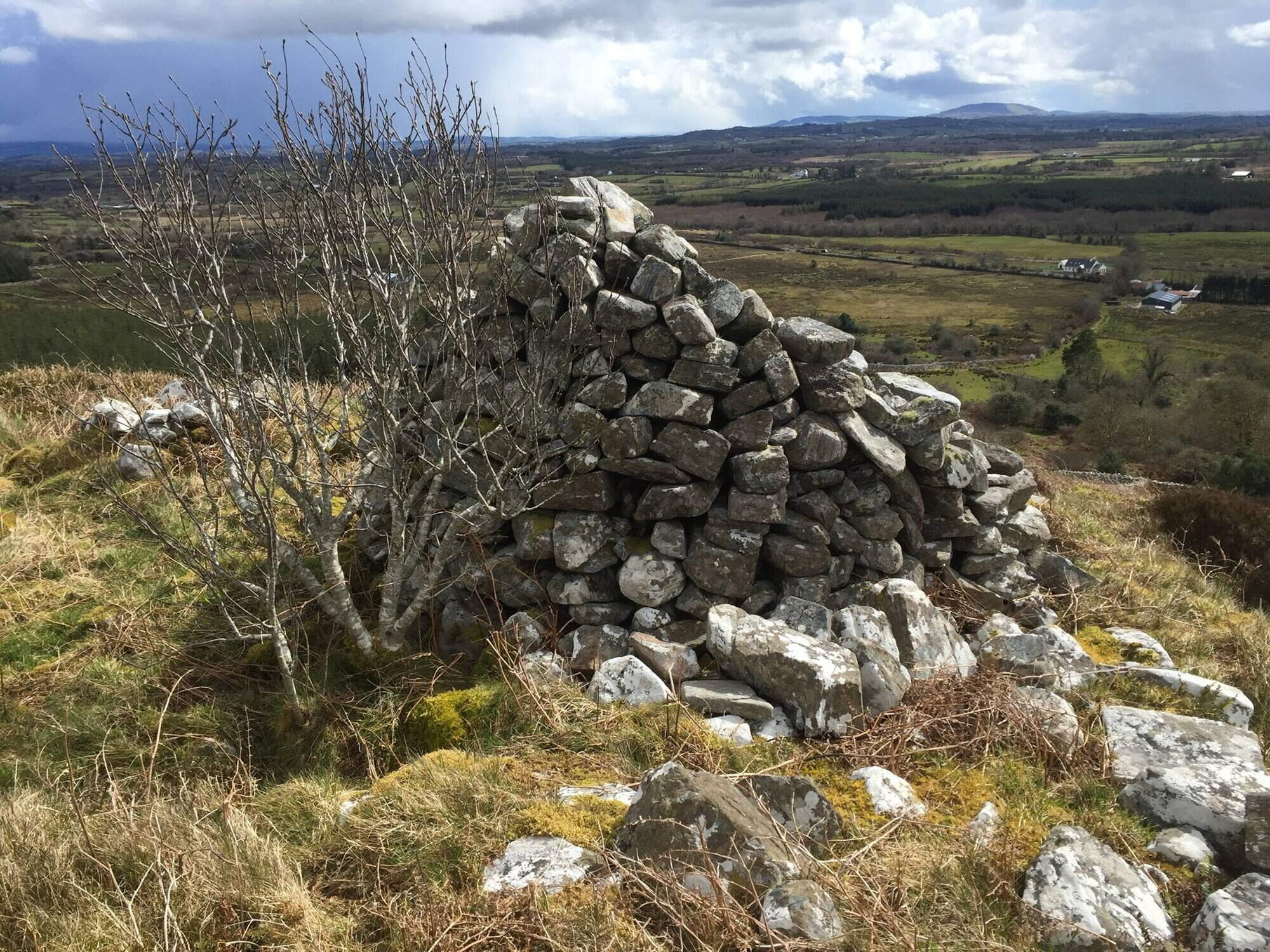
In Ireland there long been a respectful attitude for holy places: blessed wells, church ruins and old graveyards, with a strange atmosphere never far away, changeful beneath a tranquil landscape just beyond our vision.
Sligo has many such places including Tullaghan Hill which is a place of great mystery.
The Hawk’s Well, or Tullaghan Hill Holy Well, is located high in the Ox Mountains on Tullaghan Hill, near Coolaney, Co. Sligo.
It is ecorded as far back as a thousand years by the Anglo Norman chroniclor Giraldus Combrensis.
A pre – Christian legend tells how Eremon, an ancient hero executed his servant and threw his head into the well, that “understandable make the well water bitter”.
The well is associated with Saint Patrick who is said to have challenged the druid Cathbhaodh the Fire Spitter.
The encounter is said to have left the saint exhausted from thirst whereby Patrick called out in prayer and a miraculous surge of water came forth.
The well itself is enclosed within a horseshoe shape of loose stones. With what was a standing stone or altar to the foreground that has long disappeared. The extraordinary fact of the well is that it is hundreds of feet above sea level though it rises and falls with the tide and is said to alternate between sea water and fresh.
Some early historians consider Tullaghan Well as initially the site of a pagan celtic festival to the goddesses’ Gamh.
Folklorist Estyn Evans writes in 1957, Ireland’s Holy Wells represents: “An ancient cult of water springing from deep within the earth (an unfathomable mystery), to the ancient mind, that was reinforced and adapted by successive cultures from the megalithic to Christian times.”
However, a revisionist narrative seems to cast some cold water upon those appealing notions of spiritual continuity. A Christian visit to a holy well today could hardly be described as, for the same reason ancient peoples did 2,000 years ago.
W B Yeat’s play at the Hawk’s Well centred around Tullaghan Well. It was performed at the Factory on lower Quay Street a number of years ago.
In this one-act play, the Tullaghan Well was reputed to periodically hold water that would make immortal whomever might have a taste.
The hero of the tale Cú Chulainn, wishing to have a chance of living forever. But an old man waiting at the Well for 50 years tells the hero he wasted his life. Recalling that whenever the well filled up with water, an enchantment came over him and he fell asleep. Missing his chance to drink and gain immortality.
Ruaidhrí Ó Flaithbheartaigh, in his 1685 History of Ireland Ogygia, wrote:
“In Sligo’s district on Mount Gam’s high side a fountain lies not washed by ocean’s tide. Each circling day it different waters brings the fresh, the salt; from it alternate springs.”
At Lughnasa, gatherings at high places was common, marking the beginning of harvest. Tullaghan Hill was one such place, changing over time and becoming a place of religious pilgrimage.
It was re-established on Garland Sunday as a place of devotion. However, the day out became one of merrymaking, courting, drinking and faction fighting.
Though one festive day (c) 1930, a terrible storm broke out. It lasted for several days. This was looked on by local clergy as a sign from Heaven of disapproval. This ended the carousing.
For some people, particularly in rural areas, beyond human sight and comprehension lies a realm, neither fairy nor ghost, but containing elements of both and uneasy spirits. This was called by country folk the otherworld, and to one’s family came baleful results of any unpleasant encounter.
Anthony Mullaney and his wife lived in the townland of Tullaghan, a place steeped in ancient lore. Natives believed, as they did, that the lands surrounding that part of the Ox Mountains was badly fairy haunted.
Mullaney’s wife had a brother a priest in Enniscrone, giving the fairies a particular interest with their detest of “ Men of the Cloth”.
One evening she was out picking blueberries near Tullaghan Well when the fairies came upon her. When she made her way home she turned into a dreamy, lazy creature who seldom spoke and moaned softly to herself. Her husband sent for her brother the priest.
The priest came with his prayers and incantations. She groaned all the more and snapped at him. “There’s something not natural here,” said the priest “something that might be of the spirit world” and he went away to reflect.
The priest returned and prayed in Latin, English and Irish and Kathleen answered with screams. “There now the exorcism is done, she is at rest now”. When she came to she was as bad as ever. Her poor husband was beside himself with fear and frustration.
Away deep in the Ox Mountains, it was said, was a woman with a deep knowledge of the ways of the fairies. She was known as Gray Ellen and it was she the husband turned to.
“ I knew you were coming” exclaimed Gray Ellen to the startled man, soon aware she knew all of his circumstances.
“The fairies were here long before us, their ways are far older than ours.” said Ellen as she fumbled in her old shawl for something.
“If you are in trouble with them use this” in the dim light of the fire it glistened like metal. “This is a fairy bolt” said the old woman/ “It is marked with a special spell, with this they won’t harm you.”
As he took it , it felt warm to the touch. ‘It’s the magic in it,’ said Gray Ellen as she further instructed him. ‘Go to the Rabbit’s Rock at the next full moon. Bring a sharp knife that has been dipped in the water of the well. Here you will encounter the fairies. On no account are you to speak a word. Go now and you will get your wife back.”
On the night ordained, Anthony Mullaney struck out for Rabbit’s Rock, a place dark and shadowy, where shapes seemed to come and go. Even as he drew near, the air seemed to grow colder. Still he held his ground, knife in hand. In the shadow of the rock he waited.
There was a movement away down the slope. There were dark men, about six in number, riding towards him. As they drew nearer, Anthony could see one of the group was not of the fairy kind—it was his wife.
She seemed to be bound to a pair of horsemen with a long silver rope. He waited as the procession drew closer.
He struck out with his knife at the silver rope binding his wife as the fairies shrieked and screamed. He pulled Kathleen down from the saddle.
As soon as her feet touched the ground, recognition returned to Kathleen’s eyes. Down the slope they ran towards the sea while the fairies danced and wheeled their horses pawing the air. Fairy bolts they threw after the couple. Anthony firing his own back, as it touched the ground it roared up in a great fountain of fire.
“Get down” shouted Anthony at his wife as he shoved her. Alas the harm was done—the spell was broken, as Gray Ellen had foretold. The whole scene faded away before him as it was no more than an illusion. Abject dejection was Anthony’s only companion as he made his way back.
Anthony finds his poor wife back in the home in a state described as neither alive or dead.
Appearing as she did to have returned to another world. At night, Anthony would sit by her bed while she slept and the fairies cried and screamed in the valleys and among the trees between his house and away in the Ox mountains.