
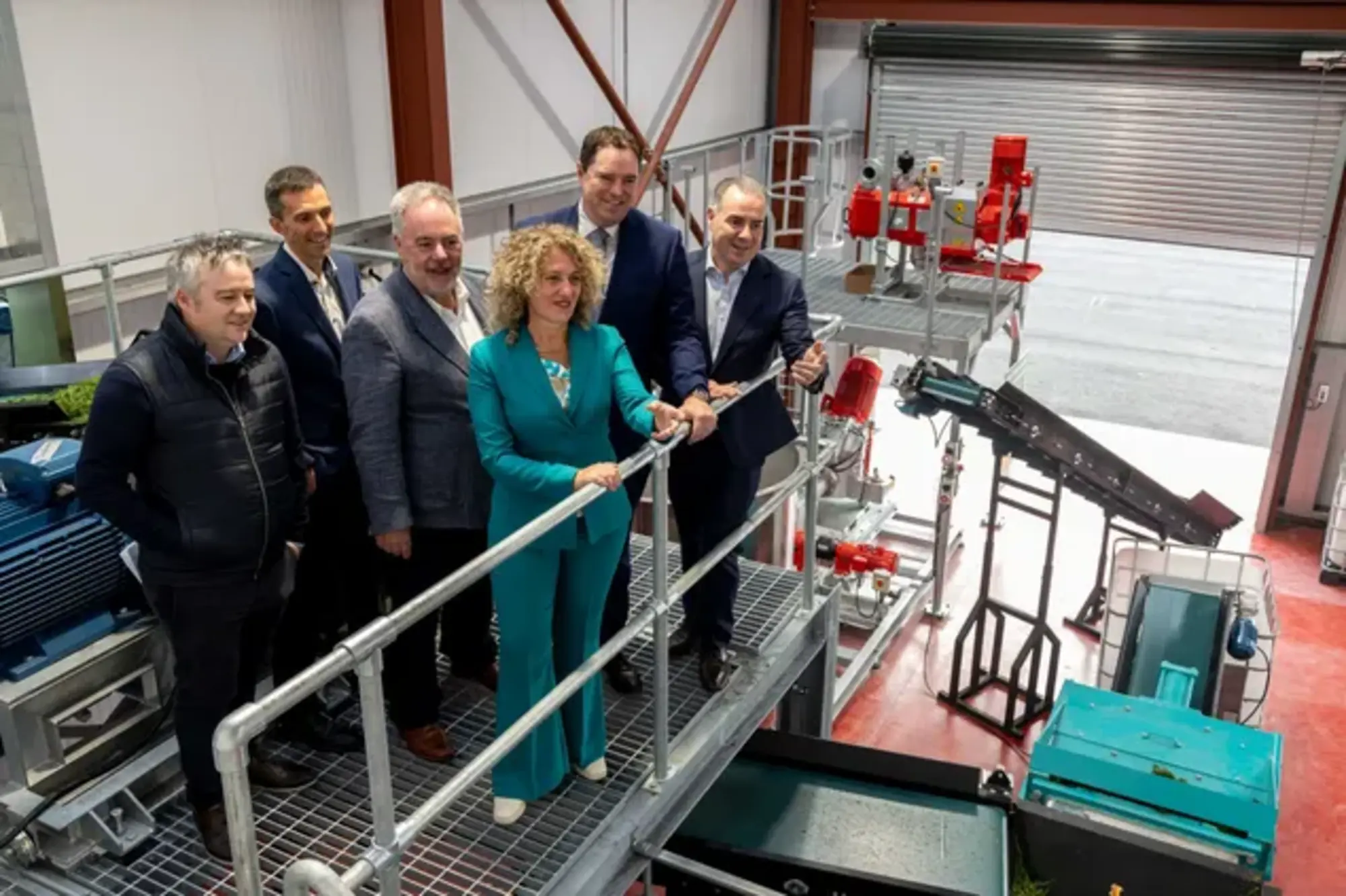
A revolutionary €3m grass biorefining plant heralds an environmentally-friendly and profitable future for farmers as new technology aims to unlock the full riches of Ireland’s grasslands.
The high-tech facility – developed as a demonstration plant at Sinagh outside Bandon in west Cork – aims to harness Ireland’s greatest natural farming asset, grass, and exploit new systems to process it into a range of added-value products including fertiliser, proteins, bio-energy and potentially even human nutrition.
Rather than simply a foodstuff for cattle, grass can now be utilised to deliver a range of products aimed to maximise the income potential of Ireland’s world-renowned pastures.
Agriculture Minister Martin Heydon hailed the plant “a significant milestone for the Irish bioeconomy.”
“This is Ireland’s first on-farm demonstration facility at scale. The facility will process fresh grass to produce a range of products including high-protein animal feed, a grass fibre fraction that can be used for applications in packaging and livestock feed, bioenergy and bio-fertiliser, and with the potential for new human food ingredients in time.”
“Instead of just using grass for one purpose – animal feed – this facility will show at a pre-commercial level how we can make further use of our grass and open up new business models and income streams for our grassland farmers.”
Ireland produces some of the highest yields of grass in the world, supported by a temperate climate, good quality soils and expert grassland-management.
“Grass from Irish pastures is the greatest single production advantage that Irish farming has,” Mr Heydon added.
“Currently, grass has one primary use – as a feed for livestock. However, research and innovation have developed technologies for green biorefining that allows grass to be processed into a range of new, high-value products, without adversely affecting its primary use as an animal feed source.”
‘Green Biorefining’ separates fresh grass into a fibre-rich press cake for livestock feed and a juice stream from which protein and other biobased ingredients can be recovered.Even the effective waste is put to use directed to anaerobic digestion to produce renewable energy and nutrient-rich material with potential for use as bio-based fertiliser.
The demonstration plant will act as a testing, learning and product validation platform.
The plant has been developed with export in-put from Munster Technological University (MTU), BiOrbic and Carbery Group.
MTU’s James Gaffey said the concept has enormous potential.
“The launch of this new state-of-the-art green biorefinery and anaerobic digestion plant, one of the largest facilities of its kind in the world, is a key development given the importance of grassland to our rural economy and farmers.
“This places Ireland firmly as a leading player in this emerging innovation space.”
Carbery Group chief executive Jason Hawkins said the plant was a key component in Ireland’s drive to Farm Zero climate ambitions.
“By using grass as more than a single output resource, it will explore how the same biomass can provide animal feed, protein ingredients, renewable energy and recoverable nutrients.
“Crucially, this is a demonstration facility. It will enable the partners to assess performance, product quality, environmental and climate impacts, costs, regulatory requirements and viable business models under real farming conditions.”