
Yotam Ottolenghi: ‘I don’t think food should be used as a tool of war’From tahini and sumac to his famous colourful salads, Yotam Ottolenghi has transformed the way many of us eat at home. As he prepares to publish his 12th cookbook, he tells Jordan Mooney why his focus has shifted to keeping things simpler Sat, 12 Sep, 2026 – 01:00Jordan Mooney
Ahead of the release of his 12th cookbook, Simple Too with Verena Lochmuller, chef, restaurateur and author Yotam Ottolenghi is sitting in his north London office, chatting with me via video call. Anyone who has been paying attention to culinary evolution over the past two decades or so might have noted what some call the “Ottolenghi effect” — his consistent advocacy around vegetables and promotion of ingredients like tahini and sumac have effectively changed how many of us dine at home. It’s likely that many home cooks reading this have at least one of his cookbooks in their kitchens, have subscribed to his Substack, dined at one of his restaurants, or have read his columns across various publications like The Guardian and The New York Times. So, to have a sit-down with the man himself is something of a golden opportunity for someone like myself.
The newest tome is born from the notion that home cooking has become something of a chore — even, sometimes, he admits, for himself.
“This book came about because it feels to me that there is quite a lot of noise and stress for people around what to cook, what they should be cooking, and how much. I feel too often that people just go for the easy way out, which is getting a ready meal or delivery, while cooking can actually be so easy and simple, if you just give yourself a break,” he explains.
“We’re trying to lower the entry point to cooking, which means we’re really embracing shortcuts, like canned chickpeas rather than soaking and cooking the chickpeas. Sometimes we use ready rice, and we use a lot of spice blends, like baharat and ras al hanout, to save you from having a pantry full of spices. Also, we use all these wonderful condiments in this book, from harissa to mirin to different marinades, because there is a whole industry that produces them and they’re wonderful, and they help you to keep cooking. That’s where the idea really came from, to just help make it a bit, well, simpler.”
In previous cookbooks, the chef was known for encouraging cooking from scratch — soaking pulses, then cooking them before whizzing them into houmous or roasting them for salads was just the start of it. Now, though, with his businesses thriving and a busy home life — he shares two young sons with his husband Karl Allen — it seems that Ottolenghi has come around to the struggle that most of us face; that time is a finite resource and most of us don’t seem to have enough of it.
“I like to cook, and I try to cook every day for myself or my kids or friends, but I do get takeout too,” he says.
If someone says to me, ‘I’m only going to go to cook from start to finish, from raw ingredients’, then I say, ‘Well, that’s nice, but not a lot of people can do that every day’.
“I really would love people to cook every day as much as possible, but this way, you’re still cooking. You still buy your ingredients. You roast your fish, or you roast your vegetables, or you steam, or you grill, or you do something.”
Ottolenghi HQ, the north London office, is where the chef spends most of his time, testing recipes with his team and discussing upcoming projects. With hundreds of employees under the brand’s name now, undertakings are very collaborative, hence why each book usually has at least one co-writer. Ottolenghi explains that day-to-day, the team — which he calls a “well-oiled machine” — is juggling multiple different creative streams, including recipe creation and testing for the Ottolenghi Substack newsletter, which has the sixth-largest number of paid subscribers in the UK. When they undertake a book, development usually takes a couple of years after one of his creators approaches him with an idea.
“Verena Lochmuller, my collaborator, came with about 40 recipes,” he explains. “Often a recipe goes through three or four iterations in the test kitchen before we can say that we really love it. We’re quite rigorous in our testing and it’s quite a long process. We would have long meetings and discussions about what we want in, what we want out, what we’re missing, making sure we’re really happy with everything at the end.”
The resulting book has 135 recipes, which were formulated to be “made in under 30 minutes, cooked in one pot, or prepped ahead”. Colourful and creative, dishes include the likes of tomatoes with tamarind gazpacho, Old Bay hake and prawn patties, and coconut greens with Scotch bonnet and eggs. Inspiration comes from all over the globe, with Ottolenghi explaining that he takes notes from his travels, although he doesn’t travel as much as he used to. It’s clear, however, that the Levantine regions still play a significant part in his cuisine.
Born in Jerusalem, Ottolenghi has long classed his food inspiration as Middle Eastern- and Mediterranean-influenced. His long-standing collaborator Sami Tamimi — now a silent partner in the business, having stepped back from day-to-day operations around 2020 — is Palestinian. The pair lived just kilometres apart from each other — albeit one on the Arabic side, one in Israeli territory — before both moved to London and met while working at Baker and Spice. Their two-decade-long partnership saw the Ottolenghi brand take centre stage in London’s dining scene, and Jerusalem, their joint 2012 cookbook, examines the shared traditions, recipes, and cuisine from their collective hometown.
Now, when I ask him about it within the context of the ongoing genocide in Gaza, Ottolenghi says that while the book is still incredibly dear to him, perhaps he would reconsider parts of it now.
“I was perhaps a bit naive at times in how I wrote certain things in Jerusalem, but I’m still very proud of it. I don’t think food should be used as a tool of war, I feel the pain of what is going on for Palestinians and Israelis. It’s not good and we need to keep talking about it,” says Ottolenghi.
“ Jerusalem was a deeply personal book, and I’m glad that we were able to show some of the positives of sharing this food together.”
While the world is ever-changing around us, the idea of good food, where accessible, continues to be a uniting force of sorts. In Ottolenghi HQ, that means more books, more recipes, and more good food for all.
- Simple Too by Yotam Ottolenghi and Verena Lochmuller, published by Ebury Press, is available now.
The Quickfire
Desert island ingredients?
Olive oil, lemons, garlic.
Biggest influence?
My late father, Michael Ottolenghi.
Most memorable meal?
Most memorable meals, plural, are the passover seder meals we had in my grandmother’s house.
Favourite country to visit?
Malaysia or Greece.
Biggest cooking disaster?
When a journalist came to my house to interview me for The New Yorker and I served her lunch. I undercooked the chicken. She wrote about it!
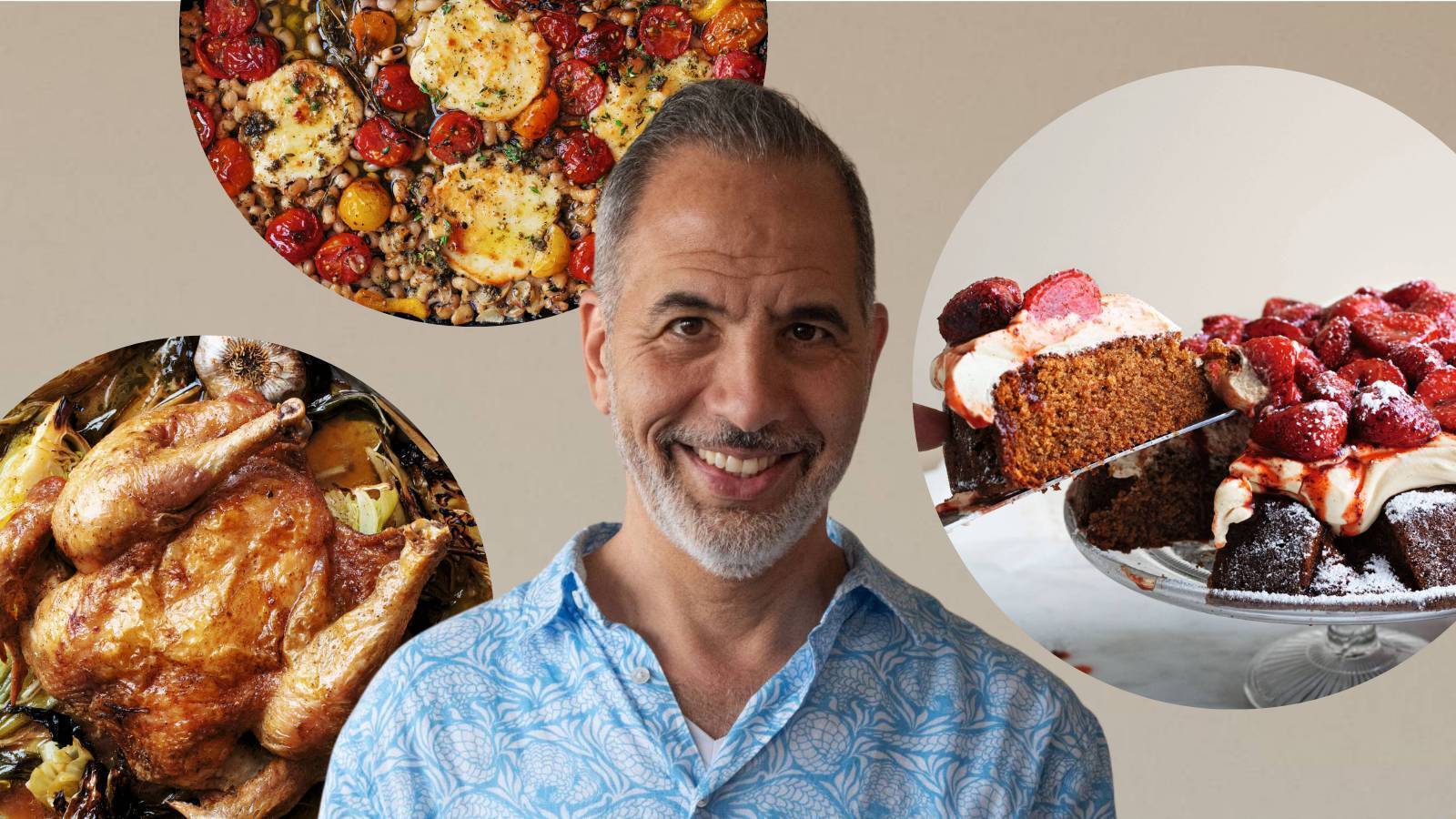
Braised halloumi with tomatoes and beans
This is either a simple speedy supper for two, with rice or bread, or part of a spread to serve more. It works really well with the green beans with miso and grapefruit, or any seasonal green veg. It’s also great as it is for a late breakfast.
Servings
2
Preparation Time
10 mins
Cooking Time
35 mins
Total Time
45 mins
Course
Main
Ingredients
-
350g cherry tomatoes (a mix of colours looks great), half cut in half and the remainder left whole
-
400g tin of black-eyed beans (or butter beans), drained (240g)
-
5 garlic cloves, 4 thinly sliced, 1 crushed
-
5–6 thyme sprigs, plus 1 tsp finely chopped leaves
-
1 lemon, zest thinly shaved to get 4 strips, the remainder finely grated
-
1 tbsp lemon juice
-
90ml olive oil
-
250g halloumi, cut into 6 slices
-
1 tsp za’atar
-
Fine sea salt and black pepper
Method
-
Preheat the oven to 180°C fan.
-
Put all the tomatoes into a 26cm round (or similar) shallow ovenproof dish along with the beans, sliced garlic, thyme sprigs, lemon zest strips, lemon juice and 75ml olive oil. Add ½ teaspoon of salt and a good grind of pepper. Mix together and nestle the halloumi slices among the beans, making sure the cheese remains exposed. Drizzle the remaining tablespoon of oil over the cheese and bake for 30–35 minutes, until the tomatoes have collapsed, released their juices and the halloumi is golden.
-
Mix together the crushed garlic, thyme leaves, grated lemon zest and za’atar. Once the dish is out of the oven, swirl this through and serve.
Roast chicken and cabbage with soy butter
There are many ways to make cabbage delicious but it’s hard to improve on butter. The result of adding nearly half a pack to the baking tray is the equivalent of liquid gold. Embrace it!
Servings
4
Preparation Time
15 mins
Cooking Time
45 mins
Total Time
60 mins
Course
Main
Ingredients
-
2 hispi cabbages, quartered (1kg)
-
2 heads of garlic, top 1cm removed
-
2 bunches of spring onions, cut into thirds (160g)
-
325ml chicken stock
-
70g ginger, peeled and cut into matchsticks
-
1 whole chicken, spatchcocked (1.7kg)
-
2 tbsp olive oil
-
100g unsalted butter, cut into small cubes
-
2 tbsp soy sauce
-
Fine sea salt and white pepper
Method
-
Preheat the oven to 220°C fan.
-
Put the cabbage, garlic, spring onions, stock and ginger in a high-sided roasting tray.
-
Season the chicken all over with 1 teaspoon of salt and 1 teaspoon of white pepper and sit it on top of the cabbage. Drizzle the chicken with the oil and roast for 30 minutes.
-
Remove the chicken from the oven and stir the butter and soy sauce into the tray juices until melted, then use the mixture to baste the cabbage. Return to the oven for another 15 minutes, until the chicken is golden and cooked through and the cabbage is tender and caramelised.
-
Squeeze out the garlic cloves, mix into the sauce and serve.
Brown sugar cake with brown sugar cream
Keeping notes: Tightly wrapped, the baked sponge will keep for 2 days. The cream is best made on the day, and once the topping is on the cake, you should serve it straight away.
Servings
8
Preparation Time
10 mins
Cooking Time
35 mins
Total Time
45 mins
Course
Main
Ingredients
-
3 eggs
-
225g dark brown soft or muscovado sugar
-
150g plain flour
-
¾ tsp fine sea salt
-
1 tsp baking powder
-
¼ tsp bicarbonate of soda
-
150g unsalted butter, melted and warm
-
75g crème fraîche icing sugar, to serve (optional)
-
For the brown sugar cream
-
200ml double cream
-
200g crème fraîche
-
1 tsp vanilla bean paste or extract
-
50g dark brown soft or muscovado sugar
Method
-
1. Preheat the oven to 180°C fan.
-
2. Put the eggs and sugar into the bowl of a stand mixer and whisk on high speed for 5 minutes (or whisk by hand), until light and almost tripled in volume. Sift over the flour, salt and raising agents and whisk on low speed until just combined. Mix together the butter and crème fraîche and, still on low speed, stream down the sides of the bowl and mix until just combined.
-
3. Transfer the mix to a 23cm round cake tin (bottom and sides lined with parchment paper) and bake for 30–35 minutes, until springy to the touch. Leave to cool completely in the tin on a wire rack.
-
4. For the cream, put everything into the bowl of a stand mixer and whisk to soft peaks.
-
5. Remove the cake from the tin and put on a serving plate, dollop the cream on top, sprinkle with icing sugar, if using, and serve.
Read More
Restaurant review: Monty’s new wine bar has a legendary wine list and sophisticated atmosphere
Eunice Power: Two irresistible late-summer recipes you’ll want to make again and again
Michelle Darmody: How to bake your own Fig Rolls at home
x
185th Anniversary Offer
Six months of digital access for €18.50
Already a subscriber? Sign in
No obligation. Ts&Cs apply.
The Deirdre O’Shaughnessy Podcast: The lasting impact of 9/11 on the people of New York
Killarney distillery set for €5.5m revival with new whiskey and beer plans
Eoin Warner: Nature is my refuge in times of intense grief — and times of joy and wonder
More in this section
S Restaurant reviews: I tried two new Marina Market food spots while searching for fried chicken nirvana
S Restaurant review: Monty’s new wine bar has a legendary wine list and sophisticated atmosphere
Wine with Leslie: Three delightful wine recommendations — including one from Ridley Scott’s estate
#Insight