
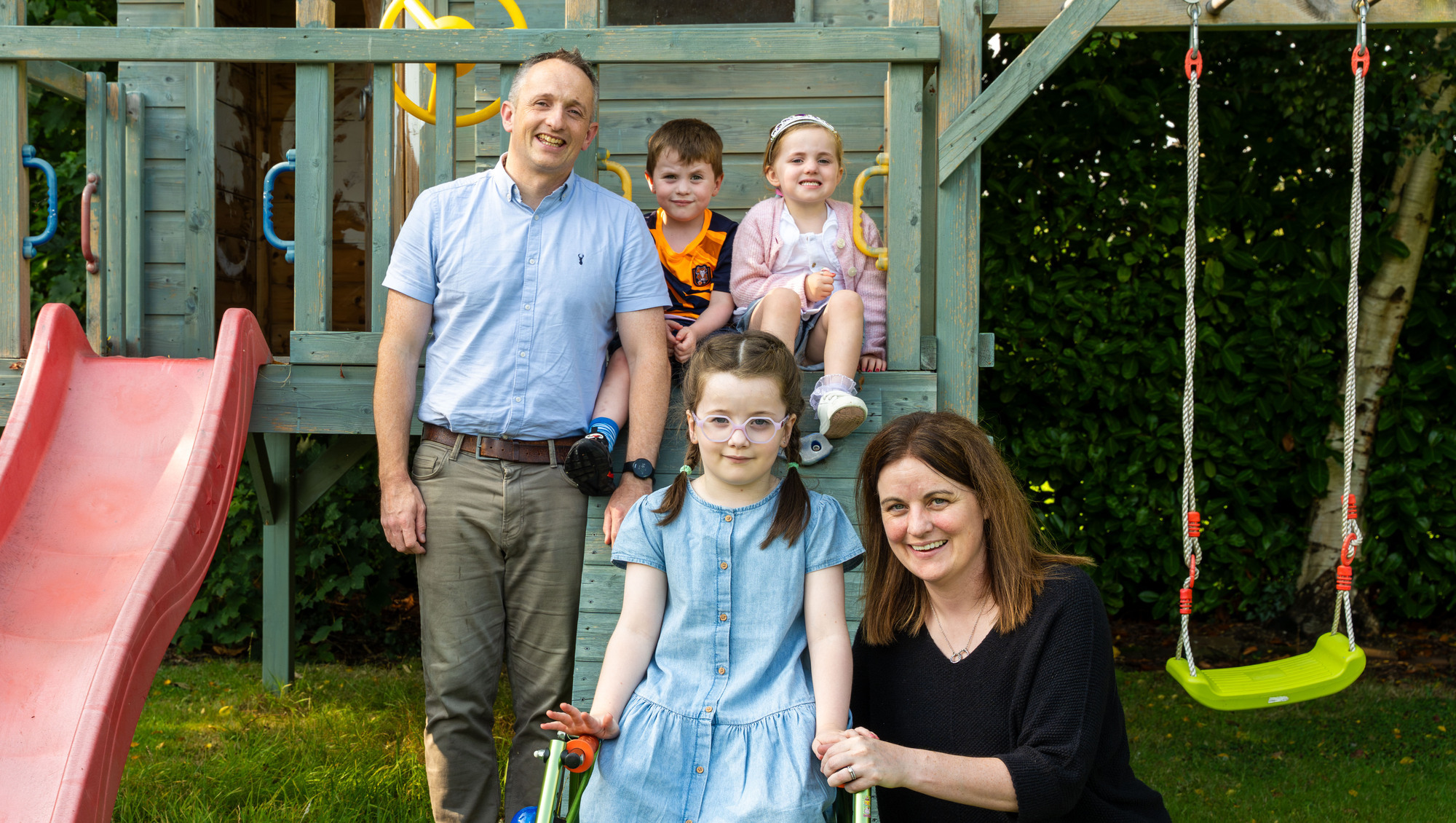
Serious childhood illness affects the whole family: ‘We grieve the life our daughter would have had’Maria and Colm Lynch felt like they were living in a warzone during their daughter’s treatment for a brain tumour, which also had an impact on their other children Fri, 04 Sep, 2026 – 11:32Deirdre McArdle
Limerick couple Maria and Colm Lynch’s eldest daughter was just three when she was diagnosed in 2023 with a brain tumour and had to undergo brain surgery.
In a matter of days, Méabh, who was always “flying around the place” could no longer hold her head up, sit up or move her feet or hands.
Before her diagnosis, Méabh hadn’t shown any of the typical symptoms of a brain tumour, Maria says.
“She never had nausea or headaches or lack of balance. She met all her milestones. She was running, jumping, and bouncing on the trampoline. You name it.”
But she had a bump on the top of her head that kept getting bigger. Because she was otherwise healthy, doctors did not believe it was anything to worry about when her parents raised concerns.
When the couple’s younger son, Seán, was having his two-year developmental check, Maria brought Méabh along too. The public health nurse suggested an X-ray. Two days later, they were in Temple Street Children’s Hospital, where Méabh was diagnosed with a benign brain tumour the size of a grapefruit. Surgery to remove the tumour was scheduled for a few days later.
“We were told that we’d get a really different child back after the surgery. We just thought she’d be different initially, but then she’d be back to herself in a couple of weeks,” Maria says.
Complete life change
What followed was three years of weeks-long hospital stays, reconstruction surgery, and additional surgeries to replace shunts and fix brain fluid leaks, regular MRIs to check for new tumours, and hours and hours of physical therapy. All of this with a young family, including a five-month-old baby girl, Sadhbh.
Maria, a secondary school principal, and Colm, an analytical chemist, had to leave their two younger children with Maria’s mum and dad, so they could stay with Méabh in hospital.
“Seán and Sadhbh were literally gone from us overnight, and we were in Temple Street for 13 weeks that first time. It was so traumatic for us, and then so traumatic for everybody at home,” says Maria.
While the couple were in the hospital with their daughter, they had one focus: being there for Méabh. “You’re going on hope. You’re going on fear. You’re just moving on to the next solution and the next. Like, how do we get over this hurdle? It’s just firefighting all the time. It felt like being in a warzone,” Colm says
No one in the family came out unscathed. Méabh, though tumour-free, had a long recovery road ahead of her.
Maria and Colm had missed key milestones with all their children, but especially their baby Sadhbh. And Seán, a year younger than Méabh, found it very difficult to be without his parents for weeks at a time.
Funded by Childhood Cancer Ireland, play therapy has helped Seán find a way of expressing his “big feelings”. He calls them “his grumbles”, Maria says.
Now, when Seán feels overwhelmed, he says: “Oh, my grumbles are coming back. I think I need to go and talk to Ailbhe [his play therapist] now.”
Colm says that simple language has given Seán a way to ask for help, and it has helped them to understand just how much he went through alongside his sister.
While the family are mostly at home these days, and life has returned to some type of normality — Méabh has started senior infants, Seán junior infants, and Sadhbh is in playschool, much has changed.
“We’re such different people and such a different family now. We have so many different emotions, and it’s very hard to deal with all of that,” says Maria. “There is a real sense of grieving for the life we thought we would have, for the life we thought Méabh would have.”
Despite her promising rehabilitation, Méabh still requires ongoing physical therapy and scans every nine months to check for any new tumours. Her mobility has recovered significantly, although she still needs a wheelchair, and she is thriving cognitively, Maria says with pride.
Although she has a positive mindset and is determined and resilient, Méabh acknowledges and names her losses. Colm says that now and then she might ask: “Daddy, why am I not climbing a tree, or why am I not running around with my friends?”
With guidance from their psychologist, Maria and Colm say they try to allow and validate those feelings instead of “rushing in” to fix them.
Complex emotional issues
The couple are also dealing with the guilt that can come with having to prioritise one child’s needs.
These complex emotions are common among families who have children with serious illness, says Dr Maireád Brennan, Childhood Cancer Ireland’s principal clinical psychologist and director of psycho-social supports.
Brennan stresses that having a child with a serious illness is “not linear by any means”.
“Emotions shift at every stage, from the initial shock of diagnosis, through treatment, to the supposed finish line when treatment ends,” she says.
“This period in particular catches a lot of people by surprise because finding a new daily rhythm can be tricky too. Even when outsiders say: ‘Isn’t it great? It’s all behind you now.’
“For many families, it’s an ongoing adjustment, and there are ongoing challenges and there are ongoing worries and uncertainties.”
- Childhood Cancer Ireland is a national charity supporting children, adolescents, and young adults affected by childhood cancer, as well as their families.
- The charity provides practical, emotional, and financial supports throughout treatment and beyond, while also raising awareness of the impact of childhood cancer.
Read More
Natural Health: What can I do about my RSI?
Workplace Wellbeing: How to step into autumn at work with a spring in your step
Cortisol: Everything you need to know about the stress hormone
x
185th Anniversary Offer
Six months of digital access for €18.50
Already a subscriber? Sign in
No obligation. Ts&Cs apply.
CONNECT WITH US TODAY
NEWSLETTERS
NOTIFICATIONS
Be the first to know the latest news and updates
€100 device has ’empowered’ heart patients in Cork to understand symptoms
Natural Health: How can I prevent another cystitis infection?
Week 1 — A short and simple Pilates workout to bring exercise into a busy routine
More in this section
Not all ultra-processed foods are bad — Here are some to put in your diet
Ray D’Arcy: Exercise helped to keep me sane
Workplace Wellbeing: Pursuing a hobby could lead to the ideal career or even starting a business
#Health – Body#Health – Life