
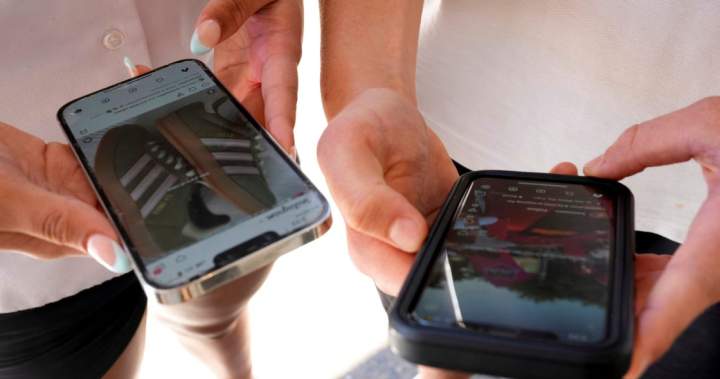
The federal government has introduced digital safety legislation that would introduce a ban on social media for kids under 16. Big tech companies are already using age assurance technology to estimate users’ age.
So what is “age assurance”?
Age assurance is the umbrella term used for efforts by tech platforms to determine the age of a user. It includes age declarations — those “click to verify you’re 18” boxes that internet users have been encountering for a long time.
But more recently, tech companies have been incorporating “age estimation.” That includes the use of AI technology to estimate a user’s age based on factors like their online behaviour or the images they post. “Age verification” is any method that requires a user to prove their age — the use of government ID, for example.
Related Videos
4:36
The importance of fact-checking posts
-
The importance of fact-checking posts
-
Managing child mental health in a new school year
-
NB announces policy banning student phone use in public schools
-
Experts, police warn parents about posting certain first-day-of-school photos online
-
Maritimers react to Meta’s multi-billion social media settlement.
Story continues below advertisement
What is Google doing?
Google said last year it would begin rolling out age assurance in the U.S. On Monday, it announced it would expand the technology to Canada.
Get breaking National news
Get breaking Canada news delivered to your inbox as it happens so you won’t miss a trending story.
By providing your email address, you have read and agree to Global News’ Terms and Conditions and Privacy Policy.
Google’s approach looks at factors like a user’s search queries and the types of videos they’ve looked at on YouTube. The company says it won’t collect any additional information for age assurance.
Users who are identified as underage by Google have additional protections placed on their accounts. They include measures like turning on tools that remind users to take a break, placing safeguards on content recommendations, disabling personalized advertising and restricting access to apps that are adults-only.
If the tech mistakenly identifies an adult as being under 18, they’ll be able to prove their age using such tools as a government ID, a selfie, or a credit card check.
Story continues below advertisement
Google says that for those users who use a government ID, it will store the date of birth in their account and delete the ID after a short period of time. It says it will use the service PrivateID to analyze selfies, which will tell Google whether it believes the user is of age. Google says PrivateID doesn’t provide it with the selfie or the precise age of the user, or retain the image.
- Calgary legislature seat up for grabs in Alberta byelection
- Carney, premiers pitching major projects at first investment summit
- Kelowna businesses raise concerns over crime on Commerce Avenue
- Saskatoon construction snarls commutes for USask students, hospital staff
-
Trump says Canada-U.S. trade deal could come ‘fairly soon’
-
‘My hydronyms are Lake and Ontario’: Merch takes aim at Trump’s ‘Lake America’
-
Gathering at Dawson College marks 20 years since deadly shooting
-
Carney’s Trade War Mission: Is It Enough to Stop the Damage?
What is Meta doing?
If Meta suspects the person behind an account is under 18, it places them in a teen account. The settings on teen accounts include additional protections limiting who can contact the user and the content they can view. It uses AI to remove individuals it believes are under 13 from its services entirely.
Meta said in a blog post it uses AI to “analyze entire profiles for contextual clues — such as birthday celebrations or mentions of school grades — to determine if an account likely belongs to someone underage.”
Story continues below advertisement
That work includes looking at posts, comments, bios and captions. “If we determine an account may be underage, it will be deactivated and the account holder will need to provide proof of age through our age verification process to prevent their account from being deleted,” Meta said.
The company said in May it would also begin using visual analysis, which “allows our AI to scan photos and videos for visual clues about a person’s age.” It said the AI doesn’t identify the person in the image or use facial recognition.