
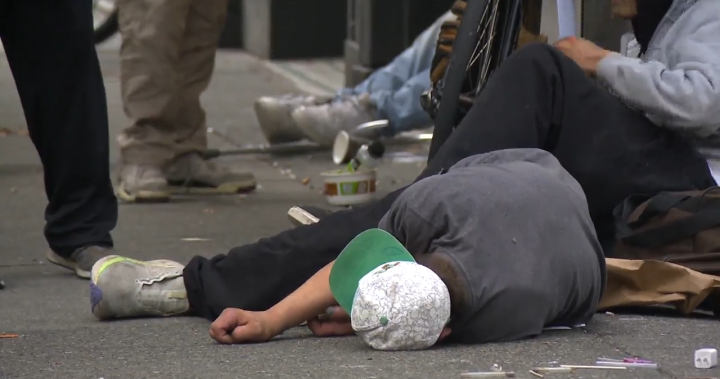
Neighbours of a planned overdose prevention site (OPS) in downtown Vancouver that was recently cancelled by the B.C. government say they’re concerned about ad hoc harm reduction services appearing outside the vacant building.
Days after Health Minister Ravi Kahlon confirmed the proposed location at 900 Helmcken Street would not move forward, business owner Denise Meikle said she noticed a table with OPS supplies set up on Hornby Street on Aug. 29.
“I just feel like the wool’s being pulled over our eyes and if these popups are happening, then what is the public safety,” the Salon Origins owner told Global News in an interview.
Meikle said she’s not opposed to life saving services but is troubled by the street disorder she witnesses after people use drugs.
“I’m all for harm reduction. However, what we absorb after, when people are coming out of their high, is the aggression, the violence,” Meikle said.
Story continues below advertisement
Jens (Spoons) Petersen, a resident of the Murray Hotel single-room occupancy (SRO) near 900 Helmcken Street, said Saturday’s sidewalk table was offering harm reduction supplies and water to those in need.
“People in this neighbourhood, they just label us, they don’t even give us a chance to be better,” Petersen said. “If we had a place to go, then they wouldn’t see us.”
Get weekly health news
Receive the latest medical news and health information delivered to you every Sunday.
By providing your email address, you have read and agree to Global News’ Terms and Conditions and Privacy Policy.
Petersen said he’s saddened by the loss of the planned OPS, and believes it will just force drug users back into the alleys and onto the streets.
“If they had a place for people to go, then they’re not on the street, they’re somewhere safe, supervised and using clean stuff,” he told Global News.
RainCity Housing, which holds the lease to operate 900 Helmcken Street, said its focus has been providing outreach services to people needing support, while other community organizations have set up tables to address the significant need for harm reduction and overdose prevention services in the area.
“It feels like someone’s trying to send a signal,” Vancouver’s mayor said Wednesday.
Ken Sim said it’s disappointing and completely inappropriate to see overdose prevention site pop ups organized by a bunch of random individuals.
“I actually think it’s quite reckless and you know, it’s not in line with what the vast majority of residents and businesses and health care professionals want,” the mayor told Global News.
- Lethbridge protesters rally as Alberta’s Bill 11 takes effect
- Nearly 400 physicians interested in joining dual practice system: Alberta government
- U of T nurse practitioner student looks to break barriers in new Scarborough program
- 3 people died from suspected overdoses on Saturday in Regina: health ministry
-
Recognizing Vascular Disease Awareness Month
-
Recognizing National Recovery Awareness Month
-
Drug advocates open pop-up overdose prevention sites
-
Unique recreation program gives seniors a chance to get out and ride a bike, with some help
Story continues below advertisement
Vancouver Coastal Health said it was alerted by RainCity to “individuals acting on their own accord distributing harm reduction supplies near 900 Helmcken”, and neither the health authority nor the nonprofit organization had advance notice of the pop up OPS.
“As a health issue, they’re probably right to have a pop up OPS because people are overdosing,” Green councillor and mayoral candidate Pete Fry said Wednesday.
Fry said the goal of the now scrapped OPS was to address public drug use and street disorder in the area.
“I do acknowledge that when they’re not run well they are an impact on neighbourhoods,” Fry told Global News. “There is an opportunity to do this right and there’s an opportunity to ensure that it’s not impacting the public but right now, there’s nothing there, all we have is pop up intervention with folks trying to keep people alive.”
When asked what it has planned for 900 Helmcken for the remainder of the two-year lease, Vancouver Coastal Health said it will work with the Ministry of Health and consult with city stakeholders to develop alternative programming in the building, such as treatment and recovery supports and long-term wellness programs.
Meikle said the status quo – with people suffering, struggling and passed out on the ground – is hard to watch.
“Nothing’s changed,” she said. “These people, they need help.”
Advertisement