
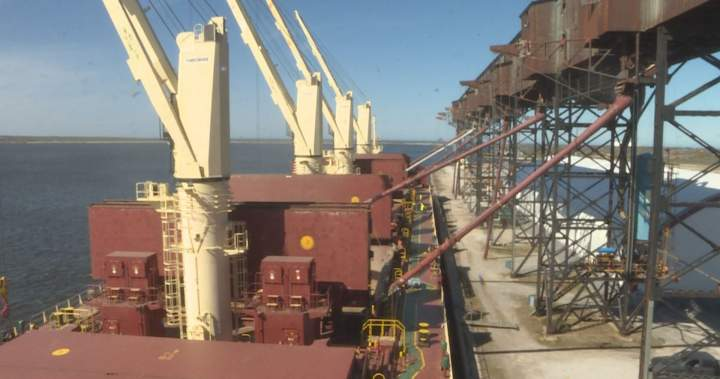
For the first time in six years, grain shipments have resumed out of the Port of Churchill this week.
A ship is being loaded with 30,000 tonnes of wheat durum from Saskatchewan-based AGT Foods this week, destined for Europe.
“What we’re witnessing is the return of Churchill as a vital arctic gateway,” federal minister of northern and arctic affairs Rebecca Chartrand said during a ceremony to mark the shipment on Monday.
Story continues below advertisement
The ship is the first of three ships slated to leave the port, which is Canada’s only arctic seaport, this season. Another ship will arrive this week to be loaded with zinc concentrate and potash, mined in Manitoba.
“The Port of Churchill is a corridor of opportunity and the benefit that we see in a world that is changing,” Manitoba agriculture minister Ron Kostyshyn said.
Operations are the Port of Churchill grinded to a halt in 2016 due to deteriorating rail line conditions, while the port and railway were owned and operated by U.S.-based company OmniTRAX.
The Manitoba-based Arctic Gateway Group acquired the Port of Churchill in 2018 and resumed operations the following year, before stopping again in 2020 as further work on the port and rail line were needed.
“This was a set of assets that was neglected for decades, ironically by American interests,” Arctic Gateway Group president and CEO Chris Avery said.
Story continues below advertisement
“And our ownership group (and partners) had the foresight to put this together, had the foresight to say, as my chairman says, ‘Enough is enough, we’re going to take control of this set of infrastructure. We’re going to take control of it (as) Canadians and as northern Manitobans and as First Nations.’”
“And what great foresight that was, because today, if this was American-owned infrastructure, we wouldn’t be having this same conversation,” Avery added.
Get daily National news
Get daily Canada news delivered to your inbox so you’ll never miss the day’s top stories.
By providing your email address, you have read and agree to Global News’ Terms and Conditions and Privacy Policy.
The shipment comes as Manitoba eyes the possibility of year-round shipping from the Port of Churchill. Three recent studies found that year-round shipping is possible due to climate change shrinking the sea ice season. The studies also show year-round shipping is possible with current ice class vessels and without the use of icebreakers.
However, one of the studies by FedNav, Canada’s largest ocean bulk-shipping company, paints a less optimistic picture, cautioning the varying sea ice conditions and the shallow and narrow final approach to the port could present challenges.
- New Brunswick horse virus scare shows need for public large-animal care, says vet
- Calgary home with pro-Trump flags vandalized amid cross-border trade war
- B.C. coast, parts of Vancouver Island set to see heavy rains, strong winds
- $55M win means new Jeep, paid-off house for some in Quebec lotto group
-
DeGroote professor dissects intensifying Canada-U.S. trade war
-
‘Lake Ontario, actually’: Adam van Koeverden responds to Trump’s ‘Lake America’ name change
-
‘What an embarrassment’: Eby derides controversial Hegseth post about B.C. cadets
-
Eby thinks B.C. NDP candidate will beat ‘hateful, divisive’ Kerry-Lynne Findlay in byelection
Story continues below advertisement
The port is also being considered as a potential hub for shipping liquified natural gas, something Prime Minister Mark Carney wants to see happening out of the Port of Churchill by 2030.
Manitoba Premier Wab Kinew recently said expanding the Port of Churchill, which would include further upgrading the rail line and building an offshore LNG terminal, would cost between $70-80 billion. The premier plans on pitching the port to international investors during a summit in Toronto this month.
But in a deep seaport surrounded by beluga whales, polar bears, and the pristine subarctic wilderness of where the arctic tundra, boreal forest, and arctic marine meet, environmental concerns remain.
Story continues below advertisement
“As you look towards the vessel today, you see the abundance of beauty, you see the beluga whales and the importance of them. You see the bears, the land, the environment, everything that surrounds us. We have a world-class tourism destination. That is increasingly important to our communities, communities throughout Canada,” Churchill Mayor Michael Spence said.
Mayor Spence says any decisions made will balance economic opportunities with environmental responsibility.
“There’s a lot of opportunity for growth here, there’s opportunity for us to prosper, there’s opportunity for continuous growth within not only northern Manitoba communities but also in Manitoba and Canada as a whole,” he said.
“But the importance of doing it is doing it the right way and doing it responsibly. As northern and Indigenous people, we know the importance of what we’re responsible to do and making sure we do it the right way and leading the way in protecting the environment. We always need to remember that.”