
This section is The content in this section is supplied by GlobeNewswire for the purposes of distributing press releases on behalf of its clients. Postmedia has not reviewed the content. by GlobeNewswire Article content
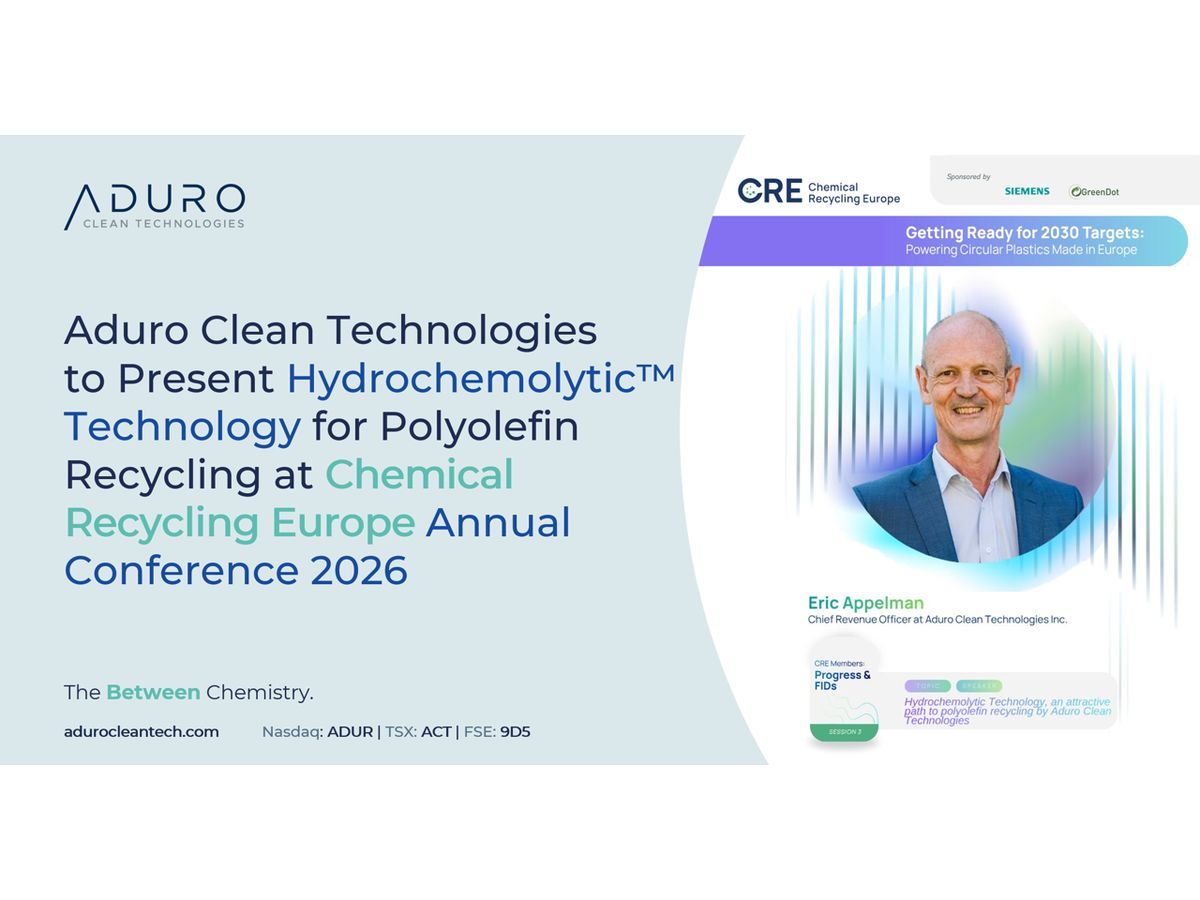
Chief Revenue Officer Eric Appelman to present in Brussels on September 30, 2026, discussing the advancement of Aduro’s Hydrochemolytic™ Technology from pilot operations to the planned industrial scale deployment, as Europe prepares for its 2030 circularity targets
Sign In or Create an Account
or View more offersArticle content
LONDON, Ontario, Sept. 08, 2026 (GLOBE NEWSWIRE) — Aduro Clean Technologies Inc. (“Aduro” or the “Company”) (Nasdaq: ADUR) (TSX: ACT) (FSE: 9D5), a clean technology company using the power of chemistry to transform lower-value feedstocks, like waste plastics, heavy bitumen, and renewable oils, into resources for the 21st century, today announced that Eric Appelman, Chief Revenue Officer, will present at the Chemical Recycling Europe (“CRE”) Annual Conference 2026, taking place September 29–30, 2026 in Brussels, Belgium.
Article contentWe apologize, but this video has failed to load.Try refreshing your browser, or
tap here to see other videos from our team.Article content
Story continues below
This advertisement has not loaded yet, but your article continues below.
Article content
Appelman will participate in Session III – CRE Members: Progress & FIDs, presenting “Hydrochemolytic™ Technology, an attractive path to polyolefin recycling.” The presentation will discuss Aduro’s perspective and approach to the chemical recycling of polyolefins and the evolution of Hydrochemolytic™ Technology (“HCT”) from pilot-scale validation toward industrial deployment. HCT is being developed to convert difficult-to-recycle polyolefins into circular hydrocarbon products, with demonstrated tolerance for contaminants and product characteristics aligned with downstream petrochemical requirements. The technology is supported by a portfolio of seven issued patents and four pending applications. Appelman will also discuss process performance and the progression from the Next Generation Process (“NGP”) Pilot Plant to the planned First-of-a-Kind (“FOAK”) Plant at Chemelot.
Article contentArticle content
The conference comes as Europe continues to move from setting circularity targets to defining the practical frameworks required to achieve them. The Packaging and Packaging Waste Regulation (“PPWR”) establishes recycled-content requirements for plastic packaging beginning in 2030, while recently adopted European Commission rules under the Single-Use Plastics Directive establish mass-balance accounting for chemically recycled content in single-use PET beverage bottles. Together with certification, product-quality requirements and market demand, these frameworks are becoming increasingly relevant to investment decisions around new recycling capacity and the integration of circular feedstocks into established petrochemical value chains.
Article content
Story continues below
This advertisement has not loaded yet, but your article continues below.
Article content
Aduro’s participation in the conference comes as the Company continues to advance HCT for waste-plastic chemical recycling from pilot-scale operation toward industrial deployment through its NGP Pilot Plant and FOAK Program at Chemelot Industrial Park in Sittard-Geleen, the Netherlands. In June 2026, the Company reported liquid hydrocarbon recovery of approximately 86% during steady-state operation using polypropylene recovered from waste plastics, with the resulting operating data informing refinement of process parameters and the design basis for the FOAK Plant. In August 2026, Aduro selected Saipem S.p.A. to provide Early Works engineering and procurement support for the planned FOAK Plant, linking pilot operating data to equipment design, utility integration, and refinement of capital cost estimates.
Article content
The scale-up pathway also builds on downstream validation completed in 2025, when an HCT-derived liquid produced from mixed waste plastics was processed in pilot-scale steam-cracking trials in Europe as produced, without dilution or hydrotreatment. The trials demonstrated stable furnace operation and olefin yields comparable to conventional liquid feedstocks, supporting the potential integration of HCT-derived liquids into existing petrochemical infrastructure.