
This section is The content in this section is supplied by GlobeNewswire for the purposes of distributing press releases on behalf of its clients. Postmedia has not reviewed the content. by GlobeNewswire Article content
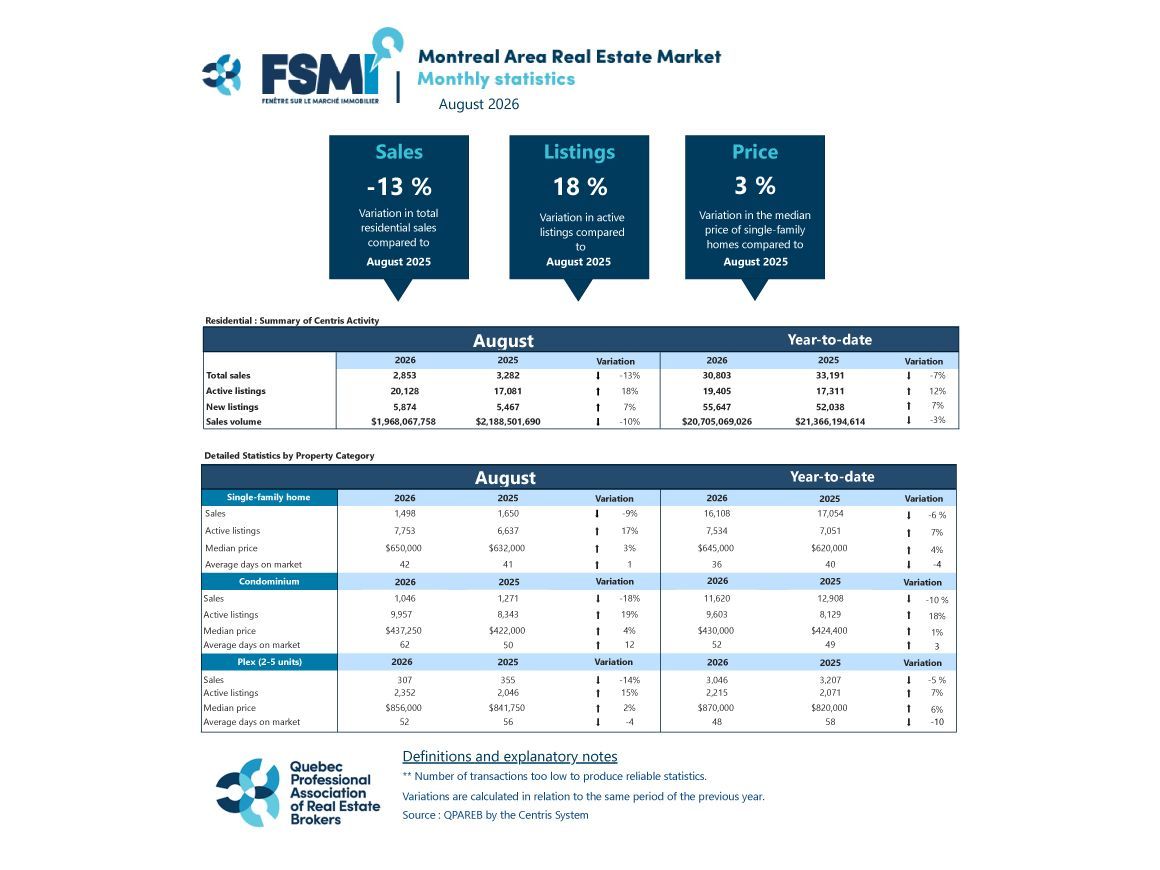
L’ÎLE-DES-SŒURS, Quebec, Sept. 04, 2026 (GLOBE NEWSWIRE) — The Quebec Professional Association of Real Estate Brokers (QPAREB) has just released its residential real estate market statistics for the month of August 2026. The most recent market statistics for the Montreal Census Metropolitan Area (CMA) are based on the real estate brokers’ Centris provincial database.
Sign In or Create an Account
or View more offersArticle content
Story continues below
This advertisement has not loaded yet, but your article continues below.
Article content
Highlights
Article contentWe apologize, but this video has failed to load.Try refreshing your browser, or
tap here to see other videos from our team.Article contentArticle content
- In August, 2,853 residential sales were completed, down 13 per cent from a year earlier. On a seasonally adjusted basis, sales declined by 2 per cent compared to July 2026. The slowdown was evident across all major geographic areas and property categories.
- The supply of properties for sale continued to grow across the metropolitan area. With 20,128 active listings, inventory was up 18 per cent from the previous year. After rising rapidly on the Island of Montreal over the past year, growth in the number of properties for sale is now more pronounced on both the South Shore (+28 per cent) and the North Shore (+26 per cent).
- The increase in listings remains widespread across property categories: +19 per cent for condominiums, +17 per cent for single-family homes and +15 per cent for plexes.
- Even as the supply of available properties increases, the single-family home market continues to favour sellers in most areas of the CMA. The condominium segment is further along in its adjustment, particularly on the Island of Montreal, where market conditions are generally sitting on the threshold between a balanced market and a buyers’ market.
- Despite more abundant supply and slower sales, median prices continued to post moderate increases. Over the past year, the median price rose by 3 per cent for single-family homes, 4 per cent for condominiums and 2 per cent for plexes.
- As buyers have more options, selling times remain on an upward trend. Single-family homes sold in an average of 42 days (+1 day), while condominiums sold in 62 days (+12 days). Plexes were the exception, with the average selling time down by 4 days to 52 days.
Article content
Story continues below
This advertisement has not loaded yet, but your article continues below.
Article content
“With a decline in activity and growing supply across the metropolitan area, August’s results confirm that the Montreal residential market continues to rebalance. While the first signs of easing were mainly visible in the central areas of the Island of Montreal, more significant increases in new listings are now being observed in the outlying areas. Despite an increase in the number of properties available to buyers, the majority of residential markets in the metropolitan area continue to favour sellers. Condominiums on the Island of Montreal remain the segment where the rebalancing process is most advanced,” explains Camille Laberge, QPAREB Assistant Director and Senior Economist.
Article content
The trend is especially evident in certain central markets. “Downtown and the Sud-Ouest borough stand apart from the rest of the metropolitan area. These areas are now posting the highest levels of listings ever recorded in the system, while condominium prices have been stagnant in recent quarters. The data suggests that smaller units are generally more difficult to sell, which is consistent with a market where buyers now have a broad range of choices,” she adds.