
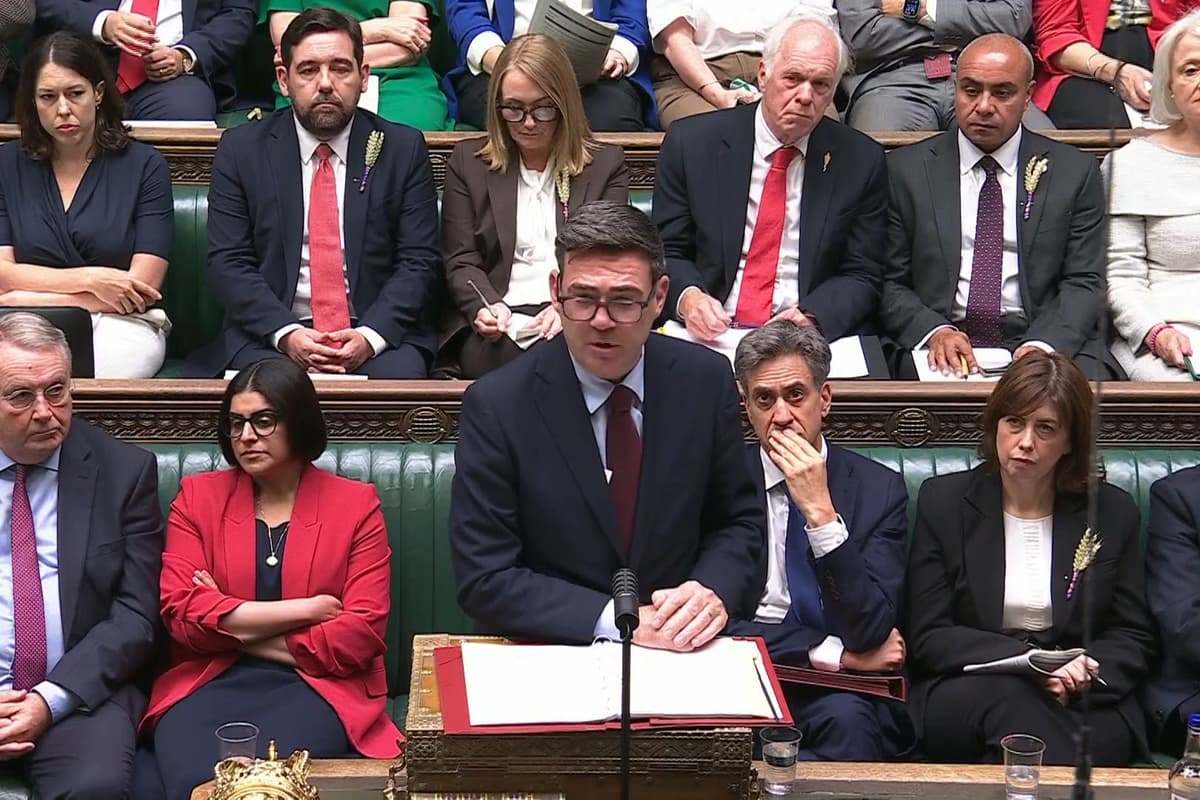
National security ‘can’t come at the expense of social security’ – Andy BurnhamTory leader Kemi Badenoch highlighted ‘serious threats to national security that cannot wait’.Andy Burnham faced questions on national security at PMQs (House of Commons/UK Parliament/PA)PA WireGeorge Thompson5 minutes ago
National security “can’t come at the expense of social security”, the Prime Minister has insisted, as he criticised Tory plans to fund defence.
Tory leader Kemi Badenoch used Andy Burnham’s second Prime Minister’s Questions to question whether the Government would reach 3% for defence funding by 2030, insisting there were “serious threats to national security that cannot wait”.
Mr Burnham hit back, insisting the Conservatives’ plan to fund defence by cutting housing benefits would create mass homelessness.
He also insisted the Government would honour Nato commitments to reach 3.5% by 2035, with a target for 3% funding set out in the spending review.
The Tories set out their plans to fund defence last week, with some £4 billion coming from a reformed housing benefit, and a further £3.1 billion through reimposing the two-child benefit cap.
Mr Burnham said: “I don’t think myself that taking £4 billion out of housing benefit is going to get the right consensus around this issue, because that would create levels of homelessness in this country that we wouldn’t have seen before – hundreds of thousands of children in temporary accommodation.
“We do everything to support our national security, but it can’t come at the expense of social security.
“Having strong national security also depends upon having resilience in our communities.
“This side of the House will not be forced to choose between the two, and we will set out a plan to get to 3.5% (of GDP spent on defence) by 2035 at the spending review.”
Kemi Badenoch criticised Mr Burnham during Prime Minister’s Questions (House of Commons/UK Parliament/PA)PA Wire
Conservative leader Kemi Badenoch replied: “It’s unbelievable that the Prime Minister would say that. He’s clearly unwilling. We need to fund our defence, not spend all of our money on welfare.”
Mrs Badenoch also accused the Government of being prepared to pay £35 billion to hand over sovereignty of the Chagos Islands to Mauritius, but not spend money on troops.
She said: “Last year, defence funding fell in real terms. That is on them.
“To govern is to choose. So why is he choosing to send £35 billion to Mauritius when they (Labour) cut the money to train our troops?”
Read More
Andy Burnham: I won’t cut Britain’s benefits bill to boost defence spending
Burnham sets out conditions for second Scottish independence referendum
West Bank trade ban is Britain showing ‘leadership’, says Burnham
Winter escapes and activities to end the year in style
Mr Burnham responded: “I don’t think she’s on strong ground when it comes to defence spending.
“It was 2.5% of GDP when the last Labour government left office. It was 2.3% of GDP when the government she was in left office. It’s now set to be 2.7% in the next year. So that is the reality of the situation.
“It would be better to work across the floor of this House to get a fully and securely funded path to 3.5% of GDP by 2035.”
Mrs Badenoch said defence must be funded (House of Commons/UK Parliament/PA(PA Wire
Downing Street insisted Mr Burnham was committed to bringing down the welfare bill, but not through “crude cuts”.
The Prime Minister’s official spokesman said: “He has said before, we’ve got to get serious as a country about getting the welfare bill down.”
But “that doesn’t mean crude cuts that simply push people into crisis and create bigger costs elsewhere”.
A spokesman for Mrs Badenoch hit back at the Prime Minister’s claim that Tory plans to cut welfare in order to pay for defence lacked detail and would cause mass homelessness.
He added: “We’ve only taken £4 billion from housing benefit. That comes from resetting the local housing allowance, exempting pensioners, and allowing tenancies to reach their conclusion.
“All that would do is require people to move out of the highest priced areas, which I imagine most people in this room have had to do at some point in their lives. All we are asking is that people on benefits have to make the same choices as everyone else.”
MORE ABOUT