
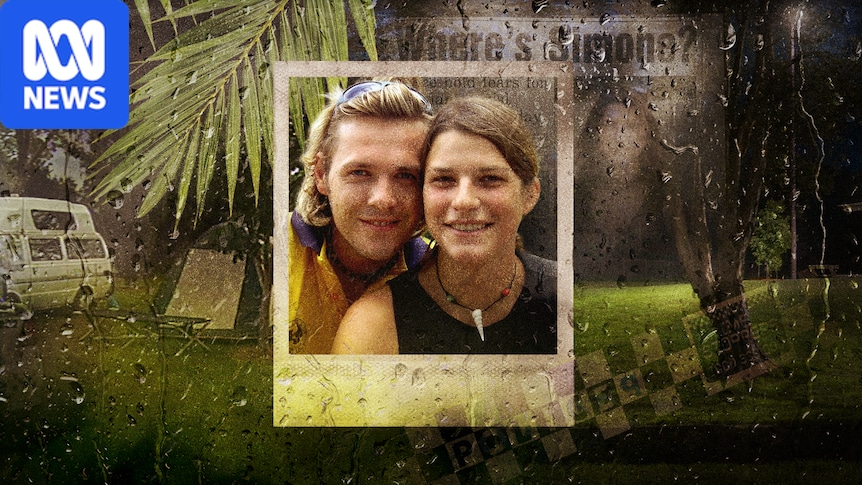
For two decades, police pursued a central theory about who killed German backpacker Simone Strobel. After their suspect was finally charged with murder, that theory began to crumble.
Rain and wind batter the campground at Sandon River, on the north coast of New South Wales. Simone Strobel opens her diary and begins to write in German: “After I begged Toby to let Käty + me into the van with him, he flipped out totally.”
Tobias Suckfuell is Simone’s boyfriend. The young German couple have been travelling around Australia for the past six months in a campervan. They’ve recently been joined by Tobias’s sister, Katrin Suckfuell, and their friend Jens Martin.
Eventually Tobias lets them into the van, but Simone is upset. She continues: “It is the “badest” [sic] vibration between us since we’ve been in Australia — f*** you!” she writes.
PREFER TO LISTEN? This article contains information revealed in Lies in Lismore, a seven-part podcast from the ABC’s awarding-winning Unravel team. If you’d prefer to listen to the podcast, you can find it here.
The next morning, February 11, 2005, the four Germans pack up and head north-west to Lismore, a little over two hours’ drive away. Simone opens her diary again. “Today began just as shit as yesterday had ended!”
It’s the last diary entry she ever makes.
Later that night, Simone disappears from their campsite at the Lismore Tourist Caravan Park.
Six days later, her naked body is discovered beneath palm fronds barely 100 metres from the caravan park. Simone Strobel has been killed.
Police in Australia and Germany will spend years pursuing a central theory: that Simone was killed by someone close to her at the caravan park on the night she went missing.
But now that theory has been seriously undermined. Not so much by new evidence, as by information police had all along.
‘Have you harmed Simone?’
It’s just after 10pm, on Saturday, February 12, 2005. Simone has been missing for almost 24 hours. Tobias sits opposite a NSW Police detective. A video camera records his every word. He is 24 years old, and he looks stressed.
“I don’t know where she is, mate. I’m, I’m really, really worried,” Tobias says, adding that Simone has no shoes or money. Tobias tells the detective he and Simone have been together for six years and come from small villages in Bavaria, in southern Germany.
The detective asks him to describe the events leading up to Simone’s disappearance the previous night.
Tobias says the four spent the evening at the Gollan Hotel in Lismore’s CBD. He says everyone had four light beers, and nobody was drunk. He says they left about 11pm — he and Simone walking “hand-in-hand” — and returned to the caravan park, where they sat around their campsite.
He says none of them were using drugs.
Everything was fine, according to Tobias, until he and Katrin began bickering about a family matter back in Germany. He tells the detective Simone tried to intervene, saying things like “that’s boring stuff” before she stood up and walked away.
“That was actually the last moment where I saw my girlfriend,” he says.
Tobias tells police that he and the others assumed Simone wanted some time alone and would return soon. He says after about 20 minutes, Katrin and Jens left the caravan park to search for her and he walked around the park calling her name. Later that night, he says Katrin and Jens headed out again for another search. They found no trace of Simone.
When she still hadn’t returned to their campsite by the next morning, Tobias told police his girlfriend was missing.
The detective asks Tobias how he and Simone had been getting along. Tobias says they are very close. He doesn’t mention what happened between him and Simone at Sandon River.
Loading…
“I have not an argument with my girlfriend,” he says. “I have a still a nice relation when she left me and walked away. You asked me that five times. Well, what, what, what? What you trying to get from me?” On the video, Tobias leans forward. His voice rises. He gestures repeatedly with his hands.
The detective eventually asks the question his line of inquiry has been moving towards: “Tobias, have you harmed Simone?”
The search
Photographer Cath Adams is working the Sunday shift at Lismore’s Northern Star newspaper. Sundays are usually cruisy, Cath says, but this day stands out in her memory. Late in the afternoon, the news desk receives a call from police saying a backpacker has gone missing in Lismore’s CBD.
“At the time we were a little bit incredulous, like, how can you get lost in Lismore CBD? It’s not very big,” Cath says.
She heads to the caravan park, where volunteers are searching nearby deep drains. An inland city of about 29,0000 people, Lismore lies in NSW’s Northern Rivers region. Known for devastating floods, the city has an artsy vibe etched into its agricultural heritage.
At the caravan park, Cath sees Tobias and Katrin sitting inside their van. She recalls thinking that they looked bewildered.
Posters bearing Simone’s photograph appear in towns across the region. “The smiling face of Simone is something that sticks with me,” Cath says.
The disappearance of the German backpacker becomes the talk of the Northern Rivers. But Cath remembers the conversation beginning to shift.
“The talk started to turn a bit more sinister,” she says. “There were people that would drink near the campground. There was talk about had something happened to her … we had had two women go missing, very nearby.”
In 1998, Widjabul Wia-bal woman Lois Roberts disappeared while hitchhiking near Nimbin, her mutilated body was found six months later in bushland outside of Lismore. Then in 2002, her cousin Lucy McDonald disappeared from her Lismore Heights home. She has never been found. To this day, neither case has been solved.
As the search for Simone intensifies, Tobias wants police to bring in a search dog. Outwardly, police remain supportive of Tobias, Katrin and Jens. Behind the scenes, however, suspicions are growing.
NSW Police are in contact with their German counterparts about the travellers. They search the van that has been Simone and Tobias’s home for the past six months. They also ask Tobias to hand over Simone’s diary. And his own.
Cath is driving to work as the search for Simone enters its sixth day. As she passes the caravan park, she notices a flurry of police activity in the parkland across the road. Police are erecting plastic sheeting around part of the parkland beside a wire fence near a rundown social club and bocce court.
Cath pulls over and calls the news desk. “Something’s going on down here,” she says she told a colleague. “And that’s when they said to me, ‘Yeah, they found her.'”
Simone’s body is naked. It appears to have been moved through a small hole in the wire fence. It is covered with broken palm fronds.
Across the street, at the caravan park, Tobias is watching. He begins crying hysterically. He also lashes out at police, calling them “kindergarten cops” for not bringing in a police search dog earlier.
The wire fence near the bocce court becomes a makeshift memorial. People from Lismore leave flowers and burn candles for the young visitor.
There is growing talk that one of their own may have killed Simone. The area where Simone’s body was concealed is a regular drinking hangout for local men.
The delay in locating Simone and the humid weather have worked against police and pathologists. It will later make it impossible for them to determine her exact cause of death, and whether or not she was sexually assaulted.
A second interview
Nine days after Simone went missing, Tobias returns to the Lismore police station. Dressed in a T-shirt, he rests his elbows on the table, as his clasped hands cover his mouth.
This time, two detectives are questioning him. One tells Tobias he is not obliged to answer questions and that anything he does say may be used in evidence. Tobias’s brother-in-law, who has flown from Germany with members of Simone’s family, sits beside him for support.
In the days since Tobias’s first interview, police have gathered evidence that calls into question parts of his account. They have CCTV footage from the Gollan Hotel showing the German group leaving the venue. Tobias maintains nobody was drunk. He also says nobody took drugs that night.
Detectives tell him witnesses have given a different account. Some witnesses describe tension within the group. Some recall seeing Simone and Katrin crying. Tobias says he and Simone separated from the others inside the pub for a while because they needed time to talk privately as a couple.
That, Tobias explains, is why people saw tears running down Simone’s face.
He says she was teary because they’d finally talked about their problems at Sandon River and that Simone was happy they’d made up. He denies they were “arguing”.
The detectives return to the CCTV. “Were you and Simone having an argument at the time you left the Gollan Hotel?” one asks.
“No. We walked away from the Gollan Hotel hand-in-hand,” Tobias replies.
“I have seen security footage of that time, and I have seen where you have attempted to take Simone’s hand, and she appears to not wish you to hold her hand,” one detective says. “What can you tell me about that?”
Loading…
Tobias says he still believes they were holding hands when they walked away, or shortly after they left. Then the detectives raise the diaries. Tobias says he knows she wrote about the problems at Sandon River in her diary.
They don’t discuss it in the interview, but Tobias had also written about the tensions between them that rainy day before they arrived in Lismore.
“Simmi got on my nerves right off in the morning, I wasn’t even quite awake!” he wrote in German. “It’s really getting too much, it can’t go on like this. So this just was not a good day, I hardly spoke with Simmi and I was very introverted.”
Sometime the next day, after they had travelled to Lismore, Tobias added: “Mood is still rock bottom and I don’t even know what’s going to happen in the coming days!”
His second recorded police interview ends much like the first: “Toby, did you kill Simone Strobel?”
“No, never. Why should I kill my girlfriend? What is that for a f***ing question?”
Katrin and Jens give the police essentially the same account as Tobias.
A few days after Tobias’s second police interview, he stands in front of the cards and flowers attached to the fence near where Simone’s body was found and reads a statement on behalf Simone’s family, his own family and their friends.
Loading…
He describes Simone as an “angel on Earth” and appeals to the people of Lismore to come forward with information that could “bring this bloody evil monster to justice”.
In early March, Tobias flies home to Germany, his airfare paid for with money donated by people in Lismore sympathetic to his plight.
In the cargo hold is Simone’s body.
“You know, we had [set] off on the big adventure and her mum asked me to bring her daughter home safe. And I, I brought her home in a coffin, on my 25th birthday,” he later tells Unravel.
Within months of Tobias leaving Lismore, news from Germany has local residents questioning what they really know about him, and NSW Police believing their suspicions are justified.
The lies
In June 2005, Tobias attends a police station in Würzburg, in Germany’s Bavarian region. German police have opened a parallel investigation into Simone’s death, examining the possibility that Tobias, Katrin or Jens may have been involved. They are liaising with NSW Police.
This time he gives a markedly different account of the night Simone disappeared. He admits lying to NSW Police about how much the group had drunk. Simone, he says, was intoxicated. He also admits smoking marijuana at the caravan park after leaving the hotel.
More importantly, Tobias acknowledges that he and Simone had been arguing during the 48 hours leading up to her disappearance. He says he played down the drinking and arguments because he believed NSW Police were not taking Simone’s disappearance seriously enough.
He also tells German police he asked Katrin and Jens to back his version of events.
News of the admissions reaches Australia. German police publicly identify Tobias, Katrin and Jens as suspects in Simone’s murder.
A strong suspicion
In July 2007, almost two-and-a-half years after Simone was killed, NSW deputy coroner Paul MacMahon opens an inquest into her death. The Lismore Courthouse is coloured a distinctive pink, like a terra cotta pot. The police station is conveniently next door. Journalist Alex Easton is in the public gallery covering proceedings for the Northern Star. Public interest in the case is intense.
“It was followed very, very closely and people were aware of it to a level that you wouldn’t necessarily expect to see,” Alex says.
Alex remembers people wanting to know what happened to Simone — and why Tobias, the man so many locals had rallied behind, had lied to police.
“The general belief was that Tobias was not the good guy that he’d painted himself to be,” he says.
The coroner hears from NSW Police officers that all persons of interest nominated by members of the public have been ruled out.
Detective Inspector Wayne Hayes and Lismore Detective Sergeant Shane Diehm outline what police believe happened. They say they believe Tobias killed Simone in the campervan sometime between 1am and 5am on February 12, 2005.
They believe he suffocated or smothered her, possibly with a pillow or plastic bag. Either alone or with help, they say, Tobias then carried Simone’s body across the road to the fenced area near the bocce court, and used palm fronds to conceal her.
For the most part, the detectives’ theory reflects the contents of a police Crime Scene Analysis Report prepared by NSW Police’s top criminal profiler. The report concludes Simone was most likely killed in or near the caravan park, by someone who knew her.
Forensic testing could neither confirm nor exclude sexual assault, but the profiler concluded there was no sexual motive based on other evidence, including the crime scene.
The detectives point to Tobias’s lies and to the diaries kept by Tobias and Simone, arguing the entries show their relationship was deteriorating by the time they arrived in Lismore.
Tobias and Katrin are invited to attend the inquest, although they’re not obligated to do so, and neither does. Alex says their absence only increases suspicion in some quarters.
There is, however, one person at the inquest who was at the caravan park with the other Germans that night: Tobias’s friend Jens Martin.
He has returned to Australia despite having been publicly identified as a suspect by German police. Jens tells the inquest he never saw Tobias kill Simone and has no direct evidence that he was involved. But he says he has considered the possibility, particularly after reflecting on the degree of control Tobias exercised over him and Katrin after Simone disappeared.
Alex remembers Jens admitting his own lies to police and giving evidence that cast Tobias in a damaging light. “Jens said he’d never seen Tobias so angry, and then, the next thing you know, Simone’s disappeared, and shortly after, or a week after that, her body is found,” Alex says.
He says Jens claimed that Tobias was “really controlling” of the group. “Jens was up there giving evidence about how Tobias was telling them, ‘This is what you’re going to tell the police.'”
By the end of the inquest, Alex believes police have presented a compelling theory implicating Tobias and, possibly, Katrin. They have both repeatedly denied any involvement in Simone’s death.
Coroner MacMahon is also persuaded by key elements of the police case. His findings accept that Simone was most likely killed by suffocation or smothering, somewhere other than where her body was found. He finds she was not sexually assaulted.
He also finds that Simone and Tobias’s relationship was troubled at the time of her disappearance, citing their diaries and other witness accounts. He says he has a “very strong suspicion” about Tobias’s involvement in Simone’s death, and possibly Katrin’s as well. But he finds there is insufficient evidence to refer the case to the Office of the Director of Public Prosecutions NSW for consideration of murder charges.
Tobias remains the main suspect for police.
During that period, Tobias’s relationship with Simone’s family disintegrates — they no longer believe him.
Meanwhile, Tobias builds a new life while reporters occasionally cover minor updates in the case. The stalemate is finally broken on a winter morning in Perth in 2022.
A murder charge
It’s dawn when Toby Moran walks down the driveway of his Perth home.
Toby Moran is the name Tobias Suckfuell has used since marrying Sam Moran in 2011. The couple met in South Africa before moving to Perth and starting a family.
He is about to leave for work on a building site when he remembers he has forgotten to take out the rubbish. He heads back to the house. By the time he returns, the street is filling with police cars.
One of Western Australia’s highest-profile detectives, wearing a bulletproof vest, is at the end of the driveway. With him is Lismore-based Detective Sergeant Dave Mackie, who was part of the investigation into Simone’s disappearance in 2005, and has been leading it since 2012.
They tell Toby he is under arrest for Simone’s murder and place him in handcuffs.
Soon, what appears to be a breakthrough in the case after 17 years is leading national news bulletins. Toby is extradited to Sydney. His arrest is significant enough for the acting NSW premier and a senior NSW Police officer to hold a press conference.
Loading…
Superintendent Scott Tanner praises Mackie and his colleagues for never giving up on the case. Tanner says the Office of the Director of Public Prosecutions NSW has approved the decision to charge Toby with Simon’s murder and that DNA will play a role in the prosecution’s case.
He also reveals NSW Police are working with German authorities to obtain warrants for two other people who were at the caravan park that night. He doesn’t say who. But he can only mean Katrin and Jens.
Toby finally talks
It’s a sweltering day in Perth in January 2026. Toby sits at a wooden table inside his house. There’s a framed photo of Simone nearby. The sea breeze known as the Fremantle doctor has yet to kick in.
Twenty years after Simone’s death, Toby, now 46, is speaking to a journalist about the case for the first time, in an interview with Unravel.
“It’s been obviously on my mind for a while, to somehow get my story across,” he says.
Toby’s blond-tinged locks seen in photographs from 2005 have been replaced by short, scruffy brown hair. His German accent remains, although it is less pronounced. He’s lived in Australia for about 14 years.
Toby says he is innocent and argues police developed “tunnel vision” about him at the expense of finding Simone’s killer.
“Crucial evidence has not been considered,” Toby says. “They’ve been on the wrong track for 20 f***ing years … I think the Australian public has a right to know that this is a full Muppet show.”
Former Victorian homicide detective Graeme Simpfendorfer, who has reviewed much of the publicly available material concerning Simone’s case, believes Toby’s criticism that police developed tunnel vision has merit.
Simpfendorfer says it appears police stuck to their theory “as opposed to a search for the truth”. He says, in this case, tunnel vision appears to have steered the investigation down a path that was “almost unrecoverable in the end”.
Asked why he lied to police, and told Jens and Katrin to lie too, Toby admits it was wrong, but he claims to have an explanation.
Toby says he lied because he was concerned that police weren’t taking Simone’s disappearance seriously enough. He was worried that how much they’d drunk, the marijuana they’d smoked, and the argument they’d had, could prove a distraction and lead police to think she’d decided to travel elsewhere alone.
By the time he sits down with Unravel, many years later, Toby is in a stronger position than he was immediately after his arrest.
Because the murder case against him began to collapse almost immediately.
‘Not the strongest’ case
Shortly after his arrest, Toby’s barrister attacks the strength of the prosecution case. Toby has made no admissions, he argues. There is no forensic evidence that places him at the crime scene.
And if police have DNA evidence implicating him, they have yet to disclose it.
The prosecutor argues police have a viable case. The magistrate disagrees, she describes the case against Toby as “not the strongest” and grants him bail.
Toby still faces the prospect of a murder trial.
Sam devotes much of her time to going through thousands of pages of police material disclosed by the prosecution. One thing she cannot find is the result of the most comprehensive laboratory comparison of Toby’s DNA with dozens of exhibits from the crime scene.
Months pass before Toby and Sam obtain the new DNA report. What it shows astonishes them. The results exclude Toby and Katrin as contributors to the DNA profiles obtained from the crime-scene exhibits that were tested. Detective Mackie had received those results before Toby was arrested and charged.
“He knew his case against Toby had become significantly weaker and he charged him anyway,” Sam says.
Detective Mackie did not respond to questions from the ABC, or Unravel.
Toby’s legal team applies to the Office of the Director of Public Prosecutions NSW to have the murder charge withdrawn, arguing there is no reasonable prospect of conviction.
In June 2023, a NSW prosecutor tells a court that the murder charge is being dropped. The news reverberates all the way to Germany.
For Simone’s family, it is another devastating blow. Her parents, Gabi and Gustav, say they’re disappointed the charges against Toby have been dropped and they do not “forget why charges were laid against Tobias Moran in the first place”.
After all the years and heartache, they say they are “shocked and saddened” by the outcome.
Later in 2023, the criminal proceedings formally end, and a court hears that the Office of the Director of Public Prosecutions NSW accepts the charge had been laid without “reasonable cause”. NSW prosecutors are ordered to pay $190,000 towards Toby’s legal costs.
Contrary to what Superintendent Tanner told the public during the press conference to mark Toby’s extradition from Western Australia to NSW, Unravel has confirmed that the Office of the Director of Public Prosecutions NSW did not approve the decision to charge Toby in 2022.
German prosecutors also said Australian police had not requested warrants for the arrest of Katrin Suckfuell and Jens Martin in 2022.
NSW Police has not explained the discrepancies. And the fundamental question remains unanswered. Who killed Simone Strobel?
The best hope of finding an answer now lies with further investigation. A second coronial inquest into Simone’s death begins in November 2024.
The other suspects
Outside the Coroner’s Court in Sydney’s west, Simone’s younger sister Christina speaks to journalists about the grief she has carried since 2005.
“My sister basically raised me up. We had a very close bond, and she was violently taken from me,” she says.
Their brother Alexander says the family has returned to Australia hoping for answers and he’s clear about who he believes can provide them.
“Tobias Moran lied consistently to the police and our family about the circumstances of my sister’s murder,” he says. “We are very hopeful that during [the] course of this inquest we will find out why so many lies were told and what is the truth about my sister’s death.”
Philip Strickland SC, the senior counsel assisting Coroner Teresa O’Sullivan, begins by running through the findings from the first inquest in 2007: that Simone’s body was most likely moved to the location where she was found; that she was most likely killed by being smothered or suffocated; that she was not sexually assaulted; and that there was a very strong suspicion Tobias was involved, possibly with his sister Katrin.
Then Strickland foreshadows evidence that could lead the coroner to set those findings aside. Over the following days, the inquest hears evidence that was either discounted, not explored in detail, or not put before the first inquest.
It hears from witnesses who have never given evidence in court about what they claim to have seen and heard in Lismore in 2005.
The court also hears about other persons of interest.
Among them were men with violent criminal histories who were in Lismore on the night Simone disappeared. Those men denied responsibility, but the evidence raises a different question. Why were some of them eliminated from initial police inquiries with such confidence?
Jamie Vidler, a man with a serious criminal history, was staying at the caravan park on the night Simone disappeared. He told investigators he did not leave the caravan park that night. But that statement was proven untrue by CCTV, which showed him in the CBD, and other parts of his alibi proved difficult to reconcile.
Then, days after Simone’s body was discovered, police received an extraordinary account from two men. They say they were drinking with Jamie at his tent, and heard him say, “I killed the Nazi bitch.”
One of the men, Heath Tunstall, told Unravel he recalls that Jamie began crying when Simone’s grieving family was mentioned. He says after reporting the incident in 2005, he heard nothing from police until shortly before the second inquest in 2024.
Jamie gave evidence at the inquest and denied both involvement in Simone’s death and making the alleged confession. He says he might have been talking about playing a World War Two video game, which involved killing Germans.
Jamie told Unravel that local police told him early in their investigation that he was cleared. In 2012, police took a DNA sample from him.
He wasn’t the only man known to police out in Lismore on the night Simone disappeared.
In 2005, friends of Gavin Parker contacted police because they believed he may have been involved in Simone’s death.
Former friend Phil Lenton says Gavin arrived at his home around the time of Simone’s death with a palm frond between his legs, calling it his “dragon’s tail”.
It was the start of a disturbing conversation where he claims Gavin confessed to killing a woman. Phil says he then asked Gavin if he was involved in the death of the girl in Lismore and that Gavin replied, “Yeah”.
Another friend, Glen Thompson, says he heard Gavin mention the general area where Simone’s body was found before the discovery was made.
Gavin was seen in Lismore about 11pm on the night Simone disappeared, and has no alibi to confirm his whereabouts. Police interviewed Gavin about the case in 2005 and again in 2019, when he denied any involvement in Simone’s death. He again denied any connection with her death when contacted by Unravel. A DNA sample from him was taken in 2024.
Brothers Allan and Thomas Green are believed to have walked into Lismore’s CBD with friends the night Simone disappeared. Based on an account from Allan, it seems their route took them past the area where Simone’s body was later discovered.
In the weeks after Simone’s body was found, police received numerous reports alleging the Green brothers, who had criminal records and were considered violent by police, were involved in Simone’s death. One man gave a statement claiming the brothers confessed directly to him and warned him not to speak about it. This man has not appeared at either inquest.
Like Jamie Vidler, Allan and Thomas Green were questioned early in the investigation. And like Jamie, aspects of the accounts they gave police were inconsistent with other evidence.
So why did the first inquest hear so little about these men? Police told the coroner they had been ruled out as persons of interest. They regarded the alleged confessions as drunken boasting and considered some of the information unreliable because of factors including substance abuse and mental-health problems.
The Green brothers denied involvement when questioned by police. They did not respond to questions from Unravel.
None of these other persons of interest have been forensically linked to Simone’s death.
The findings
A year after the inquest, Coroner O’Sullivan delivers her findings. She sets aside central elements of the theory police had pursued for two decades.
The coroner finds the evidence supports Simone being killed in the vicinity of the bocce court where her body was discovered, not moved there after she was killed, as the police theory suggested.
Among the evidence she relies upon are the accounts of three witnesses who saw a woman matching Simone’s appearance near a roundabout leading towards the bocce court, where Simon’s body was found. They saw the woman between about 11pm and midnight. O’Sullivan also cites six witnesses who reported hearing a woman screaming in or near the parkland late that night.
Much of this evidence was already known to police at the time of the first inquest. But police had discounted the proposition that the woman seen near the roundabout was Simone and the possibility that the screams were hers.
O’Sullivan also sets aside the earlier finding that Simone was not sexually assaulted. She finds the forensic evidence remains inconclusive but that the circumstances in which Simone’s naked body was discovered support a sexual motive on the balance of probabilities.
The police theory, and the coroner at the first inquest, had also said Katrin might have helped Toby move Simone’s body from the caravan park to the area beside the bocce court. O’Sullivan finds no evidence to support Katrin’s involvement and says the involvement of either Katrin or Jens in Simone’s death is unlikely. She also considers it unlikely that Toby could have acted alone in killing Simone and then moving her body through a small opening in the wire fence during the night.
Regarding other persons of interest, O’Sullivan says it is implausible that both Gavin Parker and Jamie Vidler were both involved, noting there is a lack of evidence linking them. On the Green brothers, she says multiple associates and anonymous informants alleging they were involved appears to be largely based on second-hand reports or rumours.
The findings dismantle much of the foundation of the original police theory that Toby had killed Simone in the campervan and moved her body across the road to the bocce court, either alone or with help. But they do not exonerate Toby.
His lawyers had asked the coroner to find it “very unlikely” that he was involved in Simone’s death. She declines to do so, saying the evidence does not permit such a finding.
O’Sullivan considers the significance of Toby’s lies. She references a submission from the barrister assisting the inquest, who says the lies were “persistent”, “numerous” and “reprehensible”. O’Sullivan says this caused police attention to focus heavily on him and his German companions. But on the balance of probabilities, she finds those lies cannot be treated as evidence of a consciousness of guilt.
As for the adequacy of the police investigation itself, O’Sullivan says that is not a matter her inquest is required to determine. But she quotes counsel assisting Philip Strickland, who submitted it was arguable police could have paid greater attention to other persons of interest.
For all the questions surrounding the original investigation, there remains hope that Simone’s murder can still be solved. Advances in technology now allow police to look for intra-familial DNA and genetic genealogy to match crime scene DNA to a suspect’s relatives who have DNA profiles on public or law-enforcement databases.
O’Sullivan recommended that the unsolved homicide unit pay particular attention to a male DNA profile recovered from the black top Simone wore on the night she disappeared — the only item of Simone’s clothing to have been recovered.
So far, the male DNA profile has not produced a match on Australia’s national DNA database. Police have tested the DNA profiles of Tobias and the four men who made alleged confessions and were in the area around the caravan park that night. None are a match.
Where to now?
Toby says he accepts that police needed to regard him as a person of interest. Yet he’s critical of police for appearing to discount information concerning others. He knows people will continue to form their own views about him.
“It’s a long time to live with this,” he says. “I can only hope that whoever listens to this can understand I made mistakes and I’m here to sort of own them, but I’m not a murderer.”
Following Coroner O’Sullivan’s recommendation, Simone’s case is now being reviewed by the state’s cold-case team.
NSW Police declined Unravel’s requests for interviews with a member of the unit or with Mackie. Police also declined to answer dozens of detailed questions about the investigation and the decision to prosecute Toby.
Instead, they provided a brief statement saying, “the matter is currently being assessed by the unsolved homicide unit and a forensic review is being conducted in line with the coroner’s recommendations” and “no further information is available at this time”.
Forensic psychologist Mark Kebbell believes some of the police investigation’s problems can be traced back to the crime scene analysis report produced in 2005.
“The crime scene analysis case report shows a clear bias against Mr Suckfuell,” Kebbell said. “The fact that the contents are referred to at the coronal inquiry by Detective Inspector Hayes, suggests this report may have had a considerable and biasing impact on the investigation.”
Now retired, former homicide detective inspector Wayne Hayes, who advised Lismore investigators after Simone’s body was discovered and liaised with German police, says he was surprised when Toby was charged with Simone’s murder because he did not believe there was enough evidence to convict him.
Hayes acknowledges that it is unusual for the Office of the Director of Public Prosecutions NSW to discontinue a murder prosecution. But he says it demonstrates that the Australian justice system works. He says Toby remains a person of interest who cannot be excluded. He places Vidler, Parker and the Green brothers in the same broad category.
The inquest’s findings are another blow for Simone’s family, who asked the coroner to leave the original findings in place. They are also disappointed that the second inquest did not hear from a witness who believes she saw Simone still inside the caravan park later than when Toby says she walked off, or from a married couple who reported hearing Toby speaking aggressively and being abusive in German around that time. Toby denies he was aggressive and says he was yelling as he searched for Simone.
“We continue to hope that one day we will learn the truth about what happened to Simone,” her family said after the second inquest findings were released.
Simone’s parents still don’t believe that Toby and Katrin have given them a full and truthful account of what happened on the night Simone was killed.
Simone’s parents declined to speak with Unravel and they raised objections with parts of the ABC’s investigation. You can read the family’s statement, which they requested be published in full, here. Toby and Katrin also provided a statement that they requested be published in full. You can read it here. Jens Martin did not respond to Unravel’s questions.
Credits:
Reporter: Richard Baker
Producer: Romy Sher
Supervising producer: Alicia Bridges
Executive producers: Tim Roxburgh and Eric George
Photography and additional reporting: Cath Adams
Graphics: Sharon Gordon
Additional photographs: Keana Naughton, Romy Sher, Leah White
Digital editor and producer: Rhiannon Stevens
- Share options
- Copy link
- X (formerly Twitter)