
The Bayeux Tapestry, British Museum review and star rating: ★★★★
Art history is not always held in the highest regard as an academic discipline, dismissed by one columnist at this newspaper as “a degree for posh girls too thick to do real history”. It stems from a notion that reading books is more demanding than looking at pictures, and therefore written documents must be richer sources than visual ones. No object proves this wrong more conclusively than the Bayeux Tapestry.
Thanks to this image, the events of 1066 are seared into the mind of every English schoolchild. It has shaped not only our understanding of who we are as a nation, but of the entire sweep of medieval history. It’s hard to imagine another 1,000-year-old relic, least of all a book, generating the excitement the British Museum’s blockbuster exhibition of the tapestry has achieved. Such is the hype that a pub opposite the museum has rebranded itself the ‘The Beer Tapestry’. The British Museum has already raised more than £2.5m in sales as up to 80,000 people at a time queued online for tickets.
The Bayeux Tapestry: tender portraits of grief
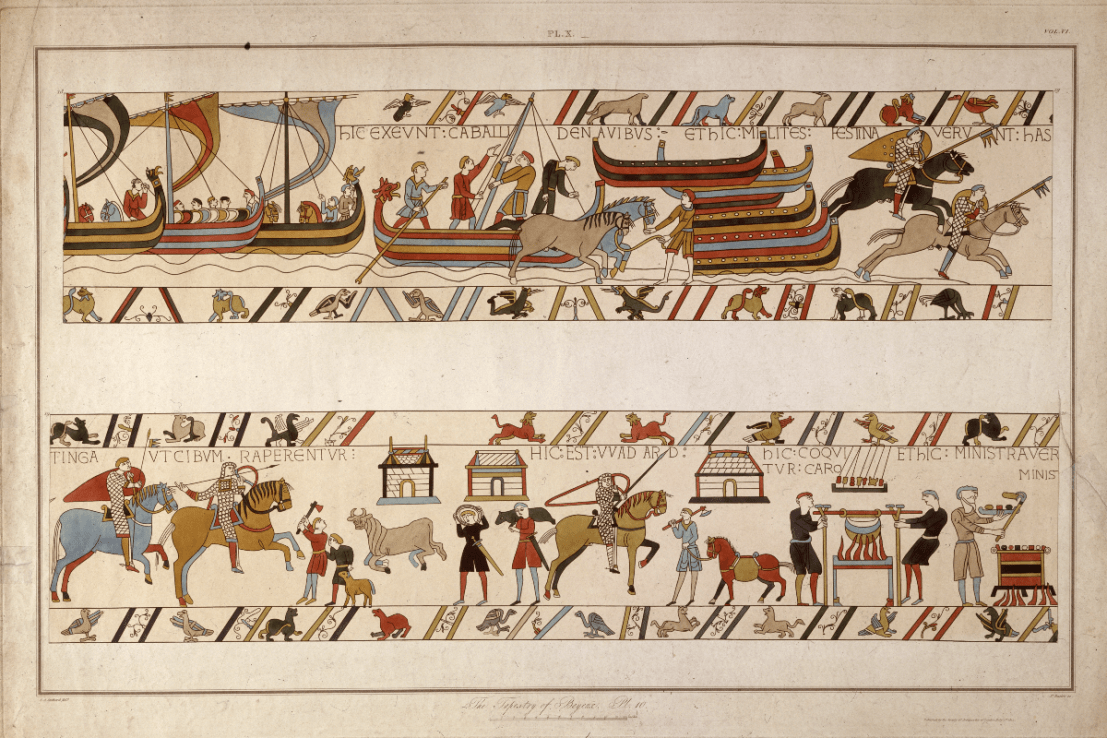
Lloyd de Beer, one of the curators, puts this down to the sheer wealth of visual interest the tapestry contains. “It’s not just a political narrative, it also has quotidian scenes of everyday life,” he told me. “It has people building castles, it has people eating, it has people sailing, and then there’s people gathering food, and people burning down houses, and it has so much besides trying to drive home one single narrative. I think that’s why it’s such a multifaceted object.”
The style of the embroidery is superficially naive, though the curators stress that English craftswomen were internationally renowned for their skill. But laid out flat, as it is in this exhibition, and stunningly lit in an otherwise dark room, you start to appreciate its narrative ingenuity. There’s the way the armada of Norman warships spreads across multiple panels, emphasising its overwhelming size. Edward the Confessor’s deathbed face as he names Harold Godwinson his heir is as tender a portrait of age and grief as you’ll find in art. And the propulsive momentum of the cavalry in the Battle of Hastings scenes, where horses start upright pivoting to the horizontal as they charge forward. A decorative border of allegorical animals and the occasional bawdy nude turns into a carpet of crumpled, decapitated bodies.
A post-Brexit gesture of friendship
As de Beer says, this is no Norman comic strip – it’s a literary object. “It’s an object full of classical allusions that tells a heroic narrative. It has betrayal, the death of a king and this eventual battle. This isn’t propaganda undertaken to convince the public of something. It’s not as simple as that”.
The Bayeux tapestry may not be propaganda but, like all great art, it is political. It doesn’t just depict transformational events, it shapes our perception of them. Indeed, such is its continued salience that the loan to the British Museum is considered a major diplomatic coup. It was first announced by Emmanuel Macron in 2018 as a post-Brexit gesture of friendship at a time when UK-EU relations were unravelling.
Beats any book
Macron once reportedly spent €26,000 on makeup in just three months – he’s a man who understands the power of visual symbolism. Now his presidency is coming to an end, Britain is seeking closer trade ties with Europe but boat crossings from Normandy remain a problem. The exhibition closes with a quote from Orderic Vitalis: “From then on [the English]… always mistrusted the Normans. Judging them to be treacherous, they yearned for a chance to have their revenge”. A pub bore might say English attitudes to the French have hardly changed but that’s not quite true. National stories are human stories – inconclusive, interwoven and riddled with loose ends.
History is written by the winners but the Bayeux Tapestry was stitched by ordinary women who lived in extraordinary times. For this posh girl too thick for real history, it beats any book.
The next ticket release takes place at the British Museum’s website on 21 October
Read more: Should we should keep that historic loan from France?