
ByUmir IrfanFootball tactics correspondent
- Published4 minutes ago
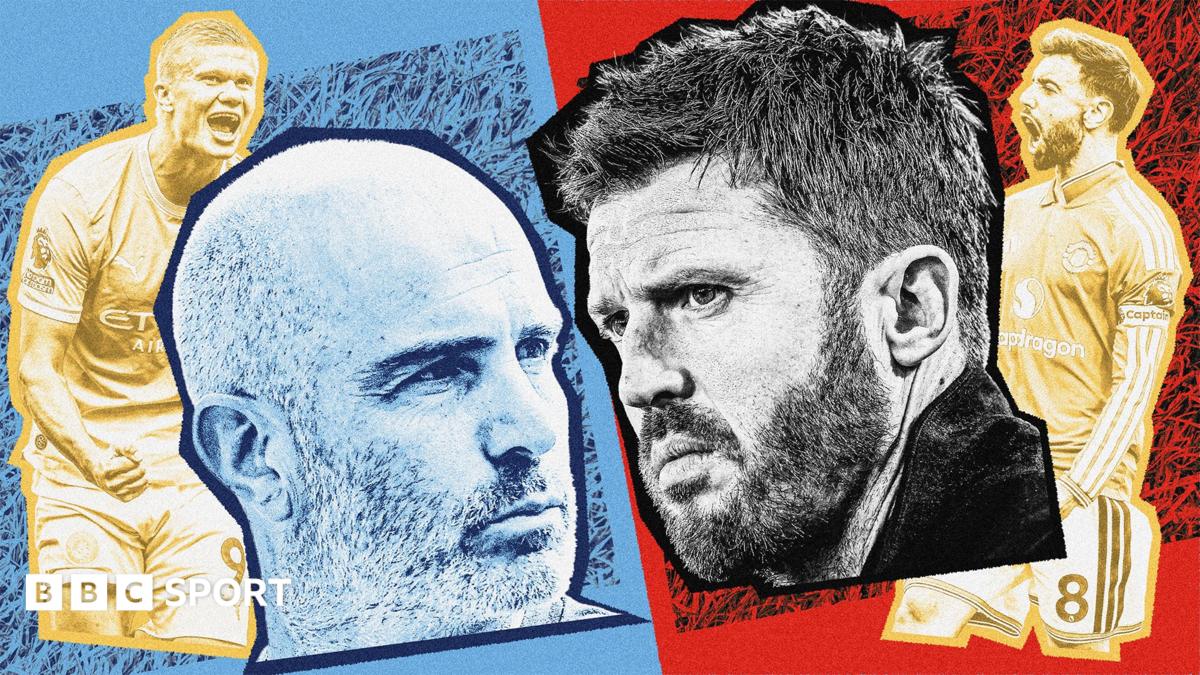
There are many things that Manchester City and Manchester United have in common – but one thing decisively separates them this season.
Based just five miles apart and united by a shared desire to return to the top of the Premier League, their gameplans are almost diametrically opposed.
The best teams in the world often play in similar ways, as demonstrated in last season’s Champions League final between between Paris St-Germain and Arsenal – teams who use similar shapes, look to dominate the ball, and encourage rotations into fixed positions.
But looking ahead to Sunday’s Manchester derby, expect to see City boss Enzo Maresca and his United counterpart Michael Carrick field teams teams that play in a totally different way to each other.
In short, City use a rigid structure with players precisely positioned, while United have a more fluid approach that has some positional guidelines but allows players the freedom to roam – here is how it works in detail.
-
Teams need to adapt to fixture scheduling – Maresca
- Published1 day ago
-
Two goals in two games – Sesko gives Man Utd a different threat
- Published2 days ago
Striking a balance between control and freedom
Maresca, inspired by mentor and former City boss Pep Guardiola, hopes to create a side synonymous with control, dominating as much of the ball as possible, looking to reduce the uncertainty that comes with playing football.
The Italian has often compared the move-based nature of chess to football, so it is not a surprise that positional play is the foundation of his sides.
These are ideas that have proved successful in modern football but Carrick’s United deviate from this approach more than most.
Image source, Getty Images
This is not to say there are not positional ideas in Carrick’s United.
There are, as we will go on to highlight, but they are certainly a smaller part of his game when compared to Maresca.
This balance is illustrated well in Carrick’s quotes about how he first managed 21-year-old midfielder Kobbie Mainoo.
“I [was] really conscious of not giving him an awful lot [of instructions],” he said. “A couple of little pointers, a few positional things, but to trust in what he is. He’s a fantastic footballer.”
Image source, Getty Images
How Carrick’s United use positional ideas
United keep their two centre-backs in fixed positions.
In United’s midfield the deepest midfielder is tasked with helping in build-up play, either as part of a narrow midfield two – alongside United’s second midfielder – or by dropping deep to create a back three with the centre-backs.
If the back three is created, the second midfielder holds his position in the centre of midfield alone.
The full-backs begin by holding more natural left and right full-back positions in build-up play. Higher up the pitch, they may join the attacking line.
When this happens, they position themselves based on their team-mate on the wing – with one out wide and one more central.
Meanwhile, the number 10 and striker have looked to drop deep, forming what looks more like a fluid front two at times.
The reasons behind United’s shape
There is logic to these positions.
With the holding midfielder given the license to drop to form a temporary back three, United have the option to overload teams that press with two strikers.
Against narrow teams, United’s wide full-backs give them an option to play around the opposition, but Carrick’s men often look to play through the middle of the pitch instead – something that appears they have been coached to do.
The positions of the full-backs help by enticing narrow opponents to be stretched wider. Concerned by the threat of United’s full-backs in space, the opposition may move over, which frees up space for team-mates to pass the ball into the midfielders in the centre of the pitch.
By playing into the middle even when it is congested, United draw opponents towards the ball. This results in Carrick’s wide men finding themselves with more time and space on the ball.
The central clusters of players set United up to try and crowd around the ball if it is lost, hoping to win it back.
How Carrick and Maresca view player freedom
The shapes and positions outlined above give United’s players a framework to start from.
But players who able to impact the game from different parts of the pitch are trusted to move more freely. This gives United a level of unpredictability which comes with pros and cons.
If Fernandes or Cunha decide that the game requires them to move close to the ball, away from the middle and closer to the touchline, they will do so.
Central defenders then face a difficult decision over whether or not to follow them.
If they are not picked up, United often find themselves outnumbering the opposition around the ball, which makes it easier for them to escape pressure.
If they are marked, space opens up in the middle of the opposition defence for another player to exploit.
Then it is up to the United players to interpret a more chaotic picture of the game, with players free to decide what to do next in that moment rather than follow a set script.
Image gallery 1Skip image gallery
1 of 2
Slide 1 of 2, Screengrab of Manchester United’s build-up play against Ipswich., Highlighted in yellow are United’s ‘front two’ – Bruno Fernandes and Matheus Cunha. Both have moved over towards the left with no defenders following them. Ipswich’s midfielders pick them up which leaves Youri Tielemans free to receive the ball in midfieldEnd of image gallery
Maresca sees freedom differently.
“If the freedom for you is that you can move everywhere, that is not freedom, that is chaos,” he told Sky Sports last September.
“[Our] freedom? You can do what you want in the position you receive the ball.”
Manchester City‘s starting XI occupy specific zones on the pitch in their 3-2-5 or 3-1-3-3 shape on the ball.
This makes their approach more predictable for opponents but it means that City’s players know each player’s role, where they are likely to be positioned and how they are likely to move.
After City’s win against Coventry, Maresca said that Iliman Ndiaye had had minimal training time and explained that meant sometimes “he was moving in the wrong way [into the] wrong position” for how City intend to play.
The advantage of this more fixed style is that, even if opponents know what is coming, the speed of execution can still make it difficult to stop.
Also, less spontaneous thinking is required to unlock a defence as solutions are set out by their manager and drilled through repetition over a season.
How Carrick introduces order within his more free system
To give this freer approach some direction, United appear to have established a set of shared tactical principles and concepts.
This includes clustering around the ball, attracting pressure, before looking to find players in space quickly.
Unlike Maresca’s more specific solutions, which outline where and when certain actions should be taken, it is often United’s players who decide when and where to use what they’ve been taught.
Watching how United pass the ball illustrates this point well.
Carrick’s United look to escape pressure through trios of players passing the ball between each other. As one player is about to receive the ball, a team-mate will often move to become the next passing option.
They do not do this in fixed zones but look to create these triangles when they feel like the moment is right.
This shared tactical language gives them a level of clarity whilst being unpredictable for the defending side.
Image gallery 2Skip image gallery
1 of 3
Slide 1 of 3, Screengrab showing Manchester United’s passing combinations in build-up against AC Milan in pre-season
, In pre-season, United have played good combinations in threes – making use of third-man runs. Here we see a vertical pass into Bruno Fernandes dropping deep, something central midfielder Youri Tielemans noticesEnd of image gallery
The pros and cons of both approaches
There is no right or wrong way to play football but, as this piece has attempted to showcase, every approach has its positives and negatives.
United’s freer approach has been praised by the maverick Fernandes, who saw a boost in his output following Carrick’s appointment last season and was subsequently crowned Premier League Player of the Season.
Image source, Opta
Conversely, there have been questions raised around City’s use of the creative Rayan Cherki.
On numerous occasions last season, Guardiola made clear he felt the Frenchman would be more effective staying between the lines, close to Erling Haaland.
“He has the ability and quality in the final third. That’s why I sometimes say when they go to the goalkeeper for the ball I say no, I want you there in the final third.”
Maresca has echoed this sentiment, perhaps not as strongly, explaining: “There is always a gameplan. When we are in our [half], Rayan drops a little bit to manage the tempo [of] the game [but] when the ball is in the opposite [half] we need Rayan in a position to be dangerous.”
Image gallery 3Skip image gallery
- Image source, Opta
- Image source, Opta
1 of 2
Slide 1 of 2, Rayan Cherki’s open-play heat map against Coventry in the first half, In the first half against Coventry, starting as a number ten, a free-spiritedCherki looked to get on the ball more often, including in his own half.End of image gallery
Some may argue that Fernandes has been maximised individually by United in a way that Cherki has not yet been by City – but the other side of the argument would be to say that City look better than United as a whole at this early part of the season.
Creating a freer style of play requires a chemistry and understanding between players that takes time to develop, while fixed roles and patterns of play can be implemented sooner and provide consistency irrespective of which players start.
Whether Carrick’s bet will pay off is yet to be seen but in a world dominated by coaches successfully prescribing solutions, giving some control back to the players is a welcome alternative – at least for the neutral.