
When thieves pulled off a heist at a Renoir museum, it didn’t go exactly go to plan By Daniela Pizzirani with wires
Posted Wed 9 Sep 2026 at 4:29pmWed 9 Sep 2026 at 4:29pmWed 9 Sep 2026 at 4:29pm
Thieves sliced through a fence, grabbed 9 million euros ($14.5 million) worth of art, dumped half of it in a garden and escaped in under three minutes.
That’s what went down when two thieves targeted the most valuable works of the famous impressionist artist Pierre-Auguste Renoir at a museum on the French Riviera.
The theft conjured up painful memories of the crown jewels heist at the Louvre Museum in Paris last year and triggered a national search for the perpetrators.
Here’s how they pulled it off.
How did the thieves steal the paintings?
A half-hour drive from the southern city of Nice, in Renoir’s last home before he died aged 78 in 1919, lies the Renoir Museum.
On Tuesday, two “well-equipped” thieves cut through the garden fence of that home using an “electric knife or saw”, the Cagnes-sur-Mer Mayor Bryan Masson said.
Shortly before 6am in the town of Cagnes-sur-Mer, they entered the museum on the ground flood via the garden and climbed through a window before cutting the clips securing the frames of four Renoir paintings.
This triggered the museum’s alarm system.
And within three minutes, the thieves had fled the scene through a garden, abandoning two of the artworks in the dirt.
Five minutes later, the police arrived.
“The museum and police sirens forced the burglars to hurry, stealing only four works from the Renoir Museum,” the mayor said.
The stolen works
Renoir’s art has fetched dozens of millions of dollars at auctions due to his pioneering portrait technique, particularly of women.
The French artist was one of the leading painters in the Impressionist movement.
Some of his more famous works are on display at the Musee d’Orsay in Paris, as well as in London and New York.
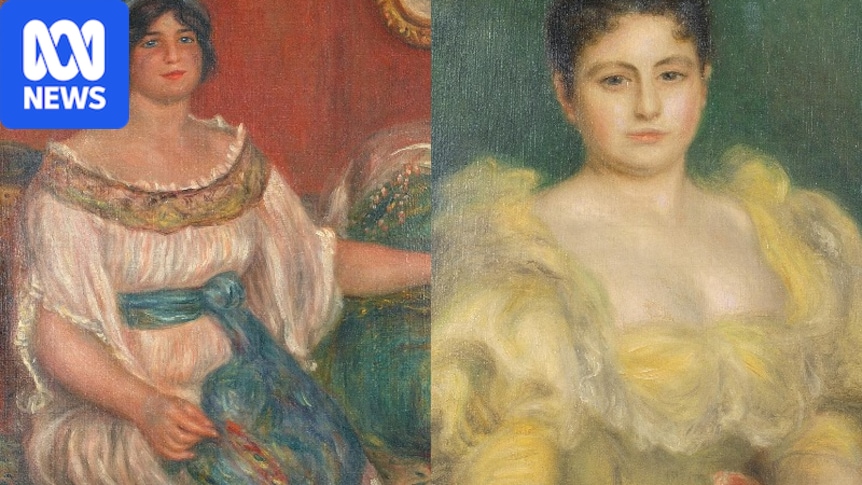
Of the four works stolen, two were left behind in the museum gardens, Portrait of Madame Pichon and Coco Reading, the prosecutor’s office said in a statement.
The two still missing are Portrait of Madame Colonna Romano and Young Woman at the Well.
At least two of the works targeted during the heist had a troubled history.
Young Woman at the Well is believed to have been looted by the Nazis during World War II, and was recovered in Bavaria in 1949 and brought back to France, according to the French Culture Ministry database.
A German officer in Paris gave Coco Reading to a German soldier at the end of the war under orders to take it to Germany, according to the database.
The soldier later gave it to a German priest, who handed it over to a Berlin museum in 1972.
Germany’s government returned it to France in 1994.
‘Almost impossible to resell’
Art theft expert James Ratcliffe of the Art Loss Register said unlike the Louvre heist targeting gold or jewels that could be melted down or recut, the Renoir theft left the thieves in a predicament.
”Although the [paintings] are valuable, and will have probably seven figures attached to them in terms of the financial value, trying to find a buyer who will pay that is going to be almost impossible for them,” Mr Ratcliffe told AP.
”Unless they have a plan for that in advance, they’re not going to be able to just go to an art dealer and say, ‘Look, I’ve got these two nice Renoirs, would you like to buy them?'”
He said that underfunding was the main problem facing museums everywhere, not just in France, and smaller museums were especially exposed because of their limited finances.
”The theft of the Louvre has demonstrated to everybody with criminal intent that museums are potentially soft targets,” he said.
“People are looking at museums differently.”
France’s art heist history
There are revived calls for better security and better funding for the many cultural sites large and small that dot France’s landscape.
The Marseille prosecutor opened an investigation into theft by an organised gang.
“This incident should serve as a warning about the protection of our museums,” the mayor said.
The museum was closed Tuesday while the investigation unfolded.
ABC/wires