
Fake Port Fairy artist prompts fears ‘ghost store’ scams will taint real reputationsBy Jean Bell, Alice Walker, and Sage Davidson
Posted Thu 10 Sep 2026 at 8:26amThu 10 Sep 2026 at 8:26amThu 10 Sep 2026 at 8:26am
In short:
A Port Fairy glass artist says he has been contacted by shoppers tricked into buying artwork by a fake artist.
A consumer watchdog says it is a “ghost store” using an AI-generated story and imagery to trick buyers into purchasing goods that often do not exist.
What’s next?
There are calls to strengthen laws to protect online shoppers from scammers.
About a week ago, Port Fairy glassblower Robert Gatt received an email from someone he did not know.
They said they had bought glassware from another artist in the coastal Victorian town, had not received a receipt, but hoped he could put them in touch.
“I thought, ‘This sounds a bit scammy,’ so I just ignored it,” Gatt said.
The next day, someone else phoned Gatt’s studio, trying to track down a glassblower in Port Fairy called Eleanor Whitmore, whose husband had tragically died.
Port Fairy has a population of around 3,000 people.
Gatt, who has practised in the area since 1993, told the caller he had never heard of the artist, let alone another glassblower in the tiny town.
‘Well, I’m the only glassblower in Port Fairy and I’m not dead, and neither is my wife,” he told them.
During the next few days, he continued to get messages and calls from people who were asking about a mysterious glassblower named Eleanor Whitmore.
Turns out, she does not exist.
The ABC has spoken to local artists and an arts advocacy group who said they have no record of an Eleanor Whitmore.
Neither does the local shire, which checked multiple electoral rolls for the artist.
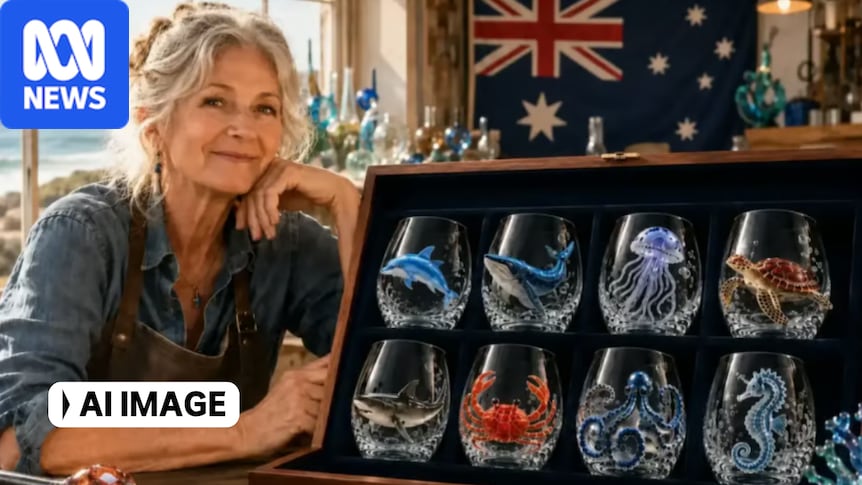
These unsuspecting shoppers have been scammed by a deceptive online website that claimed to sell sets of eight nautical-themed drinking glasses for $250, purportedly handmade by the artisan glassblower.
“It’s very sad, because it seemed to be targeting elderly people,” Gatt said.
AI-generated scam
The Consumer Action Law Centre’s assistant director of policy and campaigns, Meg Dalling, told ABC Statewide Mornings the website was an example of a “ghost store” scam.
“[Ghost stores] look legitimate, they are typically built by AI, but they really have the sole intent of taking people’s money without really ever delivering a product to them,”
Ms Dalling said.
In the case of ‘Eleanor Whitmore’, the ghost store was hidden behind the veneer of a bogus story about the death of the fake artist’s husband, embellished with AI-generated images.
“It has a very compelling, emotionally heart-rending story, but it’s actually all just fake,”
Ms Dalling said.
The website in question is owned by a Hong Kong-based company that appeared to develop AI software.
Sponsored ads for the fake store have been seen on Australian news websites alongside other offerings for AI-stock market bots, handmade chopping boards and fat-loss deals.
Most thumbnails carried an AI label; however, the chopping board website did not.
Ms Dalling said most shoppers who purchased goods through a ghost store would receive nothing, while others might get a poor imitation or knock-off version.
She said digital platforms needed to do more to stop these advertisements appearing on their websites, but said there was no silver bullet for the issue.
System-level change, including new laws and a scams protection framework, was needed to protect consumers, Ms Dalling said.
“Individuals will never be able to tackle this,” she said.
She urged shoppers to be cautious while shopping online, and look out for tell-tale signs a website might be a rort.
“Do they have Australian business numbers on their website? Are there any signs that the imagery looks fake or AI-generated?” she said.
The Australian Competition and Consumer Commission did not comment on the number of reports received about ghost stores this year, but said consumer laws prohibit businesses from engaging in misleading conduct or claims.
The ACCC said it warned shoppers last year about ghost stores and asked companies Shopify and Meta to scrutinise and take action against the operators of suspected ghost stores.
This resulted in more than a dozen suspected ghost stores ceasing operations, the commission said.
Harmful for real artists
Regional Arts Victoria communications and engagement director Kate Gerritsen said the organisation had no record of a Port Fairy-based glassblower called Eleanor Whitmore.
She said a bad experience with a fake website could put people off buying genuine artworks, while the fake spiel was cheap in comparison to the background of authentic makers.
“It takes away from the real and beautiful stories, particularly in regional Victoria, about artists connecting to their country, and artists creating beautiful products for sale,” she said.
“People’s perceptions of what an artist is and what an artist creates could be tainted.“
Ms Gerritsen said the rise of AI had caused issues around artist consent, attribution, and transparency.
“To add on this fraudulent artist profiling, it’s just another example of harmful practices that are coming out of AI,” she said.
Robert Gatt said he only permitted online sales for customers who had previously visited his studio. The experience has made him more cautious when purchasing goods personally.
“It does start making you wary of buying online,”
he said.
Despite being caught up in the peculiar situation, Gatt said he did not expect his business to be impacted.
“I don’t think I’m implicated at all, but you always worry,” he said.
“We’ve worked on the philosophy that people want to buy a piece of the artist, so we like to chat with our customers and explain what we’ve done,”
he said.
“I think the customer really enjoys that.
“It becomes a more personal thing; it’s not like going on Etsy and saying, ‘oh, that will do'”.