
Indonesian wildfires spurred by super El Niño choke South-East AsiaBy Tim Swanston and Ari Wu in West Kalimantan, with Raffa Athallah, and Erwin Renaldi
Posted Mon 7 Sep 2026 at 11:54amMon 7 Sep 2026 at 11:54amMon 7 Sep 2026 at 11:54am
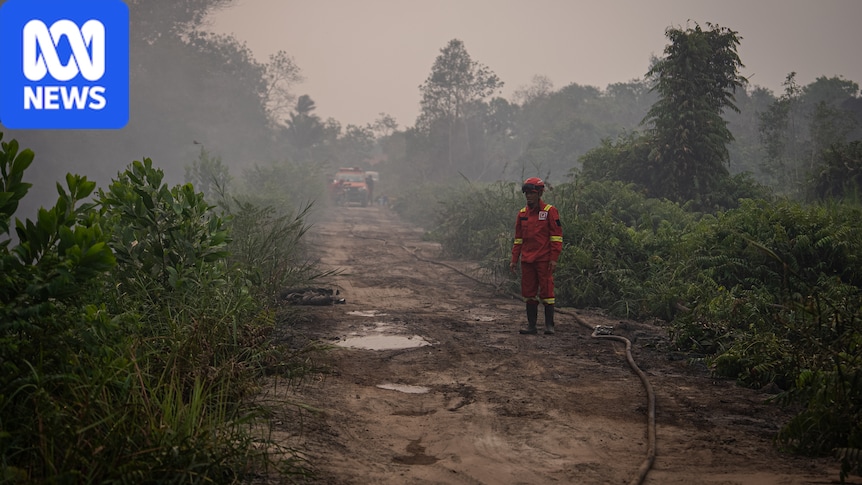
For three exhausting months, Andri Susanto and his crew have been fighting raging forest and land fires on the island of Borneo.
For many, it’s reminiscent of 2015, a horrid fire season that led to a smoke haze and air pollution crisis across parts of South-East Asia.
But Andri said this time around felt different.
“Conditions in 2026 are indeed worse than in 2015,” Andri said.
“The impact of El Niño has been so severe across Indonesia, and water sources have begun to dry up.”
“It’s been 60-plus … I’ve lost count of how many days without rain.“
He and his crew of firefighters from Manggala Agni have just spent the past few hours bringing a fire under control on the outskirts of Ketapang in West Kalimantan.
But these fires on Indonesia’s peatlands, a type of wetland made up of thick layers of decaying dead plants, are notoriously challenging to extinguish.
Indonesia’s dangerous fire season
In the peatlands, flames may not be visible on the surface, but embers could still be burning metres below ground.
“If we don’t extinguish it completely until the smoke is gone, it will spread again. It spreads underground, so it’s not visible,” Andri said.
Some of Andri’s crew, weary from a hard day’s work, will need to stand by overnight to watch the site in case the fire rages and flares up again.
Rampant land and forest fires have been burning for months across the Indonesian provinces of Kalimantan, on the island of Borneo, with a super El Niño exacerbating drought and fire conditions across the region.
Indonesia’s forestry minister has warned that the coming weeks will likely be the toughest for fire crews, with forecasters saying dry conditions are expected to peak this month.
“The field of struggle is right here in September,” Forestry Minister Raja Juli Antoni said.
At least 200,000 hectares, nearly three times the size of Singapore, have been burnt across the country, but that figure does not yet include August.
While it is still well below the amount of land that burnt in 2015, this year’s fire season is yet to finish.
No rain for months
From the air, the West Kalimantan capital, Pontianak, is nearly invisible.
A thick shroud of toxic haze has enveloped the city, along with large swathes of the mighty island of Borneo.
Pontianak’s residents are used to a bit of haze, but they say this is different.
“The smoke is strong. Look around: it’s dark,” Pontianak resident Fatmawati said as she waited at a clean water distribution point.
“We’ve never experienced anything like this.“
Fatmawati was with dozens of families at a reservoir in Pontianak, queuing up to fill containers with water being treated by officials.
Many families, including Fatmawati, collect rainwater at home for drinking, but their supplies have run out.
“There’s no water … the water at home has dried up,” she said.
She said it had rained a little once at her house but, because of the dust from the haze on her roof, the water turned black.
“The children are sick, they’re coughing, they have runny noses,” she added.
Bambang Supriyono said it had been months without rain at his home.
“The water is simply gone,” he said.
“I’m concerned. I feel sorry for my family. But what can we do? It’s like this for everyone.”
Tens of thousands of cases of respiratory infections
At a health clinic in Pontianak, Muhammad Arief Tri Hapsoro was busily treating an influx of patients who had come in because of the haze.
“In terms of health effects, many patients come here with coughs, then shortness of breath, sore throat, fever, diarrhoea, and vomiting,” Dr Arief said.
“Compared to previous years, this year the number has roughly doubled from the year before.
“The haze this year is also thicker. In my view, this may be the worst year yet … it is getting worse.”
He said he was very worried about the health of the community, “especially the children and the elderly”.
Indonesia’s Health Ministry has recorded tens of thousands of cases of respiratory infections, which have been linked to land and forest fires.
While the ABC was in Pontianak, an Air Quality Index monitor in the city recorded a reading of more than 900, three times the rating for hazardous air quality.
Septika Sari, a forecaster for Indonesia’s meteorological service BMKG, said the region had not experienced rainfall in two months.
“We can see from our PM 2.5 data, it has now entered the dangerous category … in terms of colour on the graph, it has gone to black.”
“The average visibility, especially in the morning, can be below 1 kilometre. It can be as low as 200–500 metres.“
Smoke haze spreads to Philippines and Malaysia
The consensus is that many of these fires were deliberately lit.
The forestry ministry is investigating and prosecuting cases of fires being lit to clear land for palm oil plantations and road construction.
Seventy-two people were arrested in August on suspicion of starting forest fires.
Satellite images show the scale of the smoke haze across the island, which even spread as far as the Philippines.
When Yogi Villalon Jumao-as first heard about the forest fires in Indonesia on the first day of September, he did not think they would affect him more than 1,000 kilometres away in Ronda, Cebu, in the Philippines.
But that afternoon, he said, the sky changed.
“I noticed that the air got really thick and it got really hazy and dark,” the physiotherapist said.
“I felt like it was harder to breathe … it’s also painful to the eye if you are going to open the window.”
An air quality report released by the ASMPH Center for Research and Innovation (ACRI) and the Breathe Metro Manila (BMM) network showed the haze from the Indonesia fires made the air in the Philippine capital of Manila “acutely unhealthy” between August 30 and September 2.
For residents in Malaysia, the haze from Indonesia is more familiar.
On Saturday, Malaysia declared a state of emergency in Sarawak, which neighbours the Indonesian province of West Kalimantan.
Kuala Lumpur-based hospitality worker Serene Nazari said she had grown up experiencing what Malaysians sometimes called “haze season”.
“I’ve grown up with kind of an annual occurrence of haze. I’ve lived it my whole life,” she said.
“It is getting very frustrating. When are things going to change?”
This year, she said, the haze again changed how she went about her day.
“I usually take my time walking to work to enjoy fresh air and sunlight. Now I’m kind of just rushing and trying to get to the office as quick as possible and spend less time outdoors.”
Ms Nazari said she had also been suffering from a sore throat for two weeks.
“It affected me with my health. That’s been the biggest hurdle,” she said.
Malaysia’s Ministry of Health said asthma cases surged 259 per cent in the last week of August amid worsening air quality, local media reported.
Smells like people ‘smoking packets of cigarettes’
In Selangor, Natalie Loi said she noticed the haze almost immediately after returning from Vietnam.
“Straight away when I landed down in KL [Kuala Lumpur] International Airport, I could smell the haze. It was so bad,” she said.
“It kind of smells like people are just smoking packets of cigarettes around you.”
Ms Loi said one of the hardest parts was feeling powerless as the haze crossed borders.
“It’s something that we have to live as per normal: get respiratory illness, get cough, get flu, and just live with it because there’s nothing we can do about it.”
Mr Jumao-as said seeing smoke from fires so far away reach his home reinforced how connected the South-East Asian region was.
“This is one manifestation for us to see that we do breathe the same air,”
Yogi said.
Last week, the ASEAN Specialised Meteorological Centre activated a level 3 alert, the highest trans-boundary haze alert, for the southern part of South-East Asia.
“Several air quality stations in West and South Kalimantan, central and southern Sumatra, as well as western Sarawak recorded unhealthy to hazardous levels,” according to a statement cited by the Bernama news agency.