
Dramatic scenes as Australian rescuers winch Canadian sailor to safety in remote Indian Ocean
Posted Mon 7 Sep 2026 at 5:17pmMon 7 Sep 2026 at 5:17pmMon 7 Sep 2026 at 5:17pm, updated Mon 7 Sep 2026 at 5:54pmMon 7 Sep 2026 at 5:54pmMon 7 Sep 2026 at 5:54pmLoading…
In short:
A Canadian sailor has been rescued by Australian authorities after his vessel began taking on water in the remote Indian Ocean.
The man was 1,000 kilometres south-east of Christmas Island when his boat began taking on water.
The Australian Maritime Safety Authority pinpointed the man’s location and dropped him critical supplies, before he was rescued by Royal Australian Navy personnel.
A precarious search and rescue mission has unfolded over some of Australia’s most isolated waters, with a Canadian solo sailor successfully winched to safety from the Indian Ocean.
The rescue took place on Sunday, around 1,000 kilometres south-east of Christmas Island.
The Australian Maritime Safety Authority (AMSA) said the sailor had been travelling to the remote territory off Western Australia from Darwin when he failed to make two scheduled calls to family back home.
His brother alerted AMSA, which scrambled its Perth-based Challenger jet to scour the vast area off the Australian mainland.
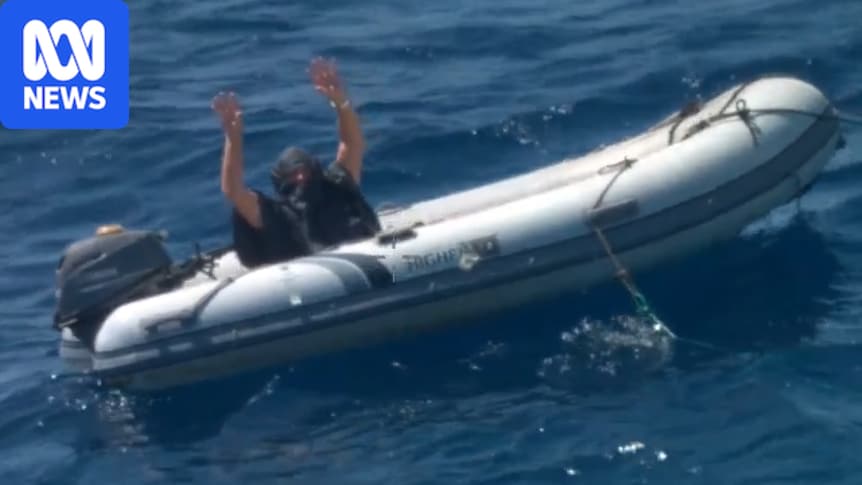
Images captured by the aircraft show the sailor’s catamaran partially submerged under rough waves and its skipper forced to take refuge in a still seaworthy tender.
Cloth draped over his face, the marooned man raised both hands as help arrived.
After parachuting down crucial supplies like a life-raft, food, water and an emergency beacon, a MH-70R Seahawk helicopter was called from Royal Australian Navy support vessel HMAS Supply.
The oiler replenishment ship had been patrolling the Indo-Pacific on a regional presence deployment, assisting part of the United States Pacific Fleet.
“The person received the emergency beacon and they were able to activate [it]. That allowed us to continuously monitor the drift of the vessel and the survivor,” said Dan Gillis, manager at AMSA’s rescue coordination centre.
“We were aware that there’d been some fairly severe weather through that area over the weekend.”
The twin engine helicopter, typically used for anti-submarine warfare as well as search and rescue, flew nearly 200kms to the sinking catamaran and winched the sailor aboard.
“We believe he’s in good condition with no serious medical issues and he’s currently on the way back to Darwin,”
Mr Gillis said.
In a statement, AMSA executive director of response and capability Alex Barrell said the complex operation was a testament to Australia’s ability to rapidly respond to emergencies in extremely remote places.
“From the initial alert raised by family members overseas through to the deployment of AMSA’s rescue jet and support from HMAS Supply and its embarked helicopter, multiple agencies worked together to achieve a successful outcome,” he said.
“This incident also highlights how quickly circumstances can change and deteriorate offshore and the importance of being prepared before heading to sea.”