
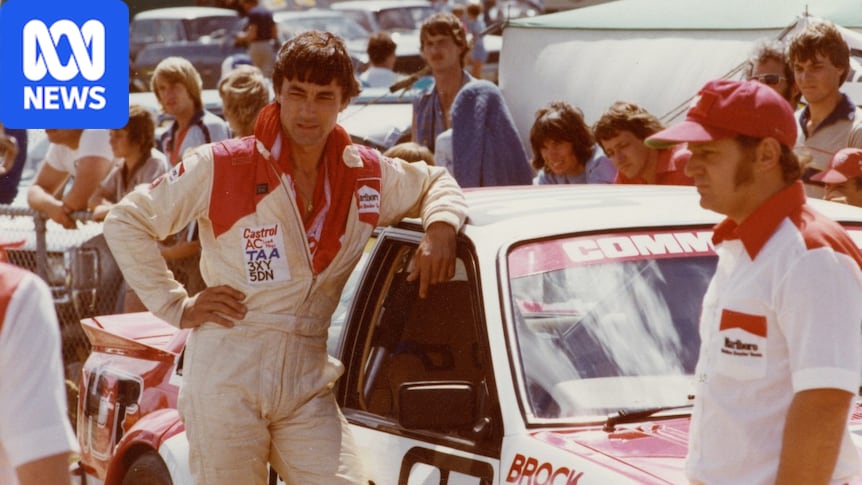
Peter Brock’s motorsport fame endures 20 years on from his death
Posted Tue 8 Sep 2026 at 5:58amTue 8 Sep 2026 at 5:58amTue 8 Sep 2026 at 5:58am
In short:
Peter Brock’s family and the motorsport community have paid tribute to the racing legend’s legacy.
The “King of the Mountain” died 20 years ago after a crash near Perth.
What’s next?
An exhibition dedicated to Brock’s career is on display at the National Motor Racing Museum in Bathurst.
Even two decades after his death, Peter Brock’s sublime driving skills are still spoken about with awe.
“I couldn’t believe the things that he could do behind the wheel,” stepson James Brock said.
“You would almost believe that he was defying physics.”
It was this ability that left the nation shocked when Peter Brock died 20 years ago on September 8, 2006 after a crash during a rally race at Gidgegannup, near Perth.
“He definitely died doing what he loved,” his son Rob Brock said.
“It was a very crazy time and very poetic that dad did go out racing.“
The 61-year-old racing legend’s death brought an outpouring of grief, a state funeral in Victoria and spontaneous memorials set up at racing tracks across the country.
“Dad left an indelible mark on Australia so it’s interesting to see how much he affected everyone,” Rob said.
Racing with Peter
James Brock laments that he didn’t get enough opportunities to race with his stepfather, but cherishes the time they had on the track together, particularly a win at Mount Panorama in the V8 Ute series in 2003.
“Peter was at the end of his career when I’d started mine, I am absolutely lucky that I did get the chance to drive with him,” he said.
“I am really glad I got to experience standing on the podium with him.
“When I was a little kid, I was just as much a fan of him as anyone else.”
But racing with Peter Brock was not without its challenges, as the pair discovered during the 1999 Targa Tasmania rally.
“We both worked out that as a navigator he was a pretty good driver and as a driver I was a pretty good navigator,” James said.
Peter Brock made his professional racing debut in 1969 at Mount Panorama, a circuit he would become synonymous with after winning the Bathurst 1000 nine times, a record that still stands today.
Over the course of his 212 race starts in the Touring Car Championship he won 48 races, three championships and was inducted into the Hall of Fame in 2001.
Racing record
To mark the anniversary of his death, an exhibition opened on Tuesday at the National Motor Racing Museum in Bathurst.
“Even 20 years after his tragic accident, Peter Brock is still probably the best-known name in Australian motorsport history,” museum coordinator Brad Owen said.
“He’s one of the most important figures in our sport … the profile that he brought to the sport is still relevant to the current day.“
Brock’s success at Mount Panorama coincided with a growing global recognition of the racetrack and Bathurst 1000 as it began to be broadcast overseas during the 1970s and 80s.
“Peter’s impact on Mount Panorama has been amazing,” he said.
“He rose to prominence as the Bathurst 1000 was becoming a much more globally recognised thing.”
Returning home
Rob Brock remembers fondly his annual trips to Bathurst.
“Going to Mount Panorama is kind of like going home,” he said.
“It’s weird because you think of it as just this place, but I spent so much time going there.
“I have a lot of beautiful memories.”
James Brock has had the opportunity to return to the mountain to drive some of the vehicles that Peter dominated the track in.
“It always brings a tear to my eye,” he said.
“Bathurst is obviously a pretty special place. It is part of my childhood; it is where I grew up.”
Remembering Brock
Mr Owen said while putting the exhibition together it became clear the impact Brock’s death had and continued to have on the racing community.
“Everyone remembers where they were when they heard the news,” he said.
“It was so unbelievable that it could happen for a guy that was so successful. To think he died in a racing car was very challenging.”
Twenty years on from his death, Rob Brock cherishes the moments he had with his father being a “weird, beautiful dork”.
“He would come home and make up for some of the absences by spending copious amounts of time with us,” he said.
“It would be these beautiful moments where you got this unapologetically human experience out of someone who was always this character to everyone else.”