
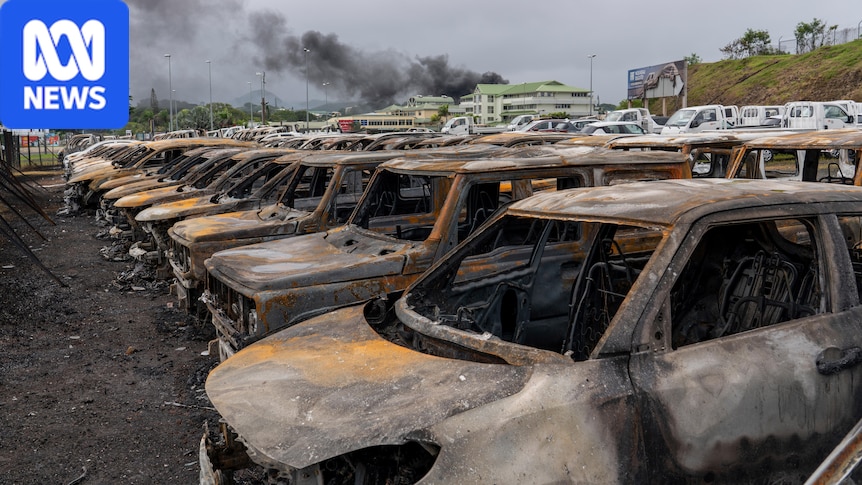
Two years on from riots, New Caledonian president visits France amid debt crisis
Posted Tue 8 Sep 2026 at 4:58amTue 8 Sep 2026 at 4:58amTue 8 Sep 2026 at 4:58am
Gaetan Babout moved to New Caledonia 14 years ago, seeking a quieter life in the south Pacific territory that shares his mother tongue.
But when deadly riots sparked by proposed voting reforms engulfed Nouméa in 2024, Mr Babout, who is from France originally, found himself on the front line of a battle over independence from France that had been simmering for decades.
Two years on, he is still dealing with the repercussions.
“2024 and last year were really, really hard,” he said.
“The economy has totally crashed.”
His tour company lost 50 to 70 per cent of its business when tourism ground to a halt after clashes between Kanak protesters and French security forces caused more than $3 billion in damage across the territory.
President of New Caledonia’s Chamber of Commerce David Guyenne said around 12,000 people have fled the territory since 2024, an exodus that left crucial gaps in healthcare and essential services.
His own shopping centre was among the many businesses lost after it was burned down on the second day of the riots.
He is still waiting for insurance to fund a rebuild, two-and-a-half-years on.
“It’s a very painful process. I personally lost 95 per cent of my businesses,” he said.
Economy on the brink
His experience reflects a broader crisis — one that newly elected President Milakulo Tukumuli highlighted in his first speech to New Caledonia’s Congress in August, when he warned the territory’s finances were on the “brink of total collapse”.
He said if nothing was done to salvage the territory’s ailing pension scheme, more than 40,000 New Caledonians could find themselves “pensionless within a few months”.
The healthcare system also had a cumulative debt of $578 million, he said.
“New Caledonia will not pass 2027 without fresh financial support from the French state,”
he said.
Last week, Mr Tukumuli was in Paris to secure more funding assistance to rescue the territory’s financially embattled pension and health schemes.
Loans arranged through the French Development Agency to support New Caledonia’s recovery already stand at about $1.2 billion.
French Prime Minister Sébastien Lecornu agreed to provide a further $600 million to $900 million, plus an extra $96 million to conclude New Caledonia’s 2026 financial year and balance its 2027 budget.
Mr Lecornu said most of the new assistance would be in the form of grants.
New Caledonia’s Congress president Virginie Ruffenach, who was part of Mr Tukumuli’s delegation, said the figure met about 90 per cent of the delegation’s $870 million plea.
But the money still requires approval by the French Parliament.
And it’s unclear exactly how much would be disbursed in loans rather than grants.
Mr Tukumuli earlier stressed that more loans for the French Pacific territory was “untenable”.
“Between 2020 and 2026, we have borrowed 1.5 billion euros ($2.5 billion),” he said.
The new assistance also comes on the condition New Caledonia would undertake “urgent reforms” to reduce spending.
Ms Ruffenach said New Caledonia had already passed a significant number of reforms resulting in savings of almost $600 million.
Mr Guyenne said additional reforms would likely involve austerity measures and were necessary, even if they meant higher taxes for people and businesses.
“I think New Caledonia is bankrupt and if we didn’t have the financial help of France then the whole social system would collapse,” he said.
Airport crisis
Although the 2024 crisis was centred on the capital city Nouméa, two years on the fallout has spread throughout the territory.
Earlier this year, domestic carrier Air Calédonie announced it would relocate all flight operations from an airport in Nouméa, to a larger facility 50 kilometres away in La Tontouta.
The move effectively doubled the travel time for people travelling from the outer islands to the capital, and sparked a protest movement throughout March which saw regional airports blockaded and flights grounded.
After weeks of flight cancellations, Air Calédonie filed for bankruptcy.
The blockades still continue intermittently, amid a stalemate over the essential flight route.
Outer islands defy financial woes
But 170 kilometres east of the mainland on the island of Lifou, locals say their community has been relatively insulated from the territory’s economic trouble.
That’s despite being essentially cut off from the mainland during the flight blockade and only accessible by a five-hour ferry.
“Life in Lifou is better than Nouméa. There’s no pollution, we have fields to work in and the sea provides us with fish to eat,” Andréa Gaze from the local Mou community said.
“We don’t need much — we have our wealth right here on the island, from the sea and the land.”
Much like Nouméa, Lifou’s tourism industry took a major hit following the pandemic and the 2024 unrest.
But its fortunes appear to be turning, due in part to a new 50-room hotel and the 144,000 cruise passengers who visited the island’s shores last year.
Among the newly-employed staff at the hotel is Sadia Citre, originally from nearby Maré Island, part of the Loyalty Islands group.
She said the recovery of tourism in Lifou and a focus on lifestyles guided by Indigenous knowledge and crop cultivation has positioned the community as self-reliant.
“It’s really an opportunity for me to continue living on the islands, especially compared to Nouméa, with its big city noise and everything,” she said.
“It’s actually a real chance for us.“
There isn’t as much optimism on the mainland, where visitation numbers remain well below pre-riot levels.
Recent figures show 58,000 international tourists stayed in New Caledonia in 2025, compared with 125,000 in 2023 — the lowest number recorded in 30 years.
For Nouméa tourism operators like Gaetan Babout, the economic outlook is deeply uncertain.
“It’s very difficult to have a vision of the future,”
he said.