
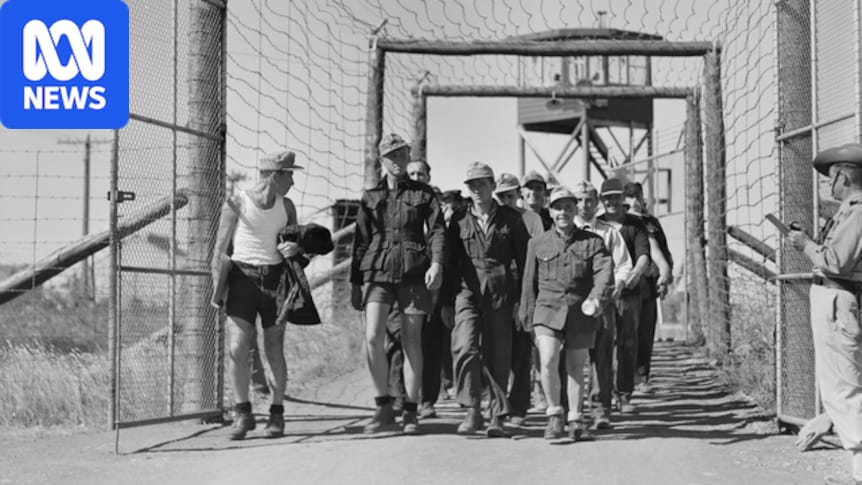
Calls to preserve history of Australia’s largest World War II prisoner of war camp
Posted Sun 6 Sep 2026 at 7:37amSun 6 Sep 2026 at 7:37amSun 6 Sep 2026 at 7:37am
In short:
A portion of Australia’s largest World War II prisoner of war camp is on the market.
The Victorian camp features a memorial to German navy officers who died on the sunken Kormoran cruiser after it famously downed the HMAS Sydney.
What’s next?
The son of a prisoner at Australia’s largest World War II POW camp is calling for its history to be preserved, including a more permanent site for visitors.
The son of a World War II prisoner is calling to preserve a key part of Australia’s history after the nation’s largest World War II-era prisoner of war camp went on the market.
Camp 13 at Murchison, 35 kilometres south-west of Shepparton in Victoria’s Goulburn Valley, housed Italian, German and Japanese prisoners between 1941 and 1947.
After the war, the land returned to private ownership and a portion of the former site is now on the market.
Beaufort man Shane Pruckner’s father, Rudolph “Rudi” Pruckner, was interned at the camp after being captured in Greece.
“He was a foot soldier in a panzer division, stationed in Greece,” Mr Pruckner said.
“They were captured in a short battle with Australia and New Zealand forces that were retreating from Greece at the time.”
From there, his father was shipped off to Australia for the remainder of the war.
“It was his 21st birthday, the day he marched into camp [in 1941].”
He said his father was treated “very well” during his time at Camp 13.
The treatment was so favourable that some camp guards even helped him escape, providing him with a uniform, wheels and a place to stay.
“They put him on a train to the western district, and he was hidden at a remote farm at Lake Condah for about six weeks before he was recaptured and taken back to Camp 13,” Mr Pruckner said.
When the war ended, he returned to Austria but soon decided to settle permanently in Australia, and even had assistance from former camp officials in that process.
“Things were so bad in Europe after the war, people were struggling, struggling for work and food, and he knew he had an opportunity back in Australia to get work,” Mr Pruckner said.
He was even sponsored by one of the camp sergeants, and the family of people where he hid during his escape offered him work on a farm there, enabling him to emigrate.
Murchison Historical Society’s Kay Ball said the portion of the camp on sale also hosts a memorial to German sailors responsible for one of Australia’s greatest naval tragedies.
The HMAS Sydney (II) famously vanished for decades off the West Australian coast after sinking with all 645 souls on board.
“The Kormoran was the German raider involved in the sinking of that ship, the largest loss of life in naval history in Australian waters, and a terrible event,” Ms Ball said.
“They were captured when they came ashore off Western Australia and brought to Camp 13.”
The site also features a gun placement which Ms Ball said was installed to guard the Japanese prisoners transferred to Camp 13 after the mass outbreak at Cowra in 1944.
“Because it was such an aggressive and bloodthirsty event, they had to increase the security,” she said.
“So they put the gun placement there with the gun trained on the section where the Japanese prisoners were.”
Preserving history
Since going on the market last December, Tatura-based real estate agent Natalie Kay said she has received a lot of interest, and has heard from some surprising quarters.
“We’ve got a number of buyers in the background who are quite interested in looking at it possibly becoming something like a tourist attraction,” she said.
“And I’ve also had quite a number of family members who had grandfathers and great-grandfathers here during the war that were housed here as prisoners.”
Ms Kay says the property, currently listed within the $650,000 to $680,000 price range, has historical overlays across much of the land.
“You would have to speak with the local council about what you could and couldn’t do with the property,” she said.
However, she would like a buyer to preserve the history of the site to ensure it lives on.
“Hopefully, whether it becomes a tourist attraction or something like that I don’t know, but just if their heritage gets looked after that would be an amazing thing,” she said.
Mr Pruckner also wants the site preserved so visitors can come and learn about its rich history.
“I think it’s come up for sale a few times over the years and it’s, to me, I think it’s a bit of a shame that it hasn’t been in some way preserved for people to go and visit,” he said.
He said it would be good if something more permanent could be established there.
“To actually be able to go and visit where the camp was and see whatever’s left of it would be an interesting thing I think,” he said.
Ms Ball would also like to have been able to acquire the site where the “two remaining artefacts” still stand.
“We would love to one day have a destination out there that people could visit and learn about the history of the camp and the people in the camp,” she said.