
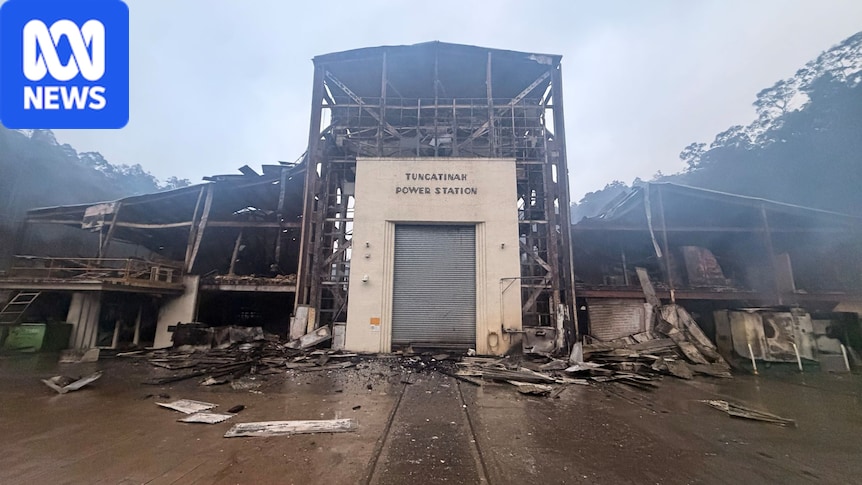
Not yet safe for authorities to access Tungatinah Power Station gutted by fire
Posted Fri 4 Sep 2026 at 5:19amFri 4 Sep 2026 at 5:19amFri 4 Sep 2026 at 5:19am
In short:
Investigations are continuing into the cause of a fire that gutted one of Tasmania’s hydroelectric power stations.
Authorities say it is not yet safe to enter the Tungatinah Power Station, which supplies 5 per cent of the state’s energy, in the Central Highlands.
What’s next?
The Tasmania Fire Service says it will likely take several days to examine the scene.
Authorities have had to use a drone to inspect the inside of a burnt-out hydroelectric power station in Tasmania, as it is still unsafe to enter the building.
The Tasmania Fire Service (TFS) is continuing to investigate the cause of Wednesday night’s fire at the Tungatinah Power Station in the Central Highlands.
“At this stage they are still struggling to make the scene safe for the investigators to gain entry,” TFS Deputy Chief Officer Matt Lowe told ABC Northern Tasmania on Thursday.
“They’re currently utilising a drone to inspect the interior and then make decisions based on where best to gain access.
“As you can appreciate with the wind today, there’s a lot of loose debris.”
The Tungatinah Power Station is Tasmania’s fifth-largest hydro power station, supplying about 5 per cent of the state’s energy.
“This is a large commercial building in industrial scale and it’s been totally destroyed by the fire,”
Mr Lowe said.
“So it is a challenging task at the moment, and at this stage it’ll be several days of examination of the scene.”
The Lyell Highway remains closed between Fourteen Mile Road and Victoria Valley Road, with diversion routes in place.
Repairs expected to come at ‘significant cost’
Hydro Tasmania said it had not yet been able to assess the site, meaning it could not comment on the condition of the assets or the cost of repairs.
“It’s obviously a significant structure, so there’ll be a significant cost in terms of remediation,” Hydro Tasmania executive Erin van Maanen told ABC Northern Tasmania.
“But until we’re in a position to assess the damage and what will be required to reinstate the power station, we really can’t give an estimate [of the cost] at this stage.”
Ms van Maanen said Tasmania’s energy supply was secure.
“We have a really strong and healthy storage position and sufficient capacity across the state without Tungatinah to meet demand,”
she said.
She acknowledged Tungatinah’s closure would impact Hydro Tasmania’s revenue.
“We’ll obviously seek to manage the balance of the portfolio in a way that continues to deliver returns through to the Tasmanian government,” Ms van Maanen said.
Question asked about station maintenance
Labor leader Josh Willie asked the government in parliament on Thursday about Tungatinah’s recent maintenance history.
“More than a decade ago, Hydro Tasmania described Tungatinah as a priority asset, saying its age meant it no longer delivered the required performance and carried duty of care risks,” he said.
“Hydro subsequently undertook a $60 million modernisation program and later scheduled further refurbishment work.
“When was Tungatinah’s most recent comprehensive condition and fire safety assessment, and were any maintenance, replacement or fire protection works identified?”
Treasurer Eric Abetz said Hydro Tasmania was actively upgrading its assets.
“At Tungatinah, approximately $60 million has been invested in the replacement and upgrade of four of the station’s five turbines and associated control systems since 2011,” he said.
“In addition, over the last three years, major maintenance has been completed on all machines at Tungatinah as part of Hydro Tasmania’s operational maintenance program.
“A deluge fire protection system was installed at Tungatinah in 2005, fire mains and hydrants have recently been upgraded, and routine fire alarm system testing has recently been completed.”