
Hundreds of regional doctors stop work amid burnout, poor conditions and low moraleBy Eden Hynninen, Charlotte Wilkes, Tyrone Dalton and Mackenzie Mitchell
Posted Thu 3 Sep 2026 at 5:25pmThu 3 Sep 2026 at 5:25pmThu 3 Sep 2026 at 5:25pm
In short:
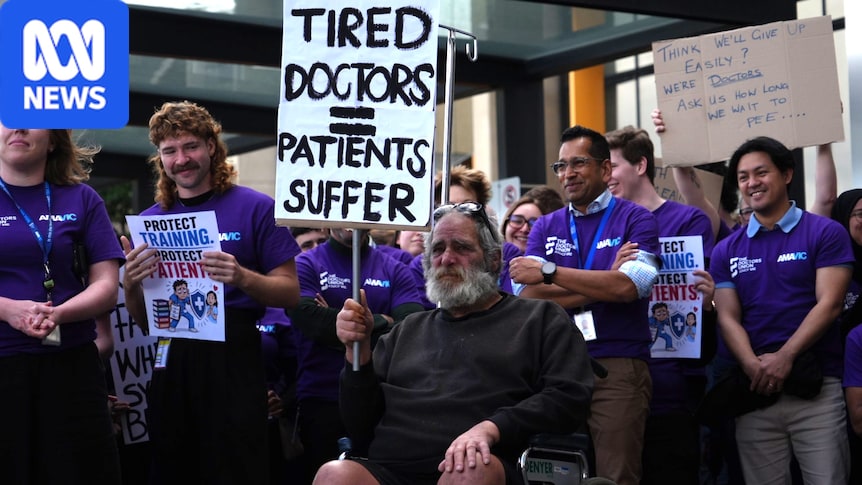
Hundreds of regional doctors in Ballarat and Bendigo stopped work amid claims of burnout, poor conditions and low morale.
The Australian Medical Association Victoria said that after a year of negotiations, public hospital doctors still did not have an offer over industrial relations or an enterprise bargaining agreement.
What’s next?
Grampians Health, which manages the Ballarat Base Hospital, and Bendigo Health said they respected the rights of doctors to take protected industrial action.
For the first time in 20 years, hundreds of Victorian doctors have walked off the job.
Doctors from the Ballarat Base Hospital and Bendigo Health, two of the largest hospitals in regional Victoria, stopped work today citing exhaustion, low morale and stressful working conditions, with some doctors saying they were near breaking point.
The four-hour stop work is part of escalating industrial action over working conditions.
Last month, the ABC reported on the Ballarat and Bendigo hospitals as being among the five regional Victorian hospitals showing signs of system failure, including excessive wait times in emergency departments.
No offer
The Australian Medical Association Victoria (AMAV) said that after a year of negotiations, public hospital doctors still did not have an offer over industrial relations or an enterprise bargaining agreement from the Victorian government.
AMAV president Simon Judkins said the state has had three health ministers over the past 12 months, and no offers over that period.
Dr Judkins said the state government was “kicking the can down the road” in Ballarat’s case, saying a major redevelopment of the Ballarat Base Hospital “will solve the problems”.
“The new build won’t solve the problem. It’s staffing that will solve the problems,” he said.
“Buildings can’t do surgery.“
The Ballarat Base Hospital redevelopment and expansion will include a new emergency department and an extra 100 inpatient and short-stay beds.
It is due to be completed in late 2027, but Dr Judkins said change was needed now.
“We hear from our doctors over and over again about the stress of working in public hospitals, about the length of their shifts, the number of night shifts, the fatigue they have at the end of the shifts, the multi-tasking,” he said.
“So we want safe working conditions for our doctors so they can look after our patients.”
Ballarat resident doctor Katie Lyng agreed.
“Everything would run smoother if we had protected breaks, good shift lengths,” Dr Lyng said.
“We are sick of it.“
Taking advantage of ‘our sense of duty of care’
Christian McCaffrey is a junior doctor at Grampians Health, which runs the Ballarat Base Hospital.
He said that while he loved his job, it was all becoming too much.
“I think the doctors are really at the end of their tether,” Dr McCaffrey said.
“My peers have to work hours beyond what they’re rostered, go days without breaks, without going to the toilet even, without having a drink of water.
“It’s hard for us to put those things ahead of a patient who needs to be reviewed or a patient who needs discharging because we’re having pressure to get patients out of the hospital to open up beds because there’s 40 waiting in the ED for a bed.
“I think the Victorian government is taking our sense of duty of care to our patients for granted.“
Last month, the ABC reported that about 3,300 patients who were admitted to emergency departments across the state from January to March this year stayed there for at least 24 hours.
Of those, 2,330 patients, or 70 per cent, were in regional and rural hospitals, with the highest numbers in Ballarat, Albury, which services many Victorians, and Bendigo.
The health department’s performance target is zero patients spending more than 24 hours in an ED.
The ABC also reported on the death of a man left unattended in the Ballarat Base ED waiting room.
Second-year doctor at Bendigo Health, Joel Findlay, said he and his colleagues were stretched to their limits.
“I’ll finish my fourth or fifth night shift and I’ll come home and I try to use my swipe [card] to get in my front door at home,” Dr Findlay said.
He said the pressure was significant.
“You haven’t eaten in three hours, you’ve got no lunch break,” Dr Findlay said.
“You’re torn between two and three different tasks, and everything goes wrong at the same time.”
Hospitals respond
A Grampians Health spokesperson said they respected “the rights of our colleagues to take protected industrial action”.
“We value the dedication and professionalism of our medical staff and recognise the important role they play in delivering care to our communities,” a spokesperson said.
“We have undertaken extensive planning to prepare for the industrial action and have worked to ensure all critical services are appropriately covered.”
They said the Ballarat Base Hospital redevelopment would deliver significant long-term benefits, but work was also being done to improve patient flow in the short term.
A spokesperson for the Victorian Health Minister said the Albanese Labor Government had made significant improvements to primary care, but more needed to be done to make it easier for Victorians to get care at a GP.
“[The Victorian government] had to step in and establish 29 urgent care clinics in Victoria when the former federal Coalition government spent a decade gutting Australia’s primary care system, leaving too many Victorians unable to secure an appointment or afford to see a GP,” the spokesperson said.
A Bendigo Health spokesperson said it respected “our employees’ right to take protected industrial action and we remain focused on providing safe, continuous patient care during this time”.
“We are working closely and collaboratively with our doctors, Australian Medical Association, and Australian Salaried Medical Officers Federation to minimise any potential impact on patients,” the spokesperson said.