
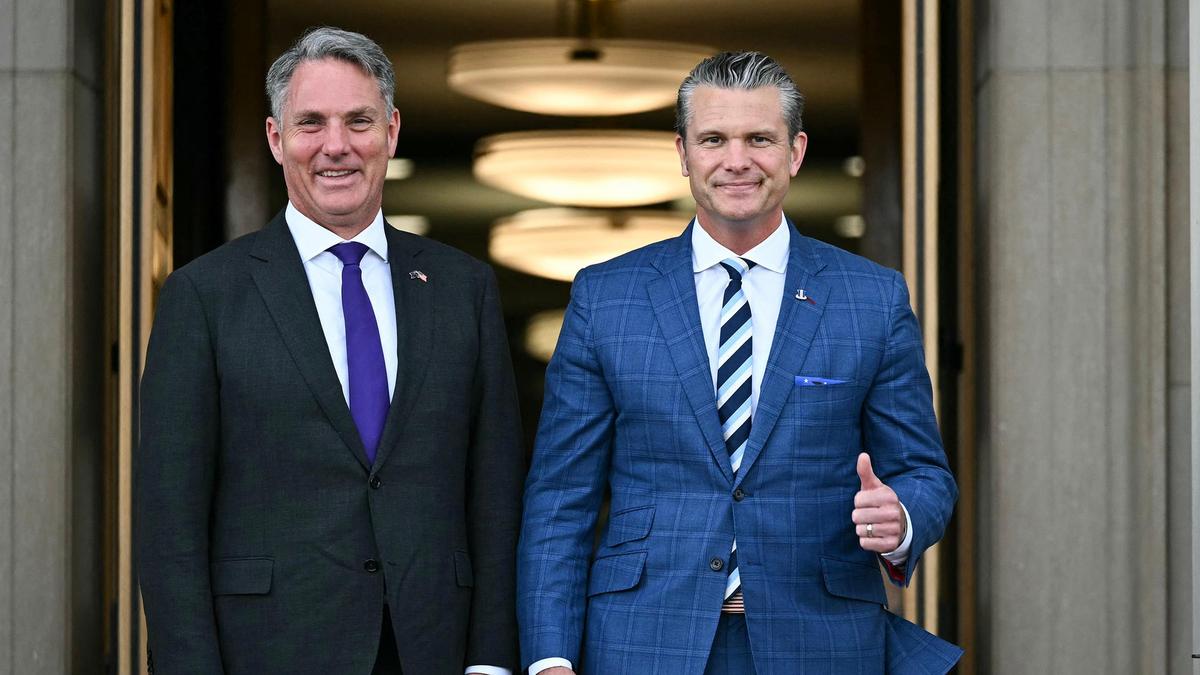
Pentagon boss Pete Hegseth has reminded his Australian counterpart Richard Marles that US allies must “contribute to the collective defence and invest in their own sovereign security” as both nations agreed to also accelerate joint military efforts.
Addressing the meeting, Secretary Hegseth declared both allies shared “a common picture of the complex threat picture in the world” and needed to ensure “our capabilities match and are complementary if and when something were to have to take place.”
Acknowledging the 75th anniversary of the ANZUS treaty, Mr Marles reminded his host that one million American service personnel used Australia as a base to project north and “win the Second World War in the Pacific theatre”.
“We live in a world which is increasingly challenging, where the strategic threat is growing, it’s not receding,” the defence minister told the US Secretary of War inside the Pentagon.
“In that context, the alliance that we have and the partnership that we have at a personal level, but very much between our two defence forces, our two countries, is as important and relevant today as it has ever been,” Mr Marles added.
In a statement issued after their meeting, the Pentagon revealed both leaders “agreed to accelerate force posture initiatives at Australian bases, bolster cooperation in combined logistics, and build greater interoperability through joint exercises”.
“They also discussed progress on defence industrial cooperation to enable shared capacity for guided weapons and next-generation capabilities,” the statement added.
Mr Marles later confirmed US force posture in Australia was discussed at the meeting but stopped short of saying whether there could be more American personnel deployed here, saying more details would be revealed at AUSMIN this year.
“As we speak, there are American personnel who are at HMAS Stirling who are there readying HMAS Stirling for the Submarine Rotation Force-West, which is on time and on track to occur from the end of next year,” Mr Marles said.
Asked whether the US had requested Australia to do more on military capability or spending, Mr Marles insisted his Government had allocated an additional $117 billion into the 10-year time frame.
“In respect of defence spending, I mean, we have a good story to tell here, and that comes from what we announced in 2023, 24, 25 and 26 — four successive years of announcements — in respect of increases in defence spending,” he told reporters.
“That we now have defence spending at 2.8 per cent of GDP by the NATO measure puts us ahead of most NATO countries, with the exception of the Nordics, the Baltics, Poland.”
During the meeting both defence ministers discussed progress on AUKUS, particularly joint efforts to improve the industrial base in the United States to allow the sale of second-hand Virginia-class submarines to Australia in the 2030s.
“We’re actually really confident about the progress of it. That that’s all moving at a pace, and so we are confident that the conditions will be met, which will enable Australia to acquire those Virginia class sufferings in the early 2030s,” Mr Marles said.
He also rejected suggestions that he had done “further cleaning up” after his colleague Defence Industry Minister Pat Conroy suggested in July that the planned rotation of US submarines in Western Australia could end in 2032.
This week’s meeting between Secretary Hegseth and Minister Marles coincides with the final hearings of a public inquiry into the AUKUS project being run by critics of the $368 billion plan for Australia to acquire nuclear-powered submarines under a partnership with the US and UK.
While in San Francisco earlier this week, Mr Marles also met with some of the world’s leading technology companies, including Anthropic, OpenAI, Microsoft and Google, as the Government pushes to attract US investment into Australian-based data centres.
Get the latest news from thewest.com.au in your inbox.
Sign up for our emails