
Advertisement
You have reached your maximum number of saved items.
Remove items from your saved list to add more.
As a budding art historian, Kim Sajet could hardly have imagined that one day she’d come up against the fury of the president of the United States. But when Donald Trump returned to power last year, primed for his war on “woke”, among his primary targets was America’s grand Smithsonian Institution, the world’s largest museum network, with collections covering art, science, history and culture. His opening strike was against the Melbourne-raised Sajet, then director of the Smithsonian’s National Portrait Gallery, and the first woman in the role since the gallery was founded in 1962.
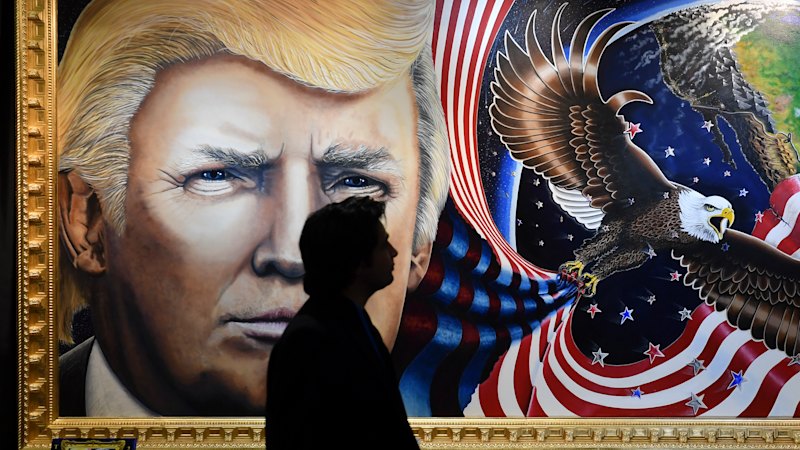
Trump wanted her gone. He called her “highly partisan” and “a strong supporter” of diversity, equity and inclusion programs. Vice President JD Vance, with typical eloquence, branded her a “left-wing crazy person”. Among the reasons for their displeasure were that Sajet had donated to the Democrats in the past, and in 2016 had rejected a pro-Trump portrait by New York artist Julian Raven. The painting, titled Unafraid and Unashamed, was exceedingly kitsch and ridiculously large: 5 metres wide, 2.5 metres tall, and weighing 113 kilograms. According to Raven, Sajet told him it was “no good”. It seems a fair judgment.
When I meet Sajet on a video call in late July, the Trumpian badgering is happening all over again, this time to another Smithsonian director.
“It feels like the longest week in history,” Sajet tells me. She’s been watching her former colleague, Anthea Hartig, director of the National Museum of American History (also the first woman in that role), being grilled on Capitol Hill. The spectacle has inevitably stirred up unpleasant memories. While the MAGA mob has lavished special attention on Sajet and Hartig, the Smithsonian leadership as a whole has been denounced by the Trump administration as being captured by a “radical, activist ideology”.
Sajet didn’t attend Hartig’s congressional hearing in person: “I just watched [online], like the rest of us with incredulity.” She hadn’t faced Congress herself – she was simply “fired” by Trump in a post on Truth Social in May last year (in reality, he had no authority to do so).
These extraordinary experiences have made her uniquely placed as a keynote speaker at the upcoming International Congress of Maritime Museums in Sydney. Her topic, fittingly, is courageous leadership. Daryl Karp, the director and CEO of the Australian National Maritime Museum, points to Sajet’s “exceptional mix of global museum leadership, bold thinking and a powerful commitment to opening cultural institutions to the communities they serve” as the reason she was chosen to address the congress.
Advertisement
As it happens, Trump wasn’t able to fire Sajet but the political pressure was so intense that she chose to walk away for the sake of the institution and its staff. “I wanted to see if we could just take me out of the story, because no one institution is represented by a single individual,” she says. “I was fairly confident that I could get another job, and I believed that it would defuse the situation.”
Sajet is now director of the Milwaukee Art Museum, a position she has held since September last year. Her resignation did not, in the end, spare the Smithsonian. In a conspicuously symbolic move, the Trump administration chose this year’s Independence Day to release its 162-page report, Saving America’s Story, which documents in weirdly forensic detail the Smithsonian’s supposed transgressions. The report takes issue, for example, with an exhibition titled Girlhood (It’s complicated) which it says encouraged girls to “upend” traditional femininity.
Trump furthermore ordered signs be put up outside the Smithsonian’s National Museum of American History warning visitors that its interpretation of history was ideologically tainted. Even by the president’s standards, the campaign against the Smithsonian has been relentless. As Sajet recently told The New York Times: “The president of the United States is spending his time going after a museum director? I would’ve thought he had more pressing matters to attend to.”
If anyone deserves the badge of courageous leadership, Sajet tells me, it’s Lonnie Bunch, the Smithsonian’s secretary, who oversees the entire organisation, and who with integrity and grace continues to contend with the administration’s interrogations and demands.
“Lonnie is trying to both stay true to the mission of the Smithsonian – which is the increase and diffusion of all knowledge, not some knowledge – while also being a good partner to government and Congress who make it possible for people to go to the Smithsonian for free.”
Even beyond the scope of Trump, cultural organisations are feeling the pressure from multiple flanks in these fractured times, be it from governments, activists or artists urging their particular world view. Julian Raven, for example, sued the Smithsonian for rejecting his painting. (His lawsuit was eventually dismissed.)
Advertisement
Says Sajet: “I think the danger, and the thing that I worry about is, are we going to get different types of museums based on how they’re put together and where they are? Will there be museums that can be more adventurous than others depending on how they’re funded, where they’re located and what the structure of those institutions are?”
She cites Tasmania’s Museum of Old and New Art, privately funded by owner David Walsh, which she visited a couple of years ago: “It was a wonderful experience, but honestly they can almost do whatever they want.”
I wonder, then, does one need more courage than ever to be a museum leader in the public sector today?
“Yes, I think so,” Sajet says. “I think the job has changed dramatically from what happened in previous generations … the job has always been a very big one … but the issue of courage didn’t come into it in the same way.”
Sajet’s advice to cultural leaders navigating these combative times is to understand clearly the mission of the institution they work for, the values by which that institution is governed, and how these square up against their own principles.
“I think you need to have your personal set of values, and ideally, they’re the ones that align with your institution, otherwise you shouldn’t be there,” she says.
Advertisement
She lists her own core beliefs: that knowledge is better than ignorance, that one inspired person can change the world, and that evidence-based history is important.
But the very notion of “evidence-based history” is contentious – on the one hand, you might be dealing with a vengeful, reality-bending president such as Trump, and on the other, with protesters insisting there’s no such thing as neutrality and demanding that your organisation take a position on the issue du jour.
In July last year, the National Gallery of Victoria was forced into lockdown after hundreds of pro-Palestine protesters marched to the gallery objecting to its high-profile Jewish donors, John and Pauline Gandel.
Who, then, would want to be a museum leader right now?
“Well, I think, get in line, because who would want to be a university president, who would want to be the editor of a major national newspaper, any kind of thought leadership right now is very fraught … there’s this real sense that everybody has an opinion and it very much is up to leadership to what extent they’re going to take on everybody’s different takes on everything,” Sajet says.
While she was never entirely clear why Trump took such a dislike to her, New York Times journalists Maggie Haberman and Jonathan Swan devote an entire chapter in their book, Regime Change: Inside the Imperial Presidency of Donald Trump, investigating the machinations that led to Sajet’s resignation. They write that Trump hated the photograph of him that was hanging in the National Portrait Gallery, and was particularly incensed by the accompanying label, which noted that he’d been impeached twice. “My understanding is that what was recounted in the book is actually quite accurate,” Sajet says.
Advertisement
Born in Nigeria to Dutch parents, Sajet grew up on Victoria’s Mornington Peninsula, studied at the University of Melbourne, and at 24 became the youngest person to head the Mornington Peninsula Regional Gallery. In the early 1990s, she was director of the Monash Gallery of Art (now the Museum of Australian Photography). She hasn’t lost her Australian accent (it occasionally slips into an American twang), even though she’s been living in the US for almost 30 years.
“It was only supposed to be temporary because my husband wanted to do his PhD at Temple University (Philadelphia), and we’re like, OK we’ll be there for a few years and go back, and then I got a job and the job led to another job, and before you know, the second kid is born here and you’re like, wow.”
Following decades in the museum sector, including 12 years at the Smithsonian, Sajet has come to the conclusion that the “blockbuster” has had its day. She points to her time as director of corporate relations at the Philadelphia Museum of Art, a role she held from 1998 to 2001.
“We would justify our existence to the city and the tourism industry by how many tourists came, how many hotel rooms were booked, how many books were sold in the bookshop, how many memberships were sold – it becomes this economic driver.
“And there was definitely a moment when many museums fell into that so that you were just constantly on the blockbuster gerbil wheel, so it was Monet, Van Gogh, Cezanne, each moment had to be better than the next moment … you’re just constantly chasing one great hit after the other,” she says.
Advertisement
In Victoria, the Melbourne Winter Masterpieces series was launched in 2004 precisely to stimulate the tourist economy in the slower winter months. According to Creative Victoria, it has generated more than $700 million in economic impact and attracted more than 8 million visitors. This year’s iteration features the luxury jewellery brand Cartier, in an exhibition criticised for being overtly commercial and lacking in curatorial depth. Sajet hasn’t seen the show but credits director Tony Ellwood for turning the NGV into one of the most successful museums in the world.
In Sydney, the blockbuster model is in full swing. The NSW government’s $40 million Create NSW Blockbusters Funding agreement has helped bring exhibitions including Kandinsky and Matisse: Life & Spirit to the Art Gallery of NSW, and Ramses & the Gold of the Pharaohs to the Australian Museum. Ramses was one of the most successful exhibitions in NSW history, attracting more than 508,000 visitors and contributing more than $57 million to the NSW economy.
But as the costs of staging exhibitions – insurance, packing, crating, shipping, marketing – have spiralled post-COVID, the blockbuster model is out of reach for many museums, Sajet says, and there needs to be another way of valuing what they do.
“I’m not against the blockbuster – I just think using it as the basis of your argument for a successful museum is fraught,” she says.
Sajet swivels on her office chair and reaches for a book – Art Cure: The Science of How the Arts Saves Lives by Daisy Fancourt – in which the author, a professor of psychobiology and epidemiology at University College London, makes a scientific case to show how participating in the arts and making art is beneficial to one’s mental and physical health. Fancourt describes art as the “forgotten pillar of health”, as important as diet, sleep, exercise and being in nature.
“So I think we need to be turning away from this idea of museums as entertainment … it’s all about the swanky party and the wealthy people coming in … and getting back to the original idea [of the museum] which is to learn from our natural and man-made world in order to pass on knowledge for a better future,” Sajet says.
Even so, when she was director of the National Portrait Gallery, she initiated a “gala”, with the inaugural event in 2015 raising $US1.74 million. Over the years, honourees and presenters have included Aretha Franklin, Spike Lee, Robert Redford, Anna Wintour, Jeff Bezos and Michelle Obama.
“And it was extraordinarily successful, but it also in its own way became really challenging, because you’re always like, well, who’s the next great person you’re going to have?” Sajet says.
She acknowledges, too, that it’s possible to have a transformative experience even with an exhibition that has people queuing around the block – as happened when the portraits of Barack and Michelle Obama (by artists Kehinde Wiley and Amy Sherald respectively) were unveiled at the National Portrait Gallery in 2018. Writing in The Atlantic magazine in 2019, Sajet described the phenomenon as a “secular pilgrimage”.
I’m curious about whether Trump’s portrait also elicited the blockbuster effect.
Sajet responds with well-honed diplomacy: “Ah … well … there were just different lines, let’s say.”
Kim Sajet will give her keynote address at the International Congress of Maritime Museums on September 14 at the Australian National Maritime Museum.
Want more Spectrum stories?
- In case it was ever in doubt, Jacob Elordi is a ‘dog person’
- Fetching performances: Hollywood’s best canine stars
- Em Rusciano thought she was a ‘broken, lesser human’. Her autism diagnosis changed everything
- VV-Ace proves Melbourne’s north is Australia’s new hotspot for hip-hop
- Jem Cassar-Daley had to be bribed to sing with her famous dad – but not any more