
Advertisement
Washington: Australia and the US flagged further acceleration of America’s military presence in Australia following a meeting between the countries’ defence ministers – though they stopped short of saying it could mean more US troops stationed in Australia.
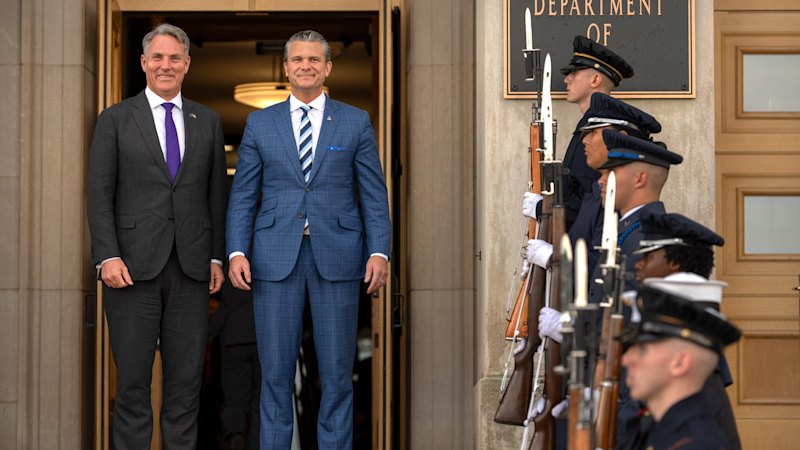
Deputy Prime Minister and Defence Minister Richard Marles met US Defence Secretary Pete Hegseth in Washington on Wednesday (US time), after which the Pentagon announced both leaders had “agreed to accelerate force posture initiatives at Australian bases”, among other things.
That is on top of the rotation of US nuclear-powered submarines through HMAS Stirling near Perth from next year under the AUKUS agreement, which will see as many as 2300 American troops deployed there.
Marles confirmed US force posture in Australia was discussed at the meeting, but would not provide details. Announcements would be made at an Australia-US ministerial (AUSMIN) meeting later this year, he said.
Advertisement
“American force posture in Australia is growing. That’s across all the domains,” Marles told reporters. “We think that’s really important in terms of providing deterrence in the Indo-Pacific, providing stability and peace in the Indo-Pacific. That’s very much in Australia’s national interest.”
Force posture expansion could involve additional joint military exercises and upping co-operation on logistics, not necessarily an increase in US troops.
In a sign that the administration had not given up its long-standing call for Canberra to increase spending on defence, the Pentagon also said Hegseth “emphasised the need for capable allies to contribute to the collective defence and invest in their own sovereign security”.
However, unlike previous occasions, the Pentagon’s summary did not include an explicit request that Australia increase spending to 3.5 per cent of gross domestic product.
Advertisement
Marles said Australia had lifted expenditure four years in a row, and it was among the highest in the region. “We have a good story to tell … we understand the American position, but I think that is a story that is well received.”
During a whirlwind visit to Washington, the deputy prime minister also met his US counterpart, Vice President JD Vance, at the White House, and President Donald Trump’s deputy chief-of-staff Stephen Miller. He now heads to the United Kingdom for further meetings about the AUKUS pact.
Marles’ encounter with Hegseth appeared friendly, with the Australian patting his American counterpart on the back as they walked into the Pentagon.
It marked a different tone to the diplomatic stoush this time last year, when – amid an ongoing review of AUKUS – the Pentagon initially described their meeting as a “happenstance encounter”.
Advertisement
This year’s meetings came on the 75th anniversary of the ANZUS defence treaty between the US, Australia and New Zealand. A poll this week by the United States Studies Centre found 68 per cent of Australians believed the US would come to their aid if attacked by China, down from 84 per cent in 2023.
Pentagon policy chief Elbridge Colby, who attended the meeting with Hegseth and Marles and was previously an AUKUS sceptic, marked the anniversary with a social media post praising the alliance as stronger than ever.
“Australia and the United States have taken great strides over the last year and a half to strengthen collective defence and deterrence by denial in the Western Pacific, but we both know we must move faster and do more to meet the moment,” Colby said.
The signal that the US intends to keep growing its military posture in Australia comes as a public inquiry into AUKUS, led by opponents of the pact, hears evidence that the deal risks making Australia more of a target.
Advertisement
Asked about that, Marles said the US-Australia alliance provided for peace and stability in the region.
“That’s what underpins the security of Australians,” he said. “This work is profoundly important.”
Get a note directly from our foreign correspondents on what’s making headlines around the world. Sign up for our weekly What in the World newsletter.
You have reached your maximum number of saved items.
Remove items from your saved list to add more.
More:
- Foreign relations
- USA
- Richard Marles
- Donald Trump
- AUKUS
- Defence
- Trump diplomacy
- Trump’s White House
- Defence spending
Michael Koziol is the North America correspondent for The Age and Sydney Morning Herald. He is a former Sydney editor, Sun-Herald deputy editor and a federal political reporter in Canberra.Connect via X or email.AdvertisementAdvertisement