
Advertisement
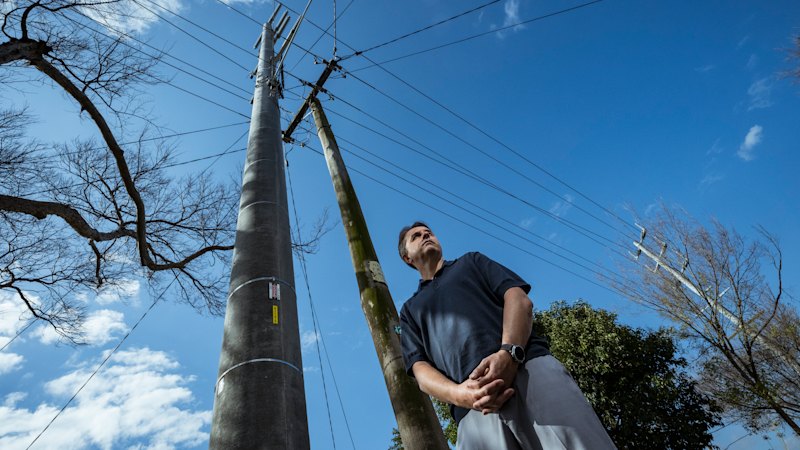
One of the nation’s biggest power companies has paused the rollout of five-storey power poles through suburban Melbourne streets following a fierce community blockade that has opened a fresh front in the fight against the data centre boom.
Electricity distributor Jemena’s retreat comes as the state government prepares new rules to control development of high-energy data centre projects across Victoria in response to rising opposition that has also seen the federal government flag new regulations for the centres.
In the face of resistance from Yarraville residents, which has included parking cars to block work trucks and filling in excavation holes under the cover of darkness, network operator Jemena confirmed on Wednesday it would pause works to replace eight-metre-high wooden poles carrying about 400 volts with 66,000-volt concrete structures towering up to 15 metres along suburban streets.
Advertisement
In its note to residents announcing the move, the company did not say when it would restart works or what it would do during the pause.
The sudden halt comes as the Carroll government next week prepares to consider statewide restrictions on data centres, seeking to balance rising public anger over the construction of industrial infrastructure required to feed the artificial intelligence boom without strangling commercial investment.
On Monday, the state cabinet is set to discuss options to reduce residential conflicts with data centres. Premier Ben Carroll on Wednesday said data centres provided “an enormous 21st-century infrastructure”.
“Equally, though, we also know that they do need guardrails,” Carroll said. “We need to make sure that there’s a community licence and a social licence for [data centres], and that they are in the locations that deliver the best value and amenity for Victorians.”
Advertisement
Carroll said Artificial Intelligence Minister Anthony Carbines was working on a policy paper and would bring something to cabinet, and announcements were expected in the “very near future”.
Some MPs have pushed for a moratorium on data centre projects amid community campaigns in their electorates during an election year.
Among them is Footscray MP Katie Hall, who in August told a protest there should be a pause on their development.
Jemena’s rollout pause follows days of resident action in one Yarraville pocket where the five-storey-high poles were installed at one end of the street with more due to be installed on Tuesday.
Advertisement
To discourage the works, residents parked their cars in front of planned excavation pits – including one resident who parked a large truck and trailer in front of a pit. Residents co-ordinated on a street WhatsApp group to ignore early-morning contractor door-knocks on Tuesday.
A resident had stuffed green waste and other materials into one pit’s foundation holes to prevent drilling.
Early on Wednesday, Jemena contractors filled holes they had dug the week before with crushed rock, which Jemena said was a temporary safety measure.
Resident Milco Bogoevski said neighbours had organised direct action after spotting the concrete pillars in adjacent streets.
Advertisement
Driving home a fortnight ago he realised the power lines were progressing into his street.
“I thought, ‘Holy crap, look at these giant things,’” Bogoevski said. “I started piecing things together, and realised the path for these enormous things coming down towards our street.”
Contractors had distributed flyers in April that framed the installations as general grid maintenance to ensure local reliability.
Another resident, Katrina Andrews, said those initial notifications misled the community.
Advertisement
“This isn’t routine pole replacement, and that letter had nothing to do with the scale of the infrastructure they’re putting in,” she said.
Bogoevski said residents in his street were now printing flyers to alert surrounding streets to adopt the same blockading tactics.
“This is coming your way unless you do something about it and stand up,” Bogoevski said.
Jemena planning documents show the multimillion-dollar line overhaul is to accommodate 27 proposed data centres across Footscray, Yarraville and Brooklyn – although the most urgent requirement for the upgrade is to increase power to NextDC’s massive facility in West Footscray.
Advertisement
Victorian Energy Minister Jaclyn Symes’ office said decisions about the upgrade and maintenance of the network were matters for the Australian Energy Regulator.
Jemena issued an apology to residents on Wednesday vowing to improve its communication.
“We’re taking this seriously and are reviewing our communication and engagement approach to ensure our customers have a clearer understanding of what is happening and what to expect next in the future,” it said.
A spokeswoman said replacing an existing pole, including with a taller pole, did not require new planning or regulatory approvals as the existing network assets in the corridor were subject to the relevant property rights, easements, licences and statutory powers.
Advertisement
Maribyrnong City Council acting chief executive Mike McIntosh said the council had no power to block or regulate the installations.
Jessica Marsh, a community independent candidate for Footscray in the upcoming state election who lives in the affected area, said residents were bearing the brunt of a rapid corporate expansion.
Jemena apology issued on Wednesday
“We know customers rely on us to provide clear, timely information, and in this instance our communications could have been improved. We’re taking this seriously and are reviewing our communication and engagement approach to ensure our customers have a clearer understanding of what is happening and what to expect next in the future.” – Jemena spokeswoman
“Residents woke up to these imposing concrete monoliths appearing directly outside their homes with virtually no warning,” Marsh said.
“This infrastructure isn’t being built to improve household supply; it’s being driven by the relentless power demands of commercial data centres being fast-tracked through the west.”
Advertisement
Hall, the local Labor MP, has faced resident fury over the power poles, in some instances suggesting they contact Maribyrnong Council.
On Wednesday, she said she had not been briefed on the installation before the project started but had advocated for affected constituents by raising questions with Jemena and Symes.
“The engagement process from Jemena’s perspective has been woeful,” Hall said.
Dylan McConnell, an energy systems researcher at the University of New South Wales, said typical street power poles were usually far lower voltage than those being installed in Yarraville and West Footscray.
Advertisement
“You need thicker wires if you’re going to be putting more power through it – it’s why you need bigger infrastructure as you’re carrying thicker wires,” he said.
He said the undergrounding of cabling, which residents in the area are calling for, could be done but came with a cost premium.
The debate triggered by power sources for data centres “is happening across the world”, he said and was the direct opposite of what had played out decades ago when power first came to many neighbourhoods.
“With that great electrification, everyone wanted transmission lines – now everyone doesn’t want them,” McConnell said.
Advertisement
“There is a long-standing tradition – Brunswick Terminal Station, VNI West [Victoria to NSW Interconnector West], and many others – where building new poles and wires is hard. And then you throw in this politically contentious infrastructure on top of that, and it’s a whole new level.”
Three sources familiar with the state government’s thinking, speaking anonymously to detail confidential discussions, said the government was considering ways to limit the presence of data centres in residential areas and required more consultation before their approval.
One option under consideration was requiring data centres to apply for a development licence through the Environment Protection Authority, which requires a greater focus on the health and human impacts.
Most data centres are eligible for approval through the fast-tracked Development Facilitation Program, and introducing an EPA requirement would probably lengthen the approval process.
Advertisement
Another option, one source said, was earmarking specific areas for data centres such as industrial precincts or special zones similar to the renewable energy zones set aside for solar and wind farms.
Start the day with a summary of the day’s most important and interesting stories, analysis and insights. Sign up for our Morning Edition newsletter.
You have reached your maximum number of saved items.
Remove items from your saved list to add more.
More:
Clay Lucas is an investigative reporter at The Age who has covered urban affairs, state and federal politics, industrial relations, transport, health and aged care. Email him at [email protected] or [email protected], or via Signal +61439828128.Connect via X, Facebook or email.Kieran Rooney is a Victorian state political reporter at The Age.Connect via email.AdvertisementAdvertisement