
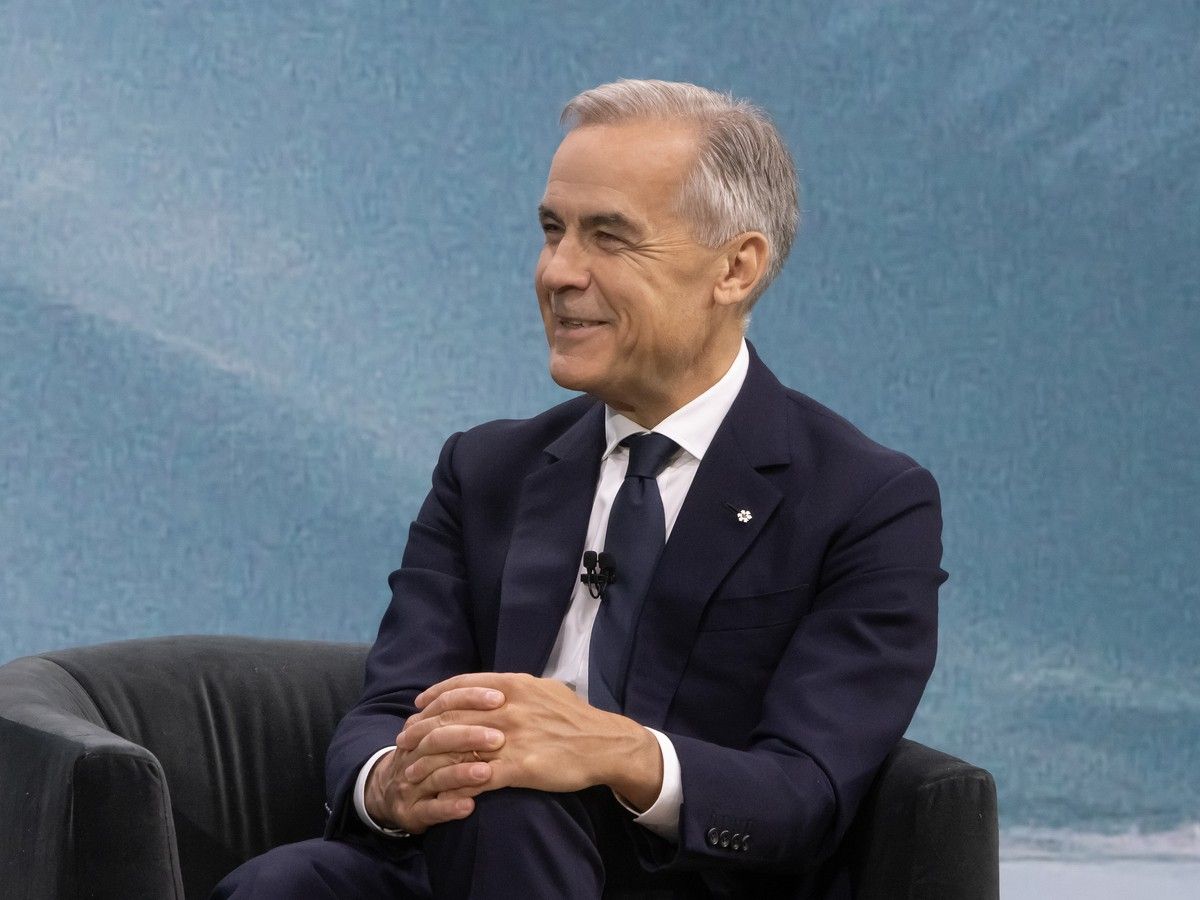
Article content
OTTAWA — Prime Minister Mark Carney has suggested that deeper integration and a “unique alliance” between Canada and the European Union (EU) could be the answer to the souring of the Canada-U.S. relationship amid the trade war with U.S. President Donald Trump.
Sign In or Create an Account
or View more offersArticle content
“We’re not looking to become a member of the European Union,” he said on Sunday.
Article contentArticle content
“What we are looking — and will begin discussions for — [is] a unique alliance with the European Union. We share the same values, we have the same priorities, and we have very complementary strengths.”
Article content
Story continues below
This advertisement has not loaded yet, but your article continues below.
Article content
Strategically, Canada offers Europe a like-minded G7 partner with natural resources, defence capacity, and similar values — as well as a shared interest in being less dependent upon an increasingly unpredictable Washington. But the policy content of Carney’s proposal remains undefined — and scholars on EU law say that the EU has no ready-made legal route for granting Canada a membership-like status.
Article contentArticle content
Under Carney especially, Canada is a “key player” and “highly respected,” said Cambridge professor Catherine Barnard, who specializes in EU law.
Article content
But trade watchers are also skeptical that Carney’s gambit for a “unique alliance” will lead to a new formal, membership-like arrangement anytime soon. The first hurdle is that no such EU category currently exists.
Article content
When asked what a “unique alliance” might look like, Barnard said nobody knows and pointed to the difference between the political and legal dimensions.
Article content
“The EU wants to be close to Canada and supportive of Canada — that’s the political side,” she said.
Article content
Legally, however, “there is just no possibility (of that) as the EU stands,” she said, pointing to the Michel Barnier staircase of the available models. At the top is full membership, followed by looser forms of economic integration — European Economic Area (EEA) participation, Swiss-style bilateral accords, customs-union arrangements, and free-trade agreements. Canada is already on the bottom step with the Comprehensive Economic and Trade Agreement (CETA), an EU-Canada free-trade agreement provisionally in place since 2017.
Article content
Story continues below
This advertisement has not loaded yet, but your article continues below.
Article content
Simon Usherwood, professor of politics and international studies at The Open University, also pointed to the lack of “off-the-shelf relationships with other countries.”
Article content
While Carney has said he’s not seeking it, full membership would simply not be feasible under the EU treaties as they stand.
Article content
“People jokingly say, ‘Oh, yes, Canada could join, join the EU,’” Barnard said. “Well, legally that’s impossible because Article 49 of the treaty says you’ve got to be a European state, and Canada is not that.”
Article content
Even if the focus is just on a bespoke partnership, the political room for this remains uncertain as it’s not just a question of what Canada hopes to obtain but also what privileges — and demands — the EU is willing to extend to Ottawa.
Article content
The EU could, in theory, devise a new arrangement for a country it wants to draw closer. But Barnard said Brussels would be wary of creating a precedent because any generous concession to Canada could prompt Britain, Switzerland, the EEA states, Ukraine and other countries outside the bloc to demand comparable treatment.
Article content
Grégoire Roos, director of the Europe and Russia and Eurasia Programmes at Chatham House, was more enthusiastic about institutional innovation and said the debate about Canada comes at an interesting time — when the EU is considering whether to create more flexible, intermediate forms of association.