
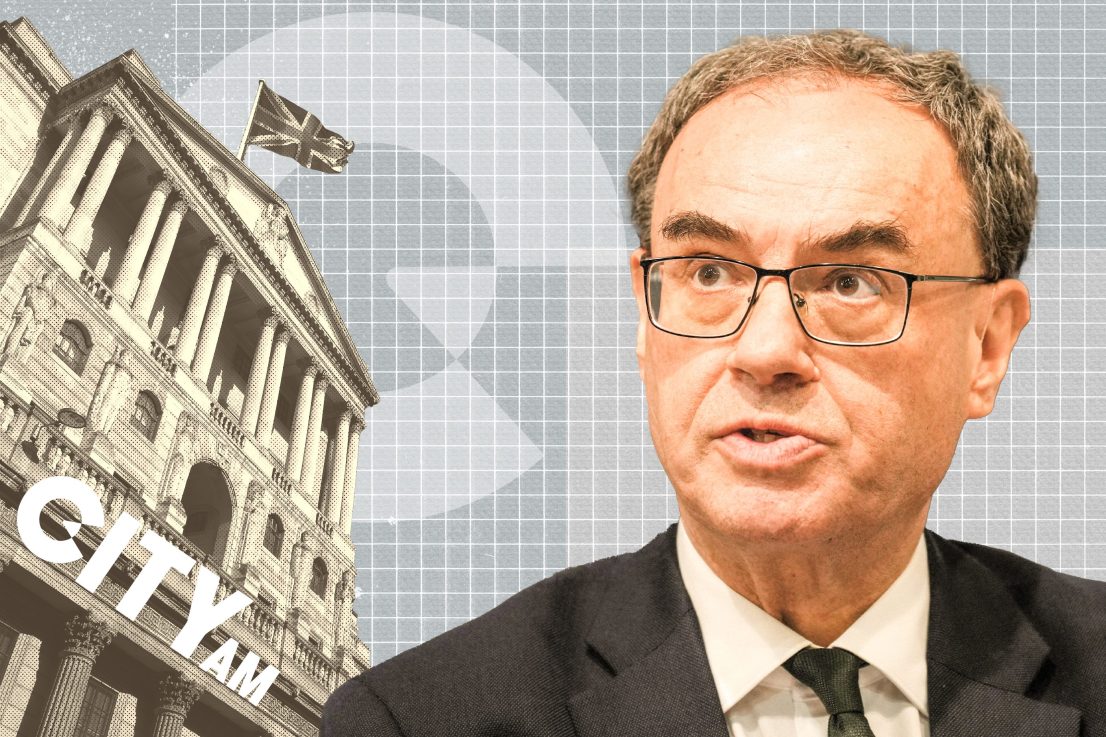
The Bank of England has been urged to hold interest rates even as inflation is set to peak higher than previously expected due to the continuation of the Iran war, City AM’s Shadow Monetary Policy Committee has said.
The Bank should leave interest rates unchanged at 3.75 per cent, according to most top economists in the mirror organisation, although some warned the case for waiting on a hike is “thin”.
City AM’s Shadow MPC was split 6-3 among those calling for no change in interest rates and those calling for monetary policy to be tightened.
Three economists on the nine-member Shadow MPC – professor Jagjit Chadha, Julian Jessop and Anna Leach – said the Bank should raise interest rates by 25 basis points.
Most economists, who participated in the exercise independently of their organisations, agreed the decision would be finely balanced.
Hold interest rates yet send ‘hawkish message’
Barclays chief UK economist Jack Meaning said he believed inflation to peak higher than previously thought in the coming months as oil prices have risen back to levels seen in May, two months into the Iran war. On Tuesday morning, the Brent crude oil price, which is an international benchmark, stood at $106 per barrel compared to a figure as low as $72 in early July.
The conflict between the US and Iran has spread across the Gulf region, hitting trading flows of critical supplies around Saudi Arabia. Shipping around the Strait of Hormuz and Bab el Madeb Strait, which is linked to the Red Sea, have dramatically slowed following attacks by Iran-backed militias.
Meaning said he would leave interest rates unchanged as there was little sign of second round effects, which can take place when higher prices push up wages, leading to a spiralling effect.
However, he said the Bank should retain a “hawkish message” that signals interest rate hikes may be on the horizon.
Traders have taken a pessimistic view on inflation as two-year gilt yields imply there could be as many as four interest rate hikes.
In the Bank of England’s adverse scenario, inflation could top four per cent around the middle of next year, more than double its own two per cent target.
Jessop said an interest rate hike would “safeguard credibility” and reduce the risk of further interest rate hikes hitting the UK economy in the next few months.
“The argument that policymakers need to look past “temporary shocks” is wearing increasingly thin,” he said.
Anna Leach – Institute of Directors, chief economist
Vote: Raise 25 basis points
Leach said her vote came down to a “close call”. Her decision was determined by inflation remaining above the two per cent target for two years, price expectations remaining elevated and business costs squeezing margins for firms.
She said “an insurance increase in interest rates” was necessary as there were “signs that these currents are shifting”, even as the labour market remains subdued.
“The risk of a small rise now that is reversed later is less than waiting too long to raise rates – particularly given the MPC’s track record of the past few years.”
Ben Ramanauskas – economist
Vote: Hold
Ramanauskas said weaknesses in the labour market would be exacerbated if interest rates were increased.
He added that low private sector regular pay growth was “comfortably below levels consistent with above-target inflation” and lessened the risk of a wage-price spiral.
The energy price shock has also not shown signs of passing through to wage settlements or services inflation while money supply growth offered “no urgent case for tightening”
“Acting now, in the face of a supply side shock, against a soft labour market and with contained pass-through, risks overtightening and crushing economic growth,” he said.
He added that the Bank should signal it would be prepared to act if data signals shift over the next six weeks.
Jack Meaning – Barclays chief UK economist
Vote: Hold
Meaning said the continuation of the war in the Middle East posed risks for inflation to be “stickier” though there was “little evidence of second round effects or broader inflationary pressures”.
He said the Bank should hold interest rates in order to balance the risks of higher price rises driven by energy against low amounts of inflationary pressures across the economy.
“For the Bank of England, messaging this against the backdrop of a market that prices a material hiking cycle will be a difficult path to navigate at this meeting,” he added.
Jagjit Chadha – professor of economics, University of Cambridge and former NIESR director
Vote: Raise 25bp
Chadha said that the Bank’s poor performance at hitting the inflation target showed that it needed to “re-state” its credibility for maintaining price stability.
He suggested the Bank was too focused on “over-engineering, or discussing, quarter point movements in response to high frequency and noisy data in a risky world”.
Key targets on inflation expectations have not been met and remain too high, he added.
“Alongside a firmer stance against inflation, communication must be more consistent about the need to act with vigilance against inflationary impulses and not to look for excuses to cut rates. Drop fine tuning – the models are not good enough.”
Julian Jessop – economist
Vote: Raise 25 basis points
Jessop said a small interest rate rise would “reduce the need for larger increases later” should inflation rise far higher than most economists expect.
He said that the Bank faced a “finely balanced decision” and that there was no clear sign that energy prices were leading to second round effects or adding to expectations.
Money growth was also “contained” yet Jessop said high levels of activity and some stabilisation in the jobs market “lessens the risk that a pre-emptive rate rise would push the economy into an unnecessary recession”.
“Inflation has been above two per cent for most of the last five years and is unlikely to return to target for at least another year,” he said.
“The argument that policymakers need to look past ‘temporary shocks’ is wearing increasingly thin.”
Kallum Pickering – Peel Hunt, chief economist
Vote: Hold
Pickering said there were “disinflationary” effects in the underlying balance of demand and supply within the UK.
He said that nominal spending and money supply was “not overheated” while private wage momentum had been slowed by a weakened jobs market.
The Peel Hunt economist added that rising mortgage rates, “subdued” growth in credit and high nominal borrowing costs did not resemble conditions in 2022 when a sharp rise in energy prices pushed inflation to as high as 11 per cent.
“Rate rises cannot produce barrels of oil. The cost of an energy shock must fall on either prices or output, and with second-round effects so far subdued, the lesser evil is to tolerate a temporary overshoot rather than inflict further damage on an already weak economy,” Pickering said.
“The Bank should hold, stay data-dependent, and tighten only if genuine domestic inflation persistence emerges.”
Katharine Neiss – PGIM Fixed Income chief European economist
Vote: Hold
Neiss said she would back no change in interest rates although there should be a “bias to tighten”
A hike in interest rates would still protect spending levels in the UK economy as growth had shown “greater resilience”. Last week, the Office for National Statistics stunned economists as it said there was growth of 0.4 per cent in July, compared to some predictions suggesting no change in GDP.
Neiss also said there were “green shoots” in the labour market.
The change in activity meant interest rates could “go higher to rein in inflation without unduly harming the real side of the economy”.
Ruth Gregory – Capital Economics deputy chief UK economist
Vote: Hold
Gregory said inflation was nearing the “adverse” scenario laid out by the Bank in July, which said inflation would jump over four per cent rather than a peak of 3.2 per cent in its main forecast.
She said an “insurance” hike could help prevent higher inflation from becoming embedded in the UK economy although the case for a hike was “not clear-cut” due to weaker growth data expected later this year and a “loose” labour market.
A slowdown in the annual growth rate of money supply also suggests conditions are “not conducive to a long period of elevated inflation”.
“Monetary policy remains restrictive and the rise in market interest rate expectations has already tightened financial conditions,” she said.
Vicky Pryce – Centre for Economics and Business Research chief economic adviser
Vote: Hold
Pryce suggested that elevatd government bond yields and the Bank of England’s quantitative tightening programme, which involves selling gilts held on the central bank’s balance sheet, combined to amount to “significant monetary tightening”.
An increase in interest rates would suggest that the Bank was “more worried over inflation than before and send those yields even higher, rather than giving any comfort to markets”, according to Pryce.
“The pick-up in inflation continues to be due to supply issues created by uncertain geopolitical developments rather than rises in demand and wage push, despite a bounce-back in GDP in June and July.”