
On 10 June 2004, a legally held, 12-gauge, Winchester pump-action shotgun was reported stolen from a house in Co Galway.
So began an extraordinary journey that took the gun from a locker in the back kitchen of a Co Galway home, to identified individuals in Co Wexford, and then in 2007 to a farmhouse in Co Kildare, where, in 2009, gardaí conducting a drugs raid seized it as an illegally-held sawn-off weapon.
It then made its way to garda headquarters for forensic examination, before being brought to Kildare Garda Station in 2010. After that, there was no recorded sighting of it for 13 years, until it turned up again in August 2023, in the hands of criminals arrested by gardaí in Mullingar.
For 13 years, garda management did not know the shotgun was missing; the discovery was only made when gardaí seized the gun in August 2023 and discovered it had been seized before.
The journey of the Winchester highlights failures of storage and security of seized weapons linked to crime in one garda station and district, Kildare, but the public has been given no assurance that it is not part of a wider problem in garda stations and storage facilities across the State.
Indeed, the report which attempts to trace the journey of the Winchester is an internal garda document, marked ‘Secret’.
Similar poor storage and security of firearms stocks at Garda headquarters as those found in Kildare Garda Station are amongst revelations in an RTÉ Investigates programme to be broadcast on Wednesday, 16 September at 9.35pm on RTÉ One.
2009 seizure
On 14 October 2009, Kildare gardaí raided a house in a planned drugs search operation. Aside from a small quantity of cannabis resin, they seized five unlicensed guns and ammunition.
The previously-stolen Winchester shotgun, which was sawn off, was seized in the raid along with four other guns — two bolt-action rifles, one of them sawn off, and two pellet guns. Also seized were 72 rounds of different calibre ammunition.
On 15 October 2009, the seized items were brought to the Garda National Technical Bureau (GNTB) for technical examination.
The Winchester was identified as the stolen 2004 Galway gun, with the same serial number. Later, a full technical examination confirmed that the firearm functioned as designed, though it had been sawn off.
A man arrested at the house in the 2009 raid admitted buying the stolen Winchester from two men in Co Wexford around two and half years prior to October 2009.
The man subsequently pleaded guilty to possession of five unlicensed firearms and received a two-year suspended sentence in June 2011.
Because he pleaded guilty, there was no trial, so no need for retention of the guns as exhibits to be physically produced in the Circuit Court.
On 10 Sept 2010, Kildare gardaí collected the exhibits, including the Winchester pump-action gun, from the GNTB, and brought them back to Kildare garda station.
The Winchester was last accounted for in a record at Kildare Garda Station on 27 September 2010. It was an exhibit, held in an exhibits bag.
Between 28 Sept 2010 and 9 Aug 2023, there was no record or recorded sighting of the Winchester.
But then, the Winchester showed up in criminal hands again.
2023 Fleadh Cheoil seizure
On the evening of 9 August 2023, as crowds moved through Fleadh Cheoil na hÉireann festivities in Mullingar, detectives on mobile patrol were attempting to quell a violent family feud.
They had just been speaking to a group of men on one side of the feud and were driving on the street when they saw a car approaching them belonging to members of the rival gang in the feud. Two men known to gardaí were in the car.
The detectives followed the car, which began driving dangerously through an area full of Fleadh goers.
One of the men then jumped from the car to flee, carrying something in a plastic shopping bag. When they apprehended him, gardaí found the Winchester in the bag, along with shotgun cartridges.
The two men were arrested and later convicted. At a court hearing in December 2024, the presiding judge was reported as saying he shuddered to think of the havoc that could have been caused by the lethal weapon.
The shotgun was brought to the Garda Ballistics Section for examination on 10 August 2023, the day after it was seized. It was quickly established that it was the same Winchester that gardaí seized in 2009, with the same serial number.
Criminal investigation
An initial fact-finding inquiry was established and completed by a senior officer attached to the Assistant Commissioner’s Office for the Eastern Region in August 2023. Under the direction of the then Garda Commissioner Drew Harris, it quickly turned into a criminal investigation.
Over a year later, on 23 October 2024, the investigation officially reported back to the Garda’s Eastern Region, which includes Kildare, where the Winchester was first seized, and Mullingar, where it was seized again in August 2023.
13-year gap
The internal investigation could not trace the weapon over a 13-year period between 27 September 2010, when it was last accounted for at Kildare Garda Station, and 9 August 2023, when it was again seized in Mullingar.
It said the reason was “primarily due to very poor systems and processes in place in Kildare Garda Station surrounding the recording, management and destruction of firearms”.
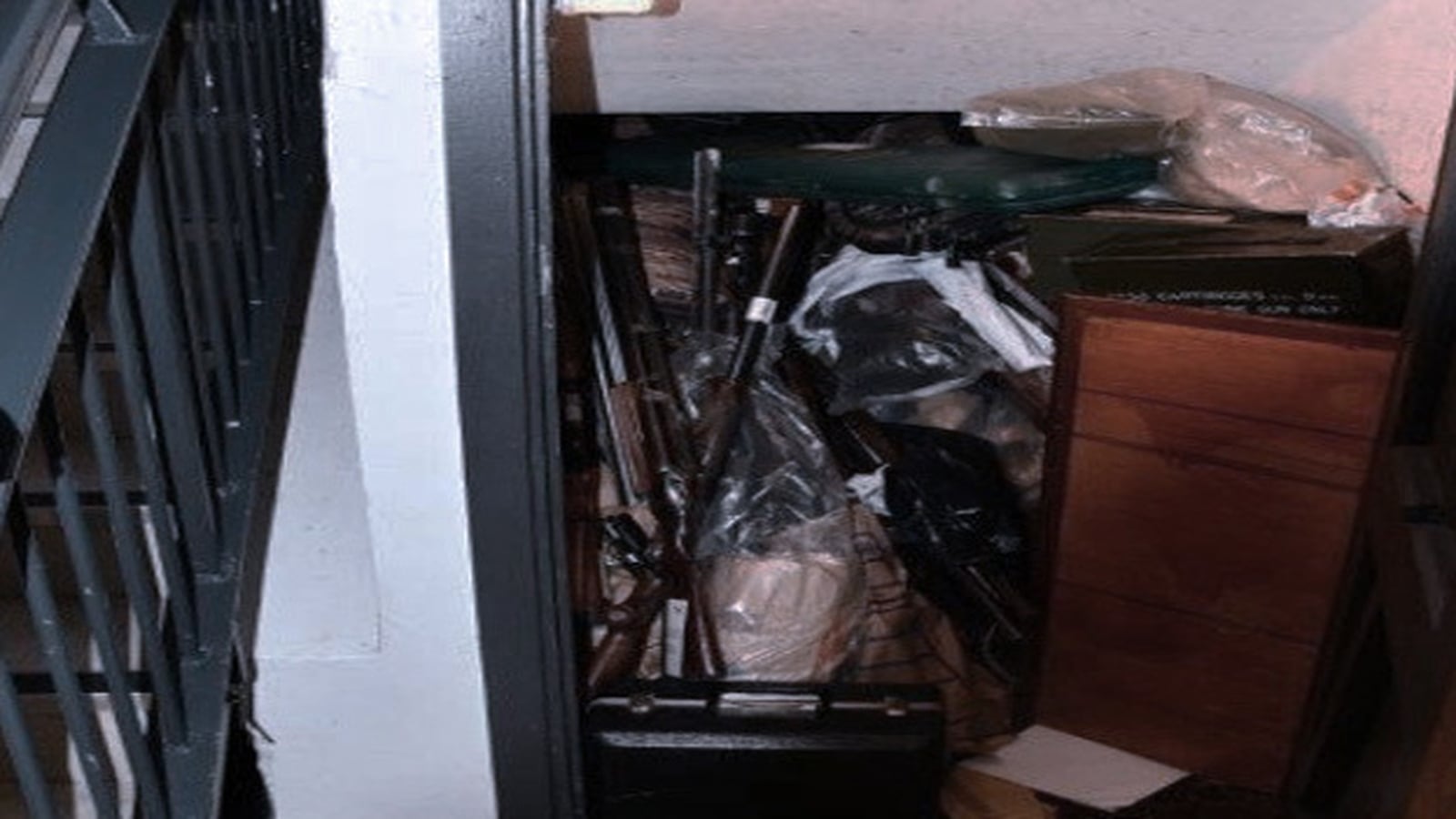
It found firearms in Kildare station were normally stored in a locked understairs cupboard known as ‘the armoury’, situated at the entrance to a private area off the foyer.
READ: Secret report says gun could have been stolen from Kildare gardaí
The investigators searched the understairs ‘armoury’ on 17 August 2023, but none of the weapons seized in the 2009 raid were there.
Further inquiries and searches of Kildare Garda Station and of local dealers and connected individuals that Kildare gardaí had used to destroy guns in the past found no trace or record of the Winchester.
Follow-up searches of property and mobile phones linked to four other individuals who featured in garda intelligence reports yielded nothing of evidential value.
But the investigation was uncovering significant concerns within Kildare Garda Station itself, with “serious internal control deficiencies … in relation to the safe and secure custody of firearms”.
Lack of controls
One was that firearms in Kildare Garda Station were kept behind a locked wooden door in a small understairs cupboard known as the ‘armoury’, and that keys to that were left in a press in the public office, readily accessible to anyone with access to the station.
The keys to the armoury were kept in a press in the public office for gardaí to access official-issue station firearms, which were also stored in the same understairs cupboard, the investigation reported. Contents included Uzi submachine guns and handguns used by gardaí for armed escorts and operations, as well as seized guns and ammunition.
The keys were “readily accessible to all garda members or any other person who may have had access to Kildare Garda Station, with no control mechanisms in place”, the investigation file stated.
“The lack of internal controls in relation to access of the keys to the armoury and the lack of appropriate storage facilities for firearms at the time are of significant concern”, it added.
Lack of proper records
Another issue emerged: there was extremely poor garda record-keeping of firearms held in the station or sent for destruction with local firearms dealers. None of the seized items from the 2009 Kildare drugs raid were logged in the station property book, and though they were recorded in a garda ‘Pulse’ database entry, it had not been updated.
As a result of “significant weaknesses in recorded and handling procedures”, tracing the movements of the four other guns seized in the 2009 raid and returned to Kildare Station from the Garda Technical Bureau in 2010 proved in part, inconclusive, with little or no definitive Kildare garda records to rely on.
Arrangements in place for the destruction of weapons locally were “haphazard”.
The report found that Kildare gardaí used four different local contacts to destroy weapons.
One of them, a firearms dealer, confirmed to the garda investigation that no member of An Garda Síochána was there to witness his destruction of weapons for them.
While the internal investigation did not rule out that the Winchester may have found its way into the hands of criminals through the ‘haphazard’ arrangements Kildare gardaí had for destruction of weapons, it found no evidence of that.
However, in addition to pointing out that any garda or member of the public could have accessed the keys to the understairs armoury at Kildare Garda Station, it also reported that it may have been the case that the Winchester had been left unsecured in another room or office at Kildare station and “could have been potentially taken by any number of personnel passing through the garda station”.
It added: “The opportunity was certainly present given the lack of controls pertaining to the management of firearms exhibits in place at that time.”
Items not accounted for
Of the five guns and ammunition seized in the 2009 raid, four items were never conclusively tracked, traced or accounted for in Kildare Garda station after 2010: the Winchester shotgun; a bolt-action rifle believed to have been “likely destroyed” in 2013; 72 rounds of ammunition; and a tiny quantity of seized cannabis resin.
The investigation found itself inhibited by “the lack of clear and proper record keeping” and the failure to strictly adhere to policy and procedures in place at the time.
It concluded that one of the other 2009 weapons seized, a .22 long rifle with a missing bolt and no serial number, was one “most likely” destroyed by a firearms handler for Kildare gardaí in 2013.
Through the records of a local firearms dealer, it also concluded that two more of the 2009 seized guns, a sawn-off bolt-action rifle and an air rifle, were destroyed by the dealer for Kildare gardaí in 2015. Another air rifle was put in storage with him until investigators removed it to a garda station in October 2023.
However, the various calibre of ammunition also seized in the 2009 raid and last recorded at the garda station were never accounted for — 72 rounds in all. The tiny quantity of seized cannabis resin was also never located.
2014 audit ‘ambiguous’
Separately, the internal investigation also found that an audit of firearms at Kildare garda station in 2014 detected that the Winchester and other firearms were not present during an inventory check.
However, the audit inventory check-marked items missing at the time of inspection as “Not Viewed”, highlighted in red text. Items that were present were marked “Viewed”, highlighted in green text.
The internal investigation said that because it was not clearly stated that the ‘Not Viewed’ items were not located or missing, this created an “ambiguity” and that local management appeared to have understood the entries to mean that the items had not been inspected, rather than that they were unaccounted for.
There was no evidence in the report that the ambiguity had been clarified by management.
“For information”
The internal investigation report of October 2024 recommended that the file be passed on to the then local management in Kildare “for information” and for consideration of what to record on Pulse, the garda database.
Commenting on that, Labour spokesperson on Justice, Alan Kelly TD, who has raised questions about the Winchester shotgun in the Dáil, questioned how it came to be “that something as serious as this would be dealt with in that way”.
RTÉ Investigates put a series of questions related to the Winchester and other matters to the current and former commissioners of An Garda Síochána, including asking the gardaí to address what specific action it took on foot of the internal October 2024 report.
In a response on Friday evening 11 September, An Garda Síochána referred RTÉ Investigates to a statement issued on its behalf in April 2024, which can be read below.
Garda headquarter failings
At the same time the internal investigation was under way, a separate review of all firearms in the possession of Kildare District Gardaí from 2009-2023 was conducted. The outcome of that review has also not been made public.
However, the poor systems of weapons control and management in Kildare station identified in the internal report mirror similar concerns about hundreds of guns and other weapons and over a million rounds of ammunition accumulated over years in a shipping container at garda headquarters itself.
In a programme to be broadcast on Wednesday night, RTÉ Investigates reports on the background to a separate audit of the contents of the shipping container, where significant disparities between weapons in the container and what was recorded on Pulse were found.
The HQ audit also found failings of record-keeping, storage and security in the wider Garda Firearms Stores, which holds weapons and ammunition held by and for the gardaí.
Informing the minister
The Oireachtas has previously heard that while the then Commissioner Drew Harris had given verbal updates to the minister in respect of the loss of the firearm, there was an eight-month delay between the discovery that the gun had been seized years before by gardaí and a written report on the issue by the Commissioner to the then Minister for Justice, Helen McEntee, under what was called a ‘Section 41’ notification.
Under it, the Commissioner is required to keep the Minister and the Secretary General of the Department of Justice, Equality and Law Reform “fully informed” of significant developments regarding the protection of life and property in the State, or that might adversely affect public confidence in the gardaí.
Section 41 of the Garda Síochána Act is now Section 36 under new legislation, the Policing, Security & Community Safety Act 2024.
Then Commissioner Drew Harris reported the matter to the Minister under Section 41 in March 2025.
He told an Oireachtas Committee hearing in June 2025 that prior to making a “full report” to the Minister and the Policing Authority, he provided “verbal updates” about it.
He said the reason for the delay of eight months was that he was awaiting the results of “a preliminary investigation”.
A spokesperson for the gardaí told RTÉ Investigates that An Garda Síochána had spoken “publicly and openly about this matter back in 2024 in various forums and had kept our oversight bodies informed of same”.
The statement on behalf of the gardaí published in April 2024 is carried in full below.
An Garda Síochána Statement of April 2024
“In mid-2023, as part of an operation into a feud between two criminal gangs, a firearm was seized in the midlands and two males arrested and subsequently charged with firearm offences.
Two days later, following examination of the firearms, the Senior Investigating Officer found that one of the firearms – a pump-action shotgun – had previously been seized by Gardaí in the east of the country in 2009 and records showed that it was supposed to be still in possession of Gardaí in the east of the country.
This firearm had originally been stolen in a burglary in 2004 and was recovered by Gardaí during a search of a premises under warrant in the east of the country in 2009.
Within a week of the firearm being seized, a criminal investigation was instigated into how the firearm left the control of An Garda Síochána and came into the possession of the individuals charged with firearms offences.
A substantial number of enquiries have been completed to date and the investigation is in its latter stages.
There has been significant recent public comment, including by Commissioner Harris, on the critical importance of the proper control and recording of evidential material in An Garda Síochána’s possession.
Commissioner Harris has recently provided a report on this matter to the Minister for Justice under Section 41 of the Garda Síochána Act 2005. Commissioner Harris has also provided a report to the Policing Authority.
Commissioner Harris will keep the Minister, and the Policing Authority informed of matters as they arise.”