
Allow Exco Player content
This content is provided by Exco Player and may use cookies or similar technologies. Please click ‘Allow and Continue’ below to load the content.
The global war on AI data centres: Why cities including London are rebelling against big tech
The approval of one in London’s Brick Lane is the latest of the many colossal data centres mushrooming across the country — but will a backlash halt the march of AI? Chris Blackhurst reports
Chris Blackhurst2 minutes ago
They are spreading across London. They could be from a sci-fi thriller, unless they weren’t so real, as gigantic metallic sheds move in to the ends of suburban streets, shielding the sky, blocking any view and emitting a constant, low-level hum.
These are data centres. They were growing in number but very soon, with the explosion in AI, one may soon be coming near you. Often, they appear near each other. Better that way, that they form clusters, so their developers say, in order to support one another. Until you’ve seen one, it’s hard to grasp their vastness. Some measure over 100,000 square feet or roughly 100 times a normal London terrace house. But that is difficult to take in and gives no indication of their towering height and width.
Think of a typical London street scene, with houses along both sides and a two or three-storey light industrial premises at the bottom. Now, look up and up, and keep on looking. Behind it looms something new and out of scale, that by its sheer size and grey, metal exterior, appears heavily forbidding. Imagine the biggest warehouse you’ve ever seen, except bigger.
Note the heavy, 24-hour security, the electric gates, CCTV cameras and high fencing. It’s as if some sort of secret military installation has been planted right in your midst, in your neighbourhood.
All around the world, not just here in the capital, residents are waking up to this new inhabitant. Everywhere, they are up in arms, shocked at what they’re expected to live alongside, worried too about the largely-unknown health implications.
London, especially in the west and east, is badly affected, because of the accessibility of super-fast fibre and electricity grid connections. As many as 40 have sprung up in the Slough area alone, 20 are planned for the Colne Valley, 11 are already operational or coming to Park Royal. Officially classed as belonging to the critical national infrastructure, these “hyperscale” — as they are termed by their developers — monsters enjoy special status.
The former torpedo factory in Park Royal, west London, in front of the Microsoft data centrePaul Laster
They are hard to dislodge — Angela Rayner has ignored local objections and controversially approved a development at the Truman Brewery site in Brick Lane in the East End. Costing £500m, this AI-serving behemoth will also create 44 additional homes. But here’s the rub: feeding the computer servers inside will use the equivalent power of 15,000 homes. And water, lots of water.
The industry body Water UK reckons data centres in England consume 6.6m litres a day to keep their equipment cool, although their proponents maintain they use closed systems so the water is recycled. Even so, they still pump out heat — recent research from Cambridge University has calculated that data centres can increase nearby soil temperatures by 2C and if there are several together, up to 9C. In the US, claims have been made they pollute the air, giving off tiny particles.
Jobs do accompany them, but usually around 30 to 40 — often nowhere near the number employed in the former factories they replace — and frequently, these new posts are highly specialised, employing people moving from elsewhere.
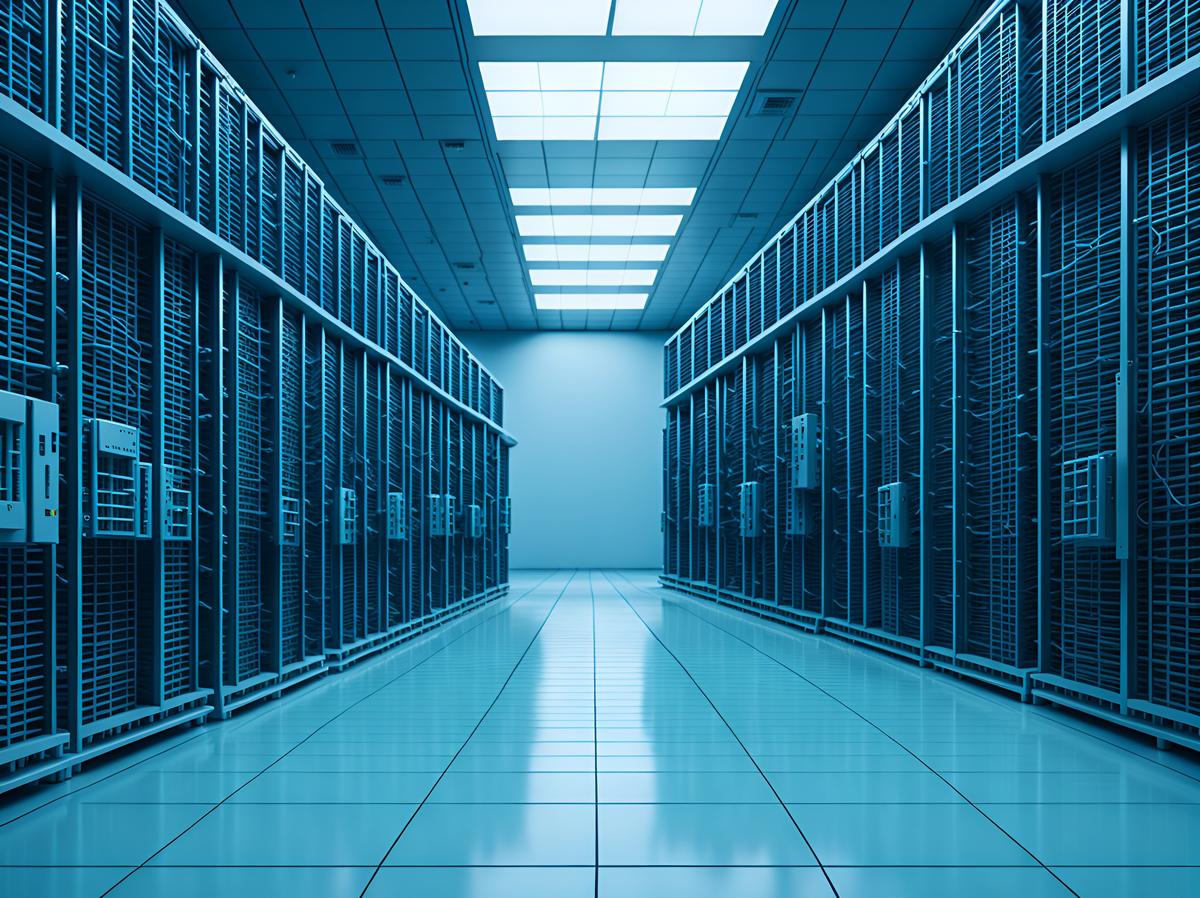
The inside of a data centreTheDigitalArtist
All of which amounts to the case for the prosecution. Added to that is the secrecy that frequently shrouds their arrival, which only serves to make them appear more sinister. In planning applications, they tend to be lodged vaguely as “storage” or “warehousing”. The true identity of the real operator also tends to be hidden.
They do that, they say, to protect their security — they are dealing with reams of hugely valuable, sensitive material. That’s fair enough, but another interpretation is that by keeping the new building’s purpose hidden, potential protests can be kept at bay until it is too late and permission is granted.
Global rebellions against data centres
In numerous places, rebellions against data centres are raging. In the US, they have become an unlikely battleground in the forthcoming mid-term elections, with Republican nimbys for once being prepared to push back against Donald Trump and the Maga movement and their love for the super-rich, all-powerful tech bros.
The centres are seen as a threat to the environment and the look of a district. But it is more than that — increasingly the digital fortresses are viewed as symbolic of the advance of AI and the threat to people’s employment prospects and future prosperity.
Trump, for now at least, is unabashed, continuing to act as their vocal champion. “The only reason that communities throughout the USA should not want data centres is if they want to end up being backwards and poor,” he posted recently. “If we kill the Golden Goose, you will only have yourselves to blame.”
People attend a protest in Austria against the construction of new Google’s data centreAFP/Getty
For their part, the tech giants are pumping more than $300m into the mid-term elections, backing a nationwide advertising campaign to highlight why the centres are vital. They face a tough challenge — a Gallup poll has found 71 per cent of Americans oppose local data centres. The usually Trump-aligned Fox News found that 70 per cent were against, including 53 per cent of Maga Republicans. Silicon Valley is isolated in the face of joint resistance from Democrats and Republicans.
In Australia, where the AI kings have been drawn to the abundance of spare land and energy, the country has become home to 162 data centres, with plans afoot for a further 90. OpenAI CEO Sam Altman has said he sees Australia as having the potential to be the world’s data centre capital. While that goal enjoys the support of the federal government, many Australians are less smitten, sparking protests and campaigns galore, some of them in territories that voted for the Canberra administration.
“We’ve got the government rolling out the red carpet saying we want to be the data centre capital of the world,” said a Sydney area deputy mayor, Rochelle Flood. “But can we actually do that sustainably, or is it going to set us back in terms of net zero and our water storage targets?”
The same pattern is being played out elsewhere, including in London. Here, the Truman Brewery proposal has aroused fierce opposition. But in Brick Lane, as in other UK locations and overseas, the central government is lending its support to the developer. That’s because ministers want to attract foreign investment and wish the UK to be a global leader in AI.
People holding placards against the approval of a data centre in Brick LaneAFP/Getty
There is talk of putting the giant constructions on brownfield locations in less built-up areas, such as Scotland, where wind turbines and hydro-electricity can help to power them. But it’s hard to see why the people there should be welcoming.
Is space the solution?
Another, intriguing solution — to what may yet emerge as an existential danger to the advancement of him and his AI brethren — has been mooted by Elon Musk. His SpaceX corporation has filed applications with the US Federal Communications Commission for putting AI data centres in space, orbiting around Earth. He’s spoken of as many as one million solar-powered satellites being deployed, forming a galactic constellation of data centres. Musk is aiming to carry out test launches in 2028. It would bypass the problems of erecting eyesores on the ground and any ensuing environmental damage, taking up valuable acreage and devouring colossal amounts of the world’s precious natural resources and energy. There would also be little risk of breaches in security and terrorist attack.
Elon Musk wants to put data centres in spacePA Archive
The downside could be the cost of putting a centre into orbit and maintaining it. Plus, the possible atmospheric pollution from having supersized structures using gigawatts of electricity circling above the globe is a complete unknown. Some scientists and pressure groups are warning that Musk’s vision is nothing but a pipe-dream, belonging to fantasy rather than achievable reality. He is unabashed, pressing ahead with seeking the necessary licences.
That Musk is doing so may indicate where the data centre backlash is heading, how it may undermine and stall the march of AI. Something pivotal may be occurring, with ordinary folks rebelling against the axis of governments and the tech corporations, against AI. London is emerging as one of the key fronts in the unfolding conflict.
MORE ABOUT