
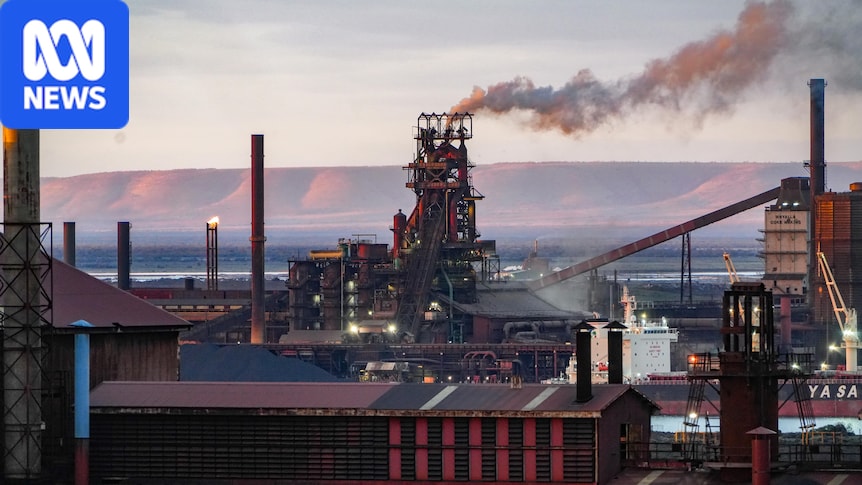
Whyalla’s steelmaking gap could last years as potential job losses mountBy Daniel Keane
Posted Tue 15 Sep 2026 at 1:20pmTue 15 Sep 2026 at 1:20pmTue 15 Sep 2026 at 1:20pm
In short:
The fate of 200 “embedded contractors” remains uncertain following the announcement 600 jobs will be slashed with the closure of the Whyalla steelworks’ blast furnace.
Experts estimate it could be between two-to-four years before steelmaking activities resume at the site.
What’s next?
Two bidders remain in the running to buy the steelworks, while a third company retains its right of last offer.
A resumption of steelmaking in Whyalla could be several years away, following the announcement that its ailing blast furnace will not be restarted.
About 500 workers at the South Australian regional city’s steelworks will lose their jobs, along with 100 labour hire workers, administrators KordaMentha revealed on Monday.
The future is unclear for another 200 “embedded contractors” employed by external companies to work at the steelworks, potentially taking the total number of initial job losses to about 800.
“That’s probably a fair number but it’s hard to say,” KordaMentha partner Sebastian Hams said on Monday.
SA Premier Peter Malinauskas said it was necessary to “exercise a degree of caution” around that figure, because some of the contractors had work elsewhere.
“There’s a bit of speculation about that, as I understand it, but it’s impossible to know just at this point because, obviously, contractors who provide services on the site will make their own decisions,” he said on Tuesday.
The job losses have been precipitated by the demise of the steelworks’ 60-year-old blast furnace — a critical piece of infrastructure that made pig iron, which was then converted into steel.
While the furnace has been offline since April, its long-term problems date back at least several years and KordaMentha said it was no longer feasible to attempt to restart it.
“The blast furnace will now go completely cold — we can’t do what’s called a ‘controlled blow-down’ because we literally can’t get enough air into it,” Mr Hams said.
Estimates have varied for how long it will take for a future owner of the steelworks to replace the coal-fired furnace with a long-proposed electric arc furnace — a technology that uses plasma to melt scrap.
Mayor Phill Stone said that, despite the blast furnace’s age, the end to its life cycle had been more abrupt than anticipated.
“We always knew there was going to be a new chapter — we didn’t expect it quite so soon,” he told ABC News Breakfast.
“We’ll now have that period between the new buyers being selected, the new technology coming online in a few years’ time, but have to get through this immediate period where we will have job losses.”
While the government yesterday announced various support measures for workers, Mr Stone said there were families who “may have to think about relocating” — but added that there were other opportunities in the region and South Australia’s north more broadly, including with BHP.
“It is probably going to be a three-to-four-year process — we will still be rolling rail line steel,” he said.
“It sounds ridiculous, but we will be bringing steel in so that the steel mill can continue.”
Two bidders — Jindal Steel and M Resources — remain in the running to buy the steelworks, while BlueScope Steel retains its right of last offer.
Sale ‘not an auction’
South Australian Treasurer Tom Koutsantonis said a return to steelmaking would depend “on who the successful bidder is”.
“There was always going to be a gap, there was always going to be a time when the blast furnace closed — between then and the new construction of the new facilities — because both bidders weren’t going to keep underwriting the loss the blast furnace was making,” he told 891 ABC Adelaide.
“I think we will see steelmaking again in the next couple of years in Whyalla.”
Journalist and author Paul Barry — whose book The Big Steal details the unravelling of the business empire of former Whyalla steelworks owner Sanjeev Gupta — said he thought a two-year time frame was unlikely.
“I think it’s going to be three years at least. That’s my understanding,” the former ABC Media Watch host said.
“The buyers who are being lined up for Whyalla — they had no desire to have the blast furnace because it loses money, and so it would add to the cost of any bailout and add to their cost of taking it over.
“But I think that within three years with luck Whyalla could have a new modern steelmaking facility that will last for years and years and years.”
Barry estimated $500 million had been spent since the site was forced into administration in early 2025, and suggested that everything hinged on a sale being secured sooner rather than later.
“I don’t want to cast doubt on the proceedings but it was supposed to happen by September and it’s not happened so clearly something is proving difficult,” he said.
“If the sale goes ahead in the next three months, I think Whyalla will have a future and I think it will make steel again.”
Mr Koutsantonis said the state and federal governments had greater control of the situation than they did when the steelworks were last in the hands of administrators KordaMentha, prior to Mr Gupta taking over the site in 2017.
“The banks were the ones who ran the administration and they wanted the highest bidder,” he said.
“[But] this isn’t a contest of who will pay the most for the steelworks — this is a contest of who is most capable of operating the steelworks.
“We’re doing a capability assessment, not an auction on who can pay us the most.
“What we’re trying to do is recapitalise with government money to make sure we’re never here again.”