
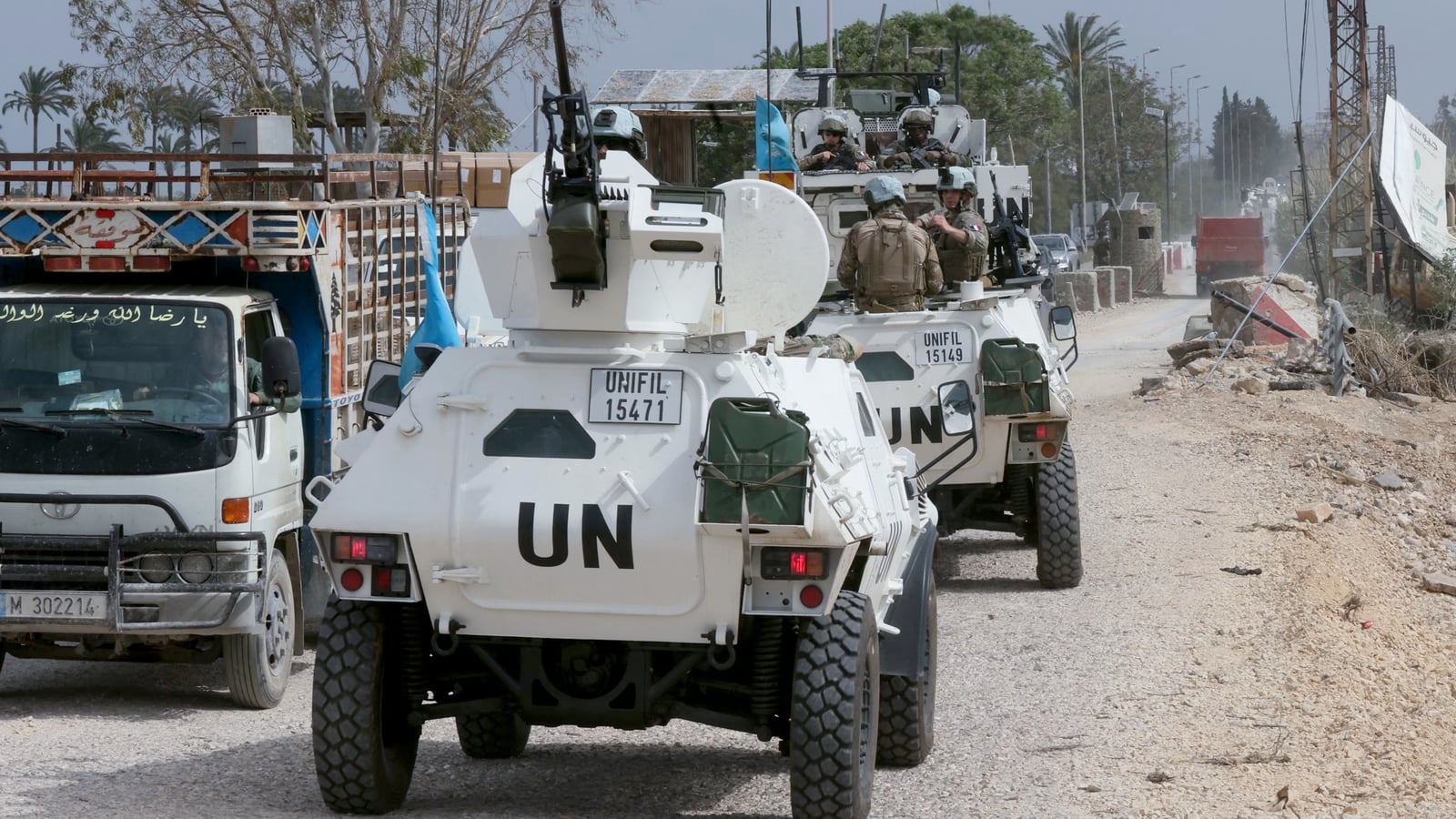
The Taoiseach says Irish troops will not be able to serve in Lebanon without a UN mandate.
Micheál Martin said that without the support of the UN Security Council, “we would not be in a position to participate in any post-UNIFIL force that may be pulled together.”
The Taoiseach said it was a “big concern” that the mission was ending, adding that “if there’s a complete pullout of Lebanon, that could lead to a deterioration of the situation from a humanitarian point of view.”
Mr Martin said that Ireland might be able to provide support in terms of training Lebanese armed forces, but also “monitoring any peace agreement” between Israel and Hezbollah.
Yesterday, Minister for Defence Helen McEntee said Ireland was “absolutely” among over 10 EU member states willing to contribute to a European mission in Lebanon.
She said there was a “desire to ensure that Irish peacekeepers remain on the ground” and added: “I utterly regret the fact that the Unifil mission is coming to an end.”
Last month, 86 Lebanese politicians signed a letter urging the Security Council to keep the peacekeepers.
UNIFIL, which now counts some 7,500 personnel from nearly 50 countries, has been in place since 1978, although its presence has not prevented repeated outbreaks of conflict.
In May, 344 Irish peacekeepers were deployed to Lebanon with UNIFIL, which marked their final mission in this form.
The deployment of the 128th Infantry Battalion marked the end of an era spanning almost 50 years.
It is hoped that Irish peacekeepers will continue to work in the region but how that may look is not yet clear.
The Government had signalled its intention to remove the requirement for UN approval when deploying more than 12 members of the Defence Forces outside the State, the third element of the “Triple Lock”.
Under existing rules, any foreign deployment of 12 or more Irish Defence Forces personnel can only take place when it has been approved by the Dáil, the Government and has received a United Nations mandate.
The draft legislation proposed by the Government removes the requirement for United Nations Security Council authorisation.
Under the proposed bill, the number of soldiers that could be deployed as part of any mission would increase from 12 to 50.
It also planned to raise the threshold at which a Dáil resolution is necessary to when more than 50 members are deployed.
However, the legislation that would be required has not materialised, amid backbench and opposition concerns around the impact on Ireland’s neutrality.