
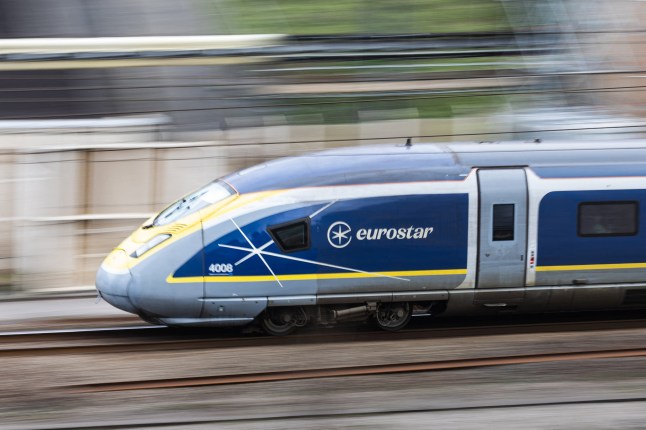
As Eurostar faces competition on high-speed services through the Channel Tunnel, the rail operator is finding ways to standout from the crowd.
After a 31-year monopoly, both Richard Branson’s Virgin Trains and Italy’s FS, look set to launch their own trains.
As well as announcing new and improved departure halls, Eurostar’s CEO, Gwendoline Cazenave, says she’s got another trick up her sleeve: a double decker on-board bar.
The new bar will feature on Eurostar’s double-decker Celestia trains, which were first announced back in October 2025.
The fleet of 50 double-decker trains, costing about €2 billion (£1.7 billion), will be the first of its kind on the cross-channel track, and are due to enter service in 2031.
Speaking to The Times, Cazenave revealed the ‘double-decker bar’ will ‘be as exciting as a speakeasy bar.’
What will Eurostar’s ‘speakeasy’ bar be like?
Speaking to Metro, Eurostar said the new bar will go towards creating ‘a travel experience beyond the ordinary’.
A spokesperson at Eurostar said: ‘The two-storey bar will be a star attraction of the bespoke train design.
‘We want to create something really special for customers, with a different ambience and vibe upstairs and downstairs, making the most of the double-decker views.
‘Open to everyone on board, our staff will have the starring role, hosting the bar like our cocktail bars in our Eurostar Premier lounges.’
What else do we know about the new Eurostar double-decker trains?
Additionally, CEO Cazenave revealed in a press release that customers can expect a ‘very special new train’.
She said: ‘Eurostar Celestia… will offer exceptional comfort, a unique Eurostar experience and new surprises to be revealed.
‘This is a golden age for international sustainable travel – and Eurostar is leading the race.’
In addition to the bar, there will be air con on board, which, after this summer’s record-breaking heat, is a welcome amenity.
A Eurostar spokesperson added: ‘A decision has been taken to equip our new fleet of up to 50 Celestia trains with air conditioning capable of operating in temperatures up to 55 degrees.
‘These trains will enter service in 2031 and run into the 2060s, so it’s essential to be prepared for the future.’
With around 18,000 people departing on Eurostar services from St Pancras each day, Cazenave is looking to increase those figures.
The new, bigger, trains will carry about 20% more passengers than Eurostar’s existing fleet as the company seeks to increase annual passenger numbers from around 20 million to 30 million.
This will mean over 1,000 people will be on board their trains for the first time.
Eurostar’s rivals for cross-channel trains
After three decades without a direct rival, Eurostar is preparing for a new era of competition on the Channel Tunnel.
Last year, St Pancras teamed up with Eurostar to expand its passenger handling facilities.
Scheduled for completion by 2028, the work is designed to more than double the station’s processing capacity, so that it can handle 5,000 passengers every hour, compared with the around 2,000 it currently handles.
Virgin Trains
One of the biggest threats to Eurostar’s dominance comes from Sir Richard Branson’s Virgin Trains, which is targeting a 2030 launch.
In August, the rail regulator, ORR (Office of Rail and Road), approved a track-access agreement allowing Virgin to run up to 20 daily return services between London and Paris, Brussels or Amsterdam between October 2030 and December 2040.
The access only covers the HS1 route, however. Virgin still needs to secure the same for the Channel Tunnel and rail networks in mainland Europe.
Keen to rival Eurostar’s stronghold with some ‘Virgin magic’, Branson previously declared: ‘We’re going to shake-up the cross-Channel route for good and give consumers the choice they deserve’.
A Virgin representative previously told Metro that stopping at Kent is also a real possibility, after Eurostar services at Ashford International and Ebbsfleet International stations were suspended in 2020. Giving more choice and competition for Eurostar.
They said: ‘Reopening the stations to be able to accommodate international services requires commitment and resources from all parties and potential competitors involved.
‘But if the stations are opened, Virgin will stop in Kent.’
Trenitalia (FS Group)
Italy’s state-backed Trenitalia France, owned by Ferrovie dello Stato Italiane (FS Group), is aiming to launch London-Paris services as early as 2029, which, if on schedule, would beat Virgin.
It has ordered 19 high-speed trains and is developing a new maintenance facility near Paris as part of its plans.
Their trains are set to include an on-board bistro, WiFi connectivity, and interiors designed to ‘provide an even more comfortable travel experience across all classes of service.’
Gianpiero Strisciuglio, chief executive and general manager of FS Italiane Group, has said that the project is ‘central’ to the group’s vision of the ‘Metro of Europe,’ the ‘integrated high-speed network that will increasingly connect Europe’s major cities.’
Gemini Trains
British start-up railway Gemini Trains shared with Metro last year that they plan to make Stratford International its gateway to the European continent, in partnership with Uber.
Gemini hope to launch in 2029 and offer services to Paris, Lille and Brussels, before expanding into Cologne and Eastern Europe.
Do you have a story you’d like to share? Get in touch by emailing [email protected]
Comment now
Comments
Add Metro as a Preferred Source on Google
Add as preferred source