
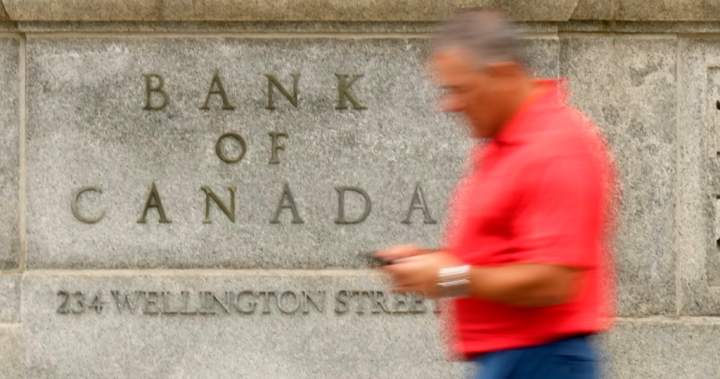
The Bank of Canada held its benchmark interest rate steady again on Wednesday as new U.S. tariffs and the ongoing war in Iran cloud the central bank’s outlook.
The Bank of Canada’s policy rate remains at 2.25 per cent after a seventh straight hold. The move was widely expected by economists.
Bank of Canada governor Tiff Macklem said in prepared remarks that the persistence of the Middle East conflict has increased inflationary risks as global energy prices continue to float higher.
0:41
Bank of Canada concerned over private credit risks
A re-escalation in the trade dispute with the United States meanwhile threatens Canada’s burgeoning economic rebound, he said. That renewed uncertainty might lead businesses to delay investment and hiring decisions until the trade picture crystalizes.
Story continues below advertisement
“Monetary policy cannot offset the effects of tariffs or influence global energy prices. What we can do is ensure global developments don’t jeopardize price stability in Canada,” Macklem said.
Get breaking National news
Get breaking Canada news delivered to your inbox as it happens so you won’t miss a trending story.
By providing your email address, you have read and agree to Global News’ Terms and Conditions and Privacy Policy.
Monetary policymakers at the Bank of Canada use the policy rate to keep a lid on inflation and support economic growth when prices are contained.
Inflation rose to three per cent in July after the Iran war drove a volatile period for gas prices over the spring and summer.
Economic growth, meanwhile, has shown signs of rebounding after stagnating for much of the last year. The economy surged with 3.3 per cent annualized growth in the second quarter, though few analysts expect that same pace continued into the current quarter.
The United States imposed 50 per cent tariffs on a range of Canadian goods on Aug. 22. Macklem said the Bank of Canada doesn’t expect a “large direct impact” on the economy from the new duties, though targeted sectors could be hit hard.
- Cost of living, fuel has Couche-Tard customers cutting back on snacks
- Maritime farmers hit by major drought last summer say they’re on the road to recovery
- Canadian families still waiting for answers 1 week after Nepal disaster
- Ottawa set to extend the pause on federal fuel excise tax: source
-
DeGroote professor dissects intensifying Canada-U.S. trade war
-
‘Lake Ontario, actually’: Adam van Koeverden responds to Trump’s ‘Lake America’ name change
-
‘What an embarrassment’: Eby derides controversial Hegseth post about B.C. cadets
-
Eby thinks B.C. NDP candidate will beat ‘hateful, divisive’ Kerry-Lynne Findlay in byelection
Canada is planning a slate of retaliatory tariffs on U.S. goods starting Sept. 8.
1:46
Canadians weigh in on Carney government’s response to U.S. tariffs
Heading into the latest wave of tariffs, Macklem said exports were on the rise and there were signs businesses were adapting to trade restrictions.
Story continues below advertisement
“Overall, the data reaffirm our view of a broadening recovery,” he said.
Because the economy was evolving broadly in line with the bank’s forecasts, governing council opted to keep the policy rate unchanged, Macklem said.
But he said there could be future adjustments depending on where the economy and inflation go from here.
“Governing council will assess the sustainability of the economic rebound and the outlook for inflation, and is prepared to adjust monetary policy as needed,” Macklem said.