
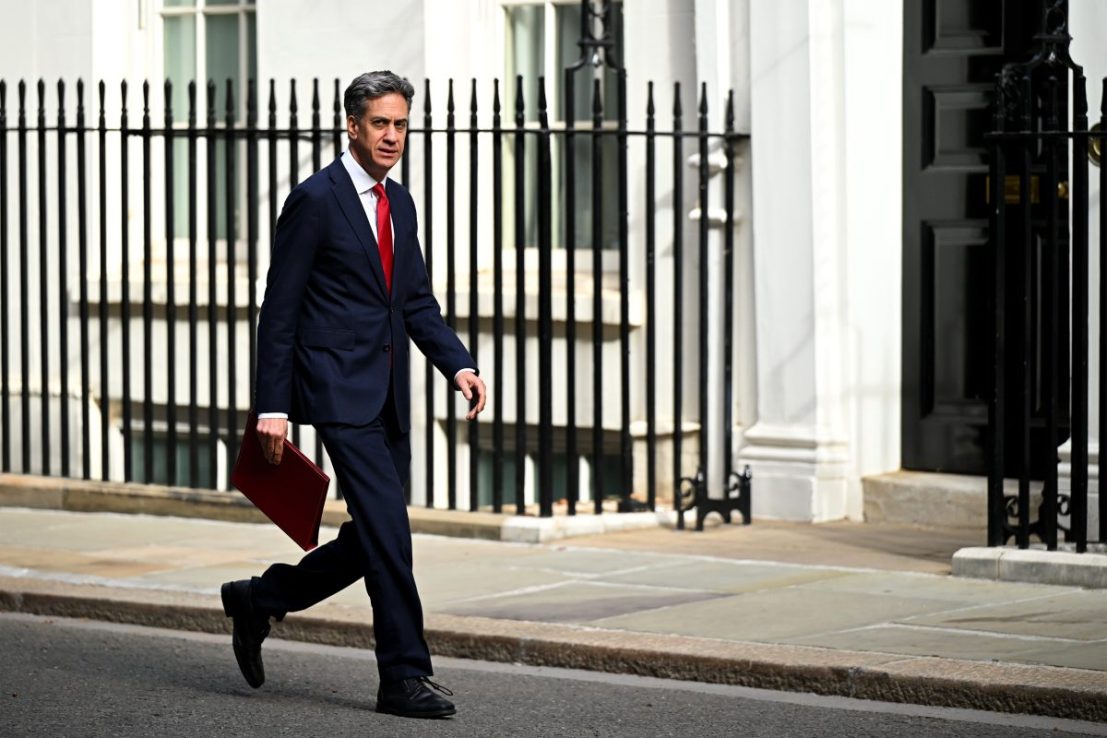
Would it be highly cynical to suggest that Labour are changing Britain’s policy on Israel in search of domestic political advantage, asks Eliot Wilson
If politics is the art of persuasion, as Aristotle’s Rhetorike seems to suggest, then there are some subjects which will always be fruitless and frustrating: abortion, capital punishment, Kashmir, Cyprus. Into the same category falls the Arab-Israel conflict, which has raged since 1948, or 1917, or 1897, or AD 640, or AD 70.
Given the seemingly intractable nature of the conflict, and the UK’s tarnished reputation as the Mandatory Power for Palestine from 1920 to 1948, British involvement in what is still optimistically referred to as the Middle East “peace process” invokes another dictum, Bismarck’s remark that politics is the art of the possible. In other words, if the British government should venture into the geopolitical quicksand, it should have clear objectives and measures of success.
The new foreign secretary, Ed Miliband, is the fifth holder of his office of Jewish descent, following his brother David, Conservatives Dominic Raab and Sir Malcolm Rifkind, and the Liberal lawyer the Marquess of Reading. In today’s climate, that is no guarantee of partiality towards the State of Israel – indeed, sometimes it seems quite the opposite.
Last week, Miliband announced to the House of Commons a range of sanctions targeted at Jewish settlements in the West Bank, and he also declared that the government’s official position was now that Israel’s control of the West Bank was an illegal occupation. When any country makes a substantial change to its foreign policy, it is reasonable to ask two questions: why this? And why now?
Why Israel?
It will not do to say that Britain is, in the words of the chair of the Foreign Affairs Committee, Dame Emily Thornberry, “finally doing the right thing”.
After all, we eagerly pursue trade and investment with China, a serial abuser of human rights which is recognised by a 2021 resolution of the House of Commons as having perpetrated “crimes against humanity and genocide” against the Uyghurs of Xinjiang. We have a formal “strategic partnership” with Saudi Arabia, consistently ranked one of the least free countries in the world by Freedom House.
There was something muddled about Miliband’s description of the new sanctions regime. He stated the government’s judgement that “there is ethnic cleansing of Palestinians in areas of the West Bank, perpetrated by settler terrorists… [to which] the Israeli Government have turned a blind eye”. Fondly recalling childhood summers on kibbutzim, he was explicit about Britain’s sympathies: “Our argument is not with the people of Israel, with whom the UK has unshakeable bonds; our argument is with the conduct of its government.”
But he then went on to explain that the new economic sanctions “will target illegal settlements and settlement expansion, not Israel”. There will be an import ban of goods from “illegal settlements in the occupied territories”, but no further restrictions on arms sales to Israel except those which “materially contribute to the occupation”.
Britain’s quarrel, therefore, is not with the people of Israel, but with the government, except that it is not really with the government but with “settler terrorists”, although the government is accused of turning a blind eye. If this sounds confused, there may be a reason.
Labour is losing the Muslim vote
Last week The Times reported that ministers, in creating the new sanctions policy, had ignored official advice. Successive governments had been warned that it was impossible to disaggregate Israel’s economy from those of settlers and Palestinians in order to impose meaningful sanctions without causing collateral hardship to groups who are not supposed to be affected. The Foreign, Commonwealth and Development Office has not denied that advice in this vein was given, and one anonymous Whitehall source said “the delivery mechanism for this has not been identified… they have no idea how this is going to work”.
Why this, and why now? We know that the Labour Party has lost a great number of Muslim votes because of its perceived weakness and lack of condemnation of Israel over the conflict in Gaza. Four independent MPs defeated Labour incumbents in 2024 by focusing on the issue, in Leicester South, Blackburn, Dewsbury and Batley and Birmingham Perry Bar. Labour fears that this openly sectarian strategy will draw voters away to the Green Party, whose candidate, Hannah Spencer, achieved a 28-point swing to win February’s by-election in Gorton and Denton, where a quarter of the electorate is Asian. Labour’s vote collapsed as it struggled across the line in third place.
Labour is facing another by-election as Sir Keir Starmer’s Parthian shot to the party which deposed him was to vacate his constituency of Holborn and St Pancras, where more than a fifth of voters are Muslims. The stakes of the contest to succeed him have been raised by the Greens’ selection of their leader, Zack Polanski, as the party’s candidate. Starmer had a majority of more than 11,500 at the last general election, but that was then and this is now.
Andy Burnham came to office already grovelling about the government’s response to the conflict in Gaza. He apologised for the “huge hurt” it had caused, and confessed: “we got it wrong and I am sorry for that”. An alarming number of British voters are aligning their political behaviour and identity in accordance with a conflict to which we are not party: many, to put it plainly, are saying they are Muslims before they are British.
It would be highly cynical to suggest that Burnham and Miliband are changing Britain’s foreign policy in search of domestic political advantage. It is legitimate to ask what concrete results the government expects the sanctions to deliver, what contribution they will make to stability and security in the Middle East, and why the official advice to Labour and Conservative ministers was wrong.
Always come back to those tests: why this? And why now? Just because you’re cynical doesn’t mean you’re wrong.
Eliot Wilson is a writer and historian. He is a senior fellow for National Security at the Coalition for Global Prosperity and a contributing editor at Defence on the Brink