
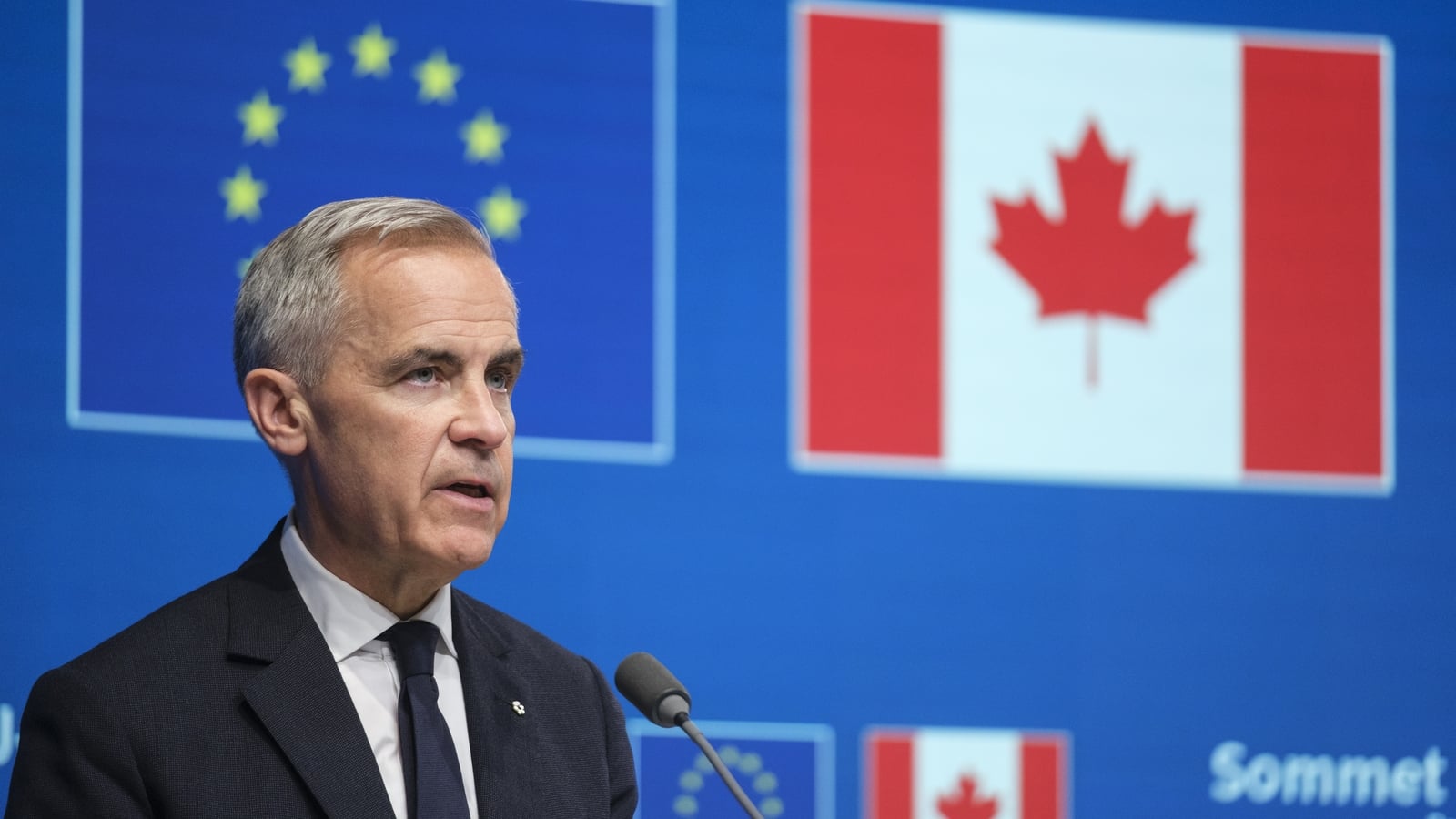
Canada is seeking a “unique alliance” with the European Union but is not looking to become a member, Prime Minister Mark Carney has said.
It comes after the Wall Street Journal reported he was exploring whether Canada could become an “associate member” of the bloc.
The EU, which has not been flexible about membership rules in the past, is open to the idea of granting Canada a yet-to-be-created status of associate membership, the newspaper reported, citing unnamed officials both from the EU and Canada.
Carney says Canada seeks ‘unique alliance’ with EU
“We’re not looking to become a member of the European Union,” Mr Carney said.
“What we are looking – and will begin discussions for – is a unique alliance between Canada and the European Union,” he told reporters at the Toronto International Film Festival.
“We share the same values, we have the same priorities and we have very complementary strengths.”
Mr Carney’s office confirmed on Saturday he will travel to France and Britain this week.
He will address the European Parliament in Strasbourg and attend EU President Ursula von der Leyen’s State of the European Union address.
The Globe and Mail newspaper separately reported it was the EU, not Mr Carney, that floated the associate membership title, citing an anonymous source who said any discussion of a title for the relationship is premature.
Spokespeople at the European Commission did not respond to requests for comment.
Canada’s escalating trade war with the United States has added urgency to its strategic pivot towards other trading partners.
Canada the ‘worst country to deal with’, says Trump
Relations between Ottawa and Washington have deteriorated sharply since President Donald Trump returned to the White House last year due to disagreements over trade and other issues. The trade dispute has led to tariffs on tens of billions of dollars in cross-border trade.
Mr Trump yesterday renewed his criticism, calling Canada “the worst country to deal with,” but adding he thought the nation was “dying to make a deal.”
“They’ve ripped off our country for years,” he told reporters aboard Air Force One.
The US president reiterated his intention to impose new tariffs on cars, trucks and auto parts from Canada beginning 1 January.
Canada and the EU are discussing ways of allowing Canada’s goods, services and workers involved in strategic supply chains such as energy, AI, defence and critical minerals to move freely, thus effectively shifting the EU border, the Wall Street Journal said.
Canada and the EU are also talking about laying underwater cables, jointly constructing data centres, cloud storage and new satellite networks as well as infrastructure to ship Canadian energy to the EU, the newspaper said.
Mr Carney has spoken regularly with several EU leaders, most notably French President Emmanuel Macron, about the possibility of letting Canadians live and work visa-free in the EU, the WSJ said, citing two unnamed officials familiar with the matter.
Mr Macron’s press office did not respond to a request for comment.
Mr Macron’s office separately confirmed that he will meet Mr Carney on 20 September in the French territory of Saint Pierre and Miquelon, a group of islands off Canada’s Atlantic coast.
Any project to forge closer ties between Canada and the EU likely faces challenges, however, based on past efforts to implement a more modest trade deal, which has faced fierce opposition within Europe.
More than a decade after the deal was struck and nine years since it provisionally entered into force, several EU countries still have not ratified it.