
Article content
The Iranian regime’s wartime propaganda leans into the story of David and Goliath, which appears in the Qur’an as well as the Hebrew scriptures. It would be foolish to take theological lessons from a regime that has so lethally perverted authentic religion, but the story of David and Goliath has not only religious significance.
Sign In or Create an Account
or View more offersArticle content
Canadian author Malcolm Gladwell, in his 2013 book David and Goliath, looks at the battlefield encounter not as a tale of divine assistance granted to the tiny faithful against worldly giants, but rather as an account of changing martial techniques.
Article contentWe apologize, but this video has failed to load.Try refreshing your browser, or
tap here to see other videos from our team.We apologize, but this video has failed to load.Try refreshing your browser, or
tap here to see other videos from our team.Article content
Story continues below
This advertisement has not loaded yet, but your article continues below.
Article content
If David had gone into hand-to-hand combat with the Philistine giant and prevailed, it would be a story of how God chooses the weak to confound the strong. But Goliath never laid a hand on David, for David never got close enough to permit that. Projectile warfare from a distance proved superior to sheer size and strength in close quarters. David, with his slingshot and stones, was actually the more powerful one at a distance. He prevailed because that is where the battle was fought.
Article contentArticle content
The 9/11 attacks were a diabolic expression of that same lesson. Attacking buildings with bombs close at hand had been done before — at the World Trade Center itself in 1993, and more catastrophically by Timothy McVeigh in Oklahoma City in 1995. A bomb requires getting close, Goliath style. The innovation of 9/11 was the use of airplanes as guided projectiles of great explosive force to massively murderous effect.
Article content
The American response after 9/11 was to bring the might of Goliath to Afghanistan first and then to Iraq. Goliath was quite good at pulverizing what he could get his hands on. But as American and Canadian and other allied soldiers learned, there were other ways to fight at a distance — the improvised explosive device, for example.
Article content
Story continues below
This advertisement has not loaded yet, but your article continues below.
Article content
The world now is in an era of the tactical Davids, and not in an inspiring way. Nearly 40 years ago, when Iran threatened to close the Strait of Hormuz, Ronald Reagan sent in the navy to escort ships through. Goliath drew near and the strait remained open for decades until President Donald Trump launched his war. The theatre has changed. David’s projectiles can close the strait in a way they could not in 1987. The Americans are still Goliath and, should they wish, could force the strait open — as they are doing partially with naval escorts and as they are not doing, with ground troops.
Article contentRead More
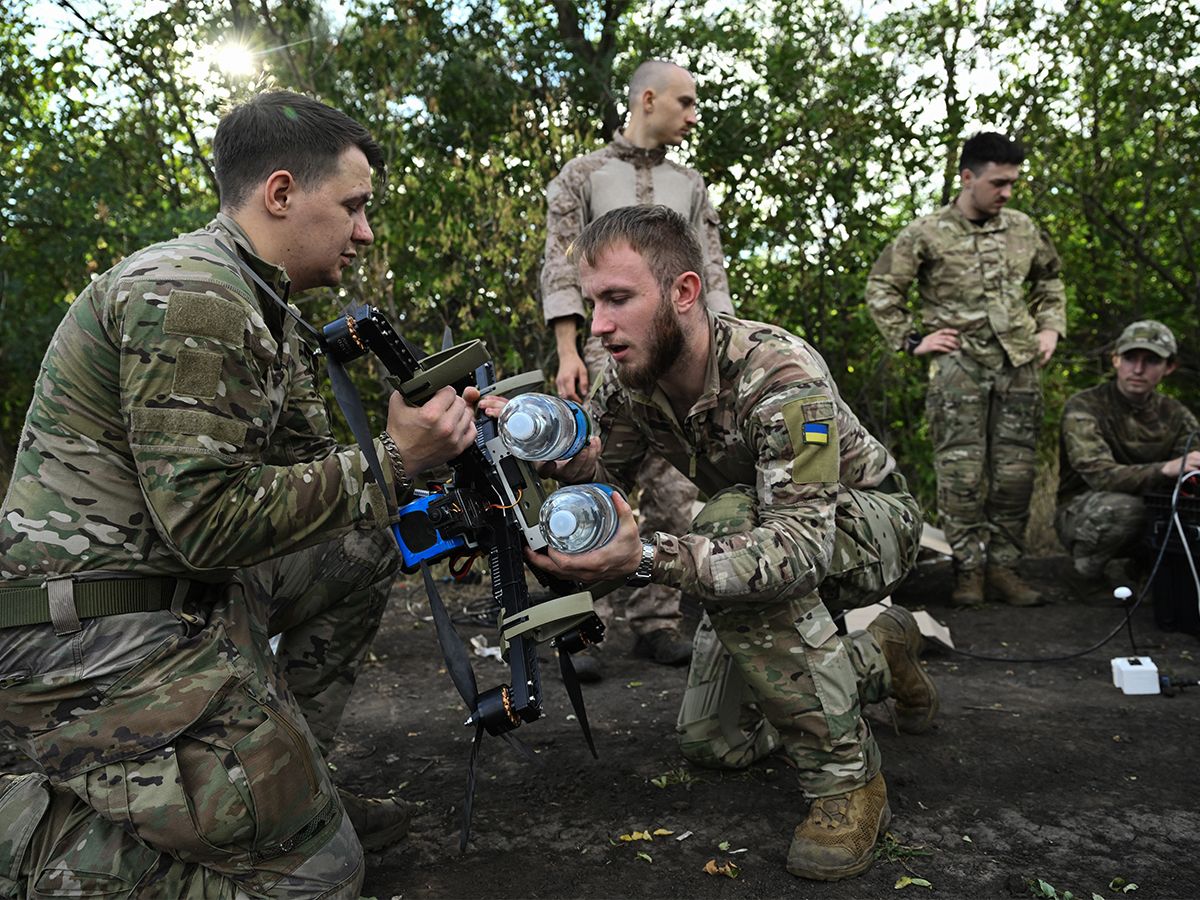
- Zelenskyy and Carney sign deal to boost drone production before heading to Banff retreat
- Canadian man killed while volunteering as a drone mechanic in Ukrainian army
- Story continues belowThis advertisement has not loaded yet, but your article continues below.
Article content
Goliath is big and heavy and hard to supply. When Iran damaged the American base in Bahrain very early in the war, a veritable Goliath of the seas — the USS Abraham Lincoln — had to be supplied from Diego Garcia, 2,200 miles away, or even Singapore. It takes a lot to feed Goliath and it is cumbersome.
Article content
The great powers have projectiles, too. Hence the missiles and anti-missiles, the drones and anti-drones, deployed in great measure to strike Afghanistan, Iraq and Iran from far away. Goliath has stones, too, only much larger ones. Indeed, one of the failures of the Iran War is that America has depleted its storehouse of mighty stones, and they are expensive to replace, in treasure and time.