
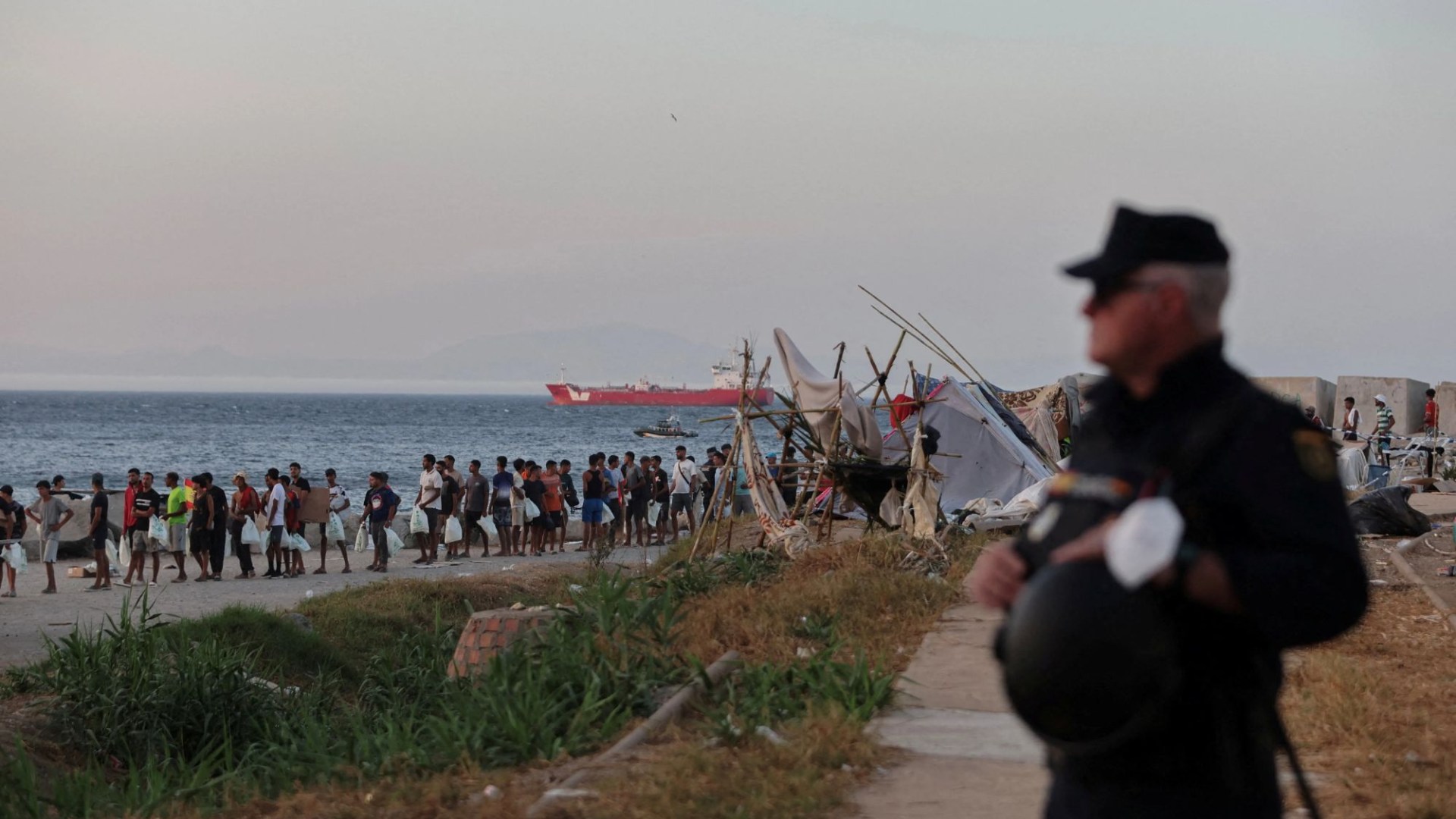
LURKING in the shadows of Ceuta’s port, mafia gangs wait for the sea to crowd with ferries before launching speedboats packed with migrants to mainland Europe.
This is one stop on the migrant smuggling highway from North Africa to Britain – where criminals charge thousands for the crossing.
12
12
A 19-year-old Brit has become the latest link in the growing smuggling chain after allegedly taking migrants from Ceuta towards Gibraltar in a speedboat.
The teenager was allegedly at the wheel as Spanish police gave chase to the boat, which was carrying migrants across the Strait.
As the vessel reached Gibraltar waters, the migrants made it to shore and the boat was abandoned.
The teenager was arrested after Spanish police followed the vessel into British territory, entering Gibraltar without first alerting local authorities.
Read More World News
ALERT ‘IGNORED’
Spanish spies warned of mass migrant invasion into Ceuta before surge
CAUGHT RED-HANDED
Ceuta migrants caught sneaking onto ferry by hauling themselves up rope
12
12
12
12
He was arrested on suspicion of assisting illegal immigration but has not been charged, and the investigation is continuing.
It gives a glimpse of how far the smuggling operation can stretch once migrants leave Ceuta – with criminal gangs using boats to move people across the Strait of Gibraltar and into southern Europe.
The migrants who reached Gibraltar would not automatically have a route into Britain.
But once on mainland Spain, the journey can continue north through Spain and France, potentially taking them towards the Channel.
Most read in The Sun
FERRY TRAGEDY
One dead and 140 missing after passenger ferry hits bad weather
CROC SHOCK
Customs officers left shocked as crocodile head discovered in suitcase
LAM FOR LONDON?
Lammy urged to stand as Labour’s candidate for London Mayor after sacking
SMOKE SCENE
Fire rips through historic mill used for filming Peaky Blinders & Downton Abbey
The dramatic incident has exposed a potentially lucrative new route for criminal gangs exploiting the chaos in Ceuta.
Migrants are being charged thousands of euros to make the dangerous crossing by speedboat, with some apparently already moving on from southern Spain as they continue their journeys north through Europe.
In one case, seven migrants allegedly paid €8,000 (£6,800) each for a crossing to La Línea in southern Spain.
That gave smugglers €56,000 (£48,000) from a single boatload.
12
12
Other crossings can cost up to €9,000 (£7,700) a head, while speedboats and jet skis can command between €4,000 (£3,400) and €6,000 (£5,100) per person.
Smugglers are even advertising the crossings openly online.
One TikTok account shows four Moroccan men aboard a motorboat alongside the message: “Ceuta-Algeciras. DM”.
But speedboats are not the only way migrants are trying to get out of Ceuta.
As The Sun has reported, three migrants were caught trying to sneak aboard a ferry to mainland Spain by hauling themselves up a mooring rope.
Two of the Moroccan men were spotted climbing the rope towards the Baleària ferry bound for Algeciras.
Crew members raised the alarm and all three were arrested by port police, delaying the ferry’s departure.
All three had entered Ceuta during the mass border storming in late July.
The road north is already well established.
Delivery and removal lorries travel between the Costa del Sol and the UK, carrying goods and the belongings of British expats moving between Spain and Britain.
That busy transport network provides another potential route north once migrants reach mainland Spain.
The Sun has spoken to residents in Ceuta who say they are watching migrants leave the enclave and make their way towards mainland Spain.
12
12
Jose “Pepe” Gil, 61, who has lived in Ceuta with his family since the 1960s, said the migrants on the move include people arriving from the south of Morocco.
He said he has seen migrants carrying huge amounts of cash, withdrawing money from ATMs and buying expensive clothing before leaving the enclave.
He told The Sun: “The migrants that have arrived, they are not all cash-strapped. I’ve seen them going to the ATM to withdraw money and go into one of our shops to buy the latest designer gear.
“There are others carrying Moroccan Dirham money to change into euros.”
Pepe said criminal gangs are exploiting the busy shipping traffic through the Strait to move migrants towards southern Spain and beyond.
He said: “The mafia gangs wait for the sea to be crowded with ferries and boats then launch a speedboat and go as fast as they can to get the migrants to mainland Spain and to Europe.
“They are charging thousands of euros for the crossing.”
Pepe said the number of migrants in Ceuta is falling every day as people leave for mainland Spain and beyond.
“They are heading to the mainland,” he said. “I know that because there are less migrants here every day.”
Ceuta shopkeeper Miguel Vasquez, 34, also told The Sun that many of the migrants arriving in the city appear to have huge amounts of cash.
He added: “I couldn’t believe my eyes the day after they all started to pour into Ceuta.
“They are dressed better than us, with the latest Nike and Adidas trainers, the latest iPhone and cosmetic dentistry.
12
12
“I saw them putting their hands into bags which were full of bank notes. They have come with plenty of money.”
Miguel said only a small proportion appear to be in genuine financial need.
He also claimed some migrants have cuts on their arms and legs, which he believes are consistent with detention in Morocco, while others appear to have criminal records.
Those claims could not be independently verified.
Miguel estimates around 20,000 migrants remain in Ceuta, although that is considerably higher than official figures.
He said: “They are everywhere, on the beach, in the mountains, even in the kids’ playgrounds. They are everywhere and sleeping rough.
“They are clogging our services: we can’t even get a simple doctor’s appointment like we used to. Ceuta was peaceful before they came.”
He believes some migrants are finding ways to continue their journeys into mainland Spain and potentially further north to France and Britain.
“We have police everywhere watching but some are slipping through the net, hiding in the rocks then jumping onto speedboats that come to collect them,” he said.
Spanish investigators have already uncovered networks holding migrants in homes and garages before taking them to departure points.
In one operation, Civil Guard officers spotted migrants gathering near the coast before a small boat headed towards the peninsula.
When officers approached, the suspected boat driver tried to turn back.
The boat capsized and seven migrants and two suspected operators were intercepted.
In another case, seven migrants were left drifting at sea after their boat ran out of fuel during a five-hour journey through thick fog.
The crossings are taking place despite the coastline being covered by SIVE, Spain’s Integrated External Surveillance System, which uses radar and other sensors to monitor maritime traffic and vessels approaching its external borders.
The operation has expanded in the aftermath of the mass influx into Ceuta on July 30 and 31.
Some 72,000 people entered the enclave during the two-day crisis, with most later returned to Morocco.
But Spanish authorities are now concerned that established drug dealing networks are exploiting the aftermath.
The Sun understands that some migrants who returned to Morocco are being offered routes back into Spain in return for carrying drugs, including cocaine.
If confirmed, the arrangement would allow criminals to make money twice from the same migrant – charging for the crossing while also using migrants to transport narcotics.
The Strait and Campo de Gibraltar are already major routes for organised drug trafficking, with powerful boats used to move drugs from North Africa into Spain.
Meanwhile, Spanish security services are monitoring calls on Moroccan social media for a so-called “March of Anger” on September 20, three days before Morocco’s parliamentary election.
Miguel fears another mass attempt to enter Ceuta and has called for stronger border security.
RECOMMENDED STORIES
He said: “Have you seen the state of the so-called southern border? It’s a thin metal fence with gaps and a floating barrier along the sea wall. It’s pathetic.”
Spanish authorities have increased surveillance around the enclaves, including the use of drones.