
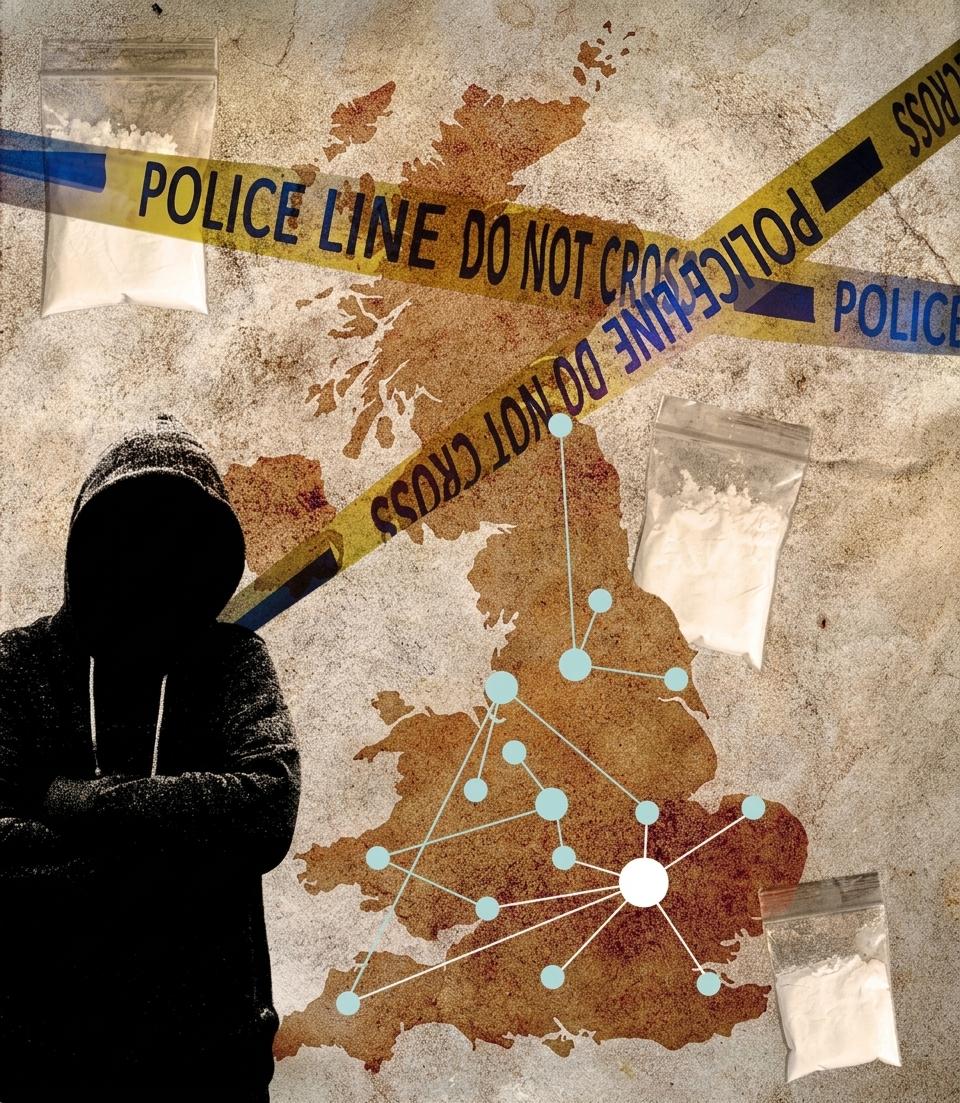
The London children trapped in Britain’s £500m County Lines drug trade
Organised gangs are forcing children into violent slavery on an industrial scale, yet the warning signs are often missed by schools, police and social care, reports Hannah WallaceHannah Wallace1 minute ago
At 14, Casper* should have been sitting in a classroom. Instead, he was trafficked out of London to help transport and sell heroin and crack cocaine. For weeks, he was held inside a filthy “trap house” — a property transformed into a drug gang operating base. During multiple moves to new locations, gang members ordered him to hide Class
A drugs inside his body — likely his anus — to evade police detection. Beatings became routine as Casper’s captors enforced obedience through fear. They targeted his family as well, repeatedly vandalising their London home. If Casper tried to leave, they put a gun to his head.
The Youth Endowment Fund estimates that one in eight British children aged 13 to 17 has been approached to sell or transport drugs
Nearly two decades after London’s postcode gangs began expanding beyond the capital, county lines has evolved into one of Britain’s most profitable criminal enterprises, generating up to £500 million a year supplying crack cocaine and heroin across England and Wales, according to National Crime Agency data.
What began as gangs exporting drugs to coastal and market towns has become a sophisticated countrywide network of child criminal exploitation, “cuckooed” homes, money laundering and manufactured debt bondage. The foundation of this corporate-style hierarchy is children — some as young as 11 — who are used to transport drugs, cash and weapons.
The Youth Endowment Fund estimates that one in eight British children aged 13 to 17 has been approached to sell or transport drugs. In London alone, more than 4,000 children have reportedly been groomed or coerced into county lines operations, according to official city data.
Children might be groomed with nothing more than a bucket of fried chicken
Child exploitation often begins with grooming. Caseworkers and frontline specialists told the Standard they repeatedly see the same pattern: fractured, low-income families rife with abuse, neglect, and children with unmet special educational needs, such as ADHD or autism.
Gang members exploit financial hardship and social isolation by offering what appears to be friendship, belonging and status. The rewards start small: a bit of cash, then maybe designer trainers or clothing. On some of London’s poorest estates, youth workers say children might be groomed with nothing more than a bucket of fried chicken. Need and naivety make them particularly vulnerable.
“Children are often deliberately targeted because they are children,” says Junior Smart, associate director at the St Giles Trust. “They can be easier to impress, frighten, isolate or control, and they are less likely to understand that what is being presented as friendship, money, protection or status is actually exploitation.”
Once dependency is established, the grooming escalates. Many children are put through violent initiations, from carrying weapons and assaulting rivals to setting up drug lines in new towns — missions that frequently place them directly in conflict with competing gangs. In one case, gang members reportedly forced a 14-year-old boy to rape a girl as part of his initiation. Casper’s story exposes repeated failures on the part of institutions created to protect vulnerable children like him. He grew up with a single mother on an estate known for gang activity. Money was tight.
His mother worked long hours, often leaving him unsupervised. Excluded from school at 12, Casper spent extended periods missing from education. Despite the clear warning signs, nobody contacted social services — a critical missed opportunity.
Read More
Robotaxis hit London: Can driverless cabs master the capital’s chaos?
Teenager jailed after robbing man’s gold necklace at central London station
Drug dealer who was caught hiding in wardrobe after accidental Wi-Fi login jailed
Police hunt man after sexual assault on north London train
Ewan’s* childhood followed a familiar pattern. Referred to the St Giles Trust aged 16 in 2025, he had already experienced years of trauma, missing episodes, criminal exploitation and deteriorating mental health. Known to services from the age of six after growing up in a chaotic home, Ewan’s childhood was marked by trauma and missed opportunities for support. He began using cannabis at just 10, trying to cope with experiences that had left him struggling. By 12, he had been drawn into county lines exploitation to fund his drug use. Within a year, his cannabis use had escalated to as much as six grams a day, while concerns grew over possible gang involvement and he began repeatedly going missing.
Exclusion removes a much-needed protective environment, creating a vacuum gangs are quick to fill
Analysts increasingly view school exclusion as a key risk factor for criminal exploitation, as it cuts young people off from the support and stability schools often provide. “The vast majority of the children — and many of the adults — we work with have histories of school exclusion or persistent absence,” says Dr Grace Robinson, founder of Black Box Research and Consultancy, which specialises in countering modern slavery and criminal exploitation. “School is often one of the last remaining protective structures in a child’s life. It provides routine, trusted adults, positive peer relationships and opportunities for professionals to identify indicators of exploitation.”
When a young person is outside the schooling system, isolated from helpful adults, or feels labelled and unwanted, that creates space for exploiters to step in. Exclusion removes a much-needed protective environment, creating a vacuum gangs are quick to fill. Ironically, many of the behaviours that trigger exclusion — truancy, drug possession or carrying weapons — are themselves some of the strongest indicators that a child may already be exploited.
Robinson says some schools have responded to behavioural incidents by calling police to remove pupils from the premises. “Such a response can be profoundly distressing and may reinforce feelings of rejection and criminalisation, further weakening the child’s trust in professionals and making engagement with safeguarding support less likely,” she says.
Many excluded pupils are then transferred into Pupil Referral Units, becoming concentrated in environments gangs regularly target. These schools operate under reduced timetables, which means young people with working parents are often left unsupervised.
Practitioners say support often focused on managing the consequences rather than addressing the causes of his vulnerability
Ewan’s education followed the same trajectory. He was excluded from three mainstream schools before being placed in alternative provision, but struggled to attend and eventually left education at 15 without any qualifications. Diagnosed as autistic, he also experienced severe mental health difficulties and twice attempted to take his own life. By then, multiple agencies had already been involved in his life. His exclusions, mental health crises and repeated contact with authorities had provided opportunities for intervention, but practitioners say support often focused on managing the consequences rather than addressing the causes of his vulnerability.
Even when social services intervene, the response is often undermined by years of financial pressure. Children are frequently placed in care homes or temporary accommodation far outside London. These out-of-area placements are widely portrayed as helping break gang connections, but practitioners say they are often a result of limited local placements and stretched council budgets.
Casper’s arrest exposed perhaps the most serious institutional failure of all. Police found him almost 100 miles from home. He had fallen way behind on his education while living in a trap house selling Class A drugs. Yet the authorities failed to place him into the National Referral Mechanism (NRM), the government framework for identifying victims of modern slavery and human trafficking.
Under the Modern Slavery Act, police and other public authorities have a statutory duty to refer children into NRM whenever there are reasonable grounds to suspect exploitation. The threshold is deliberately low, and placing a child into NRM is merely a recognition that he or she may have been trafficked and compelled to commit crimes. But lawyers and frontline practitioners say too many exploited children are still viewed primarily as offenders. Children groomed into county lines are frequently traumatised, distrustful of authority and reluctant to cooperate with police.
Yet investigators often interpret inconsistent accounts, silence or repeated returns to gangs as evidence of criminal intent rather than signs of coercive control. “We have seen a number of cases where police have been asked by defence solicitors to act as first responders and refer a potential child victim into the NRM but have refused because they did not believe there were reasonable grounds to suspect modern slavery, despite credible indicators,” says Robinson.
Even when a child is recognised by the NRM, state protections only go so far. Schools could still treat that child as a disciplinary problem, the police as a missing person, the criminal justice system as a defendant. Crucially, NRM decisions are not binding on prosecutors and cannot be relied on as evidence in criminal proceedings.
Defence solicitors say this creates a postcode lottery of justice, where whether an exploited child is recognised as a victim or prosecuted as a criminal can come down to discretion, or location.
Yet practitioners say recognising exploitation is only the first step. Helping a child leave county lines often requires months of patient, trauma-informed support built on trust rather than punishment. That was the approach taken when Ewan was referred to St Giles after years of criminal exploitation. Agencies warned a caseworker that Ewan did not engage with professionals. Instead of overwhelming him with targets, staff at St Giles adapted their approach around Ewan’s autism, trauma and mental health needs, focusing on building trust.
The children most easily labelled as criminals are often those the state has failed for the longest
If London and Britain are serious about ending county lines, policing alone will not solve a crisis rooted in poverty, exclusion and eroded public services. The Metropolitan Police continues to shut down hundreds of drug lines every month. But enforcement addresses the symptoms, not the causes. School absence remains poorly monitored, youth services have been hollowed out and councils continue to struggle under financial pressure. Recent legislation, including the Crime and Policing Act, has strengthened offences relating to child criminal exploitation. Yet some worry about creating more offences to address modern slavery when police are inadequately trained to identify such cases.
Robinson says few cases have led to what might be described as a thorough investigation. The children most easily labelled as criminals are often those the state has failed for the longest. Experts argue the answer lies in identifying exploitation much earlier: intervening before children disappear from school, improving information-sharing between agencies, rebuilding support services and ensuring safeguarding responses take precedence over criminalisation.
Until that changes, children like Casper will continue to be treated as criminals.
*Names have been changed
MORE ABOUT