
Advertisement
MUSIC
Belle and Sebastian ★★★★★
Palais Theatre, September 12
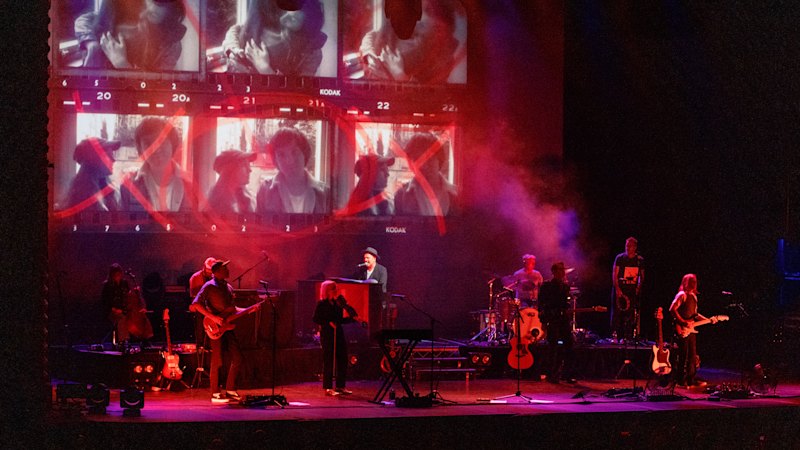
“Welcome to the second recording session for this still quite-new band,” Stuart Murdoch says with a grin. His tongue is firmly in cheek – Belle and Sebastian, the indie-pop group he’s led for more than half his life, is on tour celebrating its 30th year. In 1996, the bookish Scots made their debut with two albums: Tigermilk and If You’re Feeling Sinister. On this anniversary tour, they’re alternating playing those records in full. Melbourne gets the Sinister treatment.
Playing albums in full live can be a cynical cash-cow in the age of commodified nostalgia, but there’s no denying the sheer delight of hearing a beloved album like this in all its glory. On record, Sinister’s arrangements are delicate; live, they’re injected with a shot of joyous energy, with buzzing synth to boot.
Many of these songs begin with Murdoch alone, singing with that sweet, instantly recognisable voice, before the eight other musicians on stage slowly blossom to create sunlight in musical form. Lead guitarist Stevie Jackson raucously takes on the harmonica for Me and the Major, his movements a chaotic blur.
Advertisement
As the album reaches its halfway point, a projection behind the band shows the LP being flipped on a turntable – “a bit of antiquated attention to detail,” Murdoch says. Eager fans have been dancing in the aisles from the beginning, but when the band plays Get Me Away, I’m Dying, the entire venue is on its feet. The gorgeous Mayfly is another highlight from this half, but really, it’s all joy, not least because Murdoch and co are clearly having a blast, too.
Murdoch’s signature humour is on display all night as he intersperses the music with quips, including a spiel about Victoria’s slogans as seen on number plates and a joke about Viagra as he takes his medication on stage. “Back to sweetness and light!” he says, and back they go.
A guitar-heavy I’m a Cuckoo kicks off the second set, comprising songs from the rest of the band’s long career. Belle and Sebastian have such a varied discography that it’s a grab-bag every night. There are some deeper cuts here, such as 2010’s Little Lou, Ugly Jack, Prophet John, recorded with Norah Jones; here, it’s long-time vocalist Sarah Martin who does the honours, beautiful as ever. 2006’s Funny Little Frog is a charming, nostalgic treat.
The band is pulling songs out on the fly by the end, with Another Sunny Day closing the night. It’s apt – with 30 years of sunny days up their sleeves, Belle and Sebastian keep on delivering.
Reviewed by Giselle Au-Nhien Nguyen
Advertisement
OPERA
Serse ★★
Gasworks Theatre, until September 13
We’re all getting restless. Twenty minutes after the curtain was meant to go up for the opening show of Lyric Opera’s Serse, we’re still waiting for the conductor to raise his baton. Eventually, company artistic director and conductor Patrick Burns addresses the audience, explaining that though they’ve tried to fix the issue, they’ve had no success.
Both projectors have died. For the near-three-hour Italian opera we’re about to witness, there will be no surtitles. No translations. Oh dear.
Turns out, if it was sung in English, it’d be hard to follow anyway. Handel’s 1738 opera about the King of Persia is one of those operas stacked with couples pursuing, deceiving, rejecting and reuniting with one another, plus disguises and mistaken identities thrown in, of course.
Advertisement
Baroque opera has a small but loyal audience in Melbourne, but for a company that has commendably programmed contemporary operas in previous seasons, Serse is, frankly, an odd choice.
The production, by director Beng Oh and designer Christina Logan-Bell, is certainly clever, updated to the Regency era where it fits quite well, what with all the letter-writing and love-in-turmoil. But even with tech issues aside, faults remain. The ornamentation demands were too much for some, and the approach (though it is correct Baroque style) of leaving out vibrato resulted in some unenergised vocal patches.
Some shined, like mezzo Naomi Flatman, who with a honeyed, resonant sound, delivered the standout performance of the night. Soprano Rebecca Rashleigh too gave a consistently vibrant performance, with thrilling top notes. As Serse, it was testament to Sally-Anne Russell’s comedic talent that though we mostly had no idea what was going on, people still laughed when they were, presumably, meant to.
Though it was the initial problem, the ensuing convoluted plot, repetitive musical style and uneven singing proved that being sung in a foreign language is not the greatest measure of an opera’s accessibility.
Reviewed by Bridget Davies
Advertisement
DANCE
7 Dances for 7 People ★★★
Northcote Town Hall, until September 19
Yes, there are indeed seven dances – or sections – in choreographer Trá Mi Dinh’s latest work, but only the first of them is unambiguously successful. I would happily have watched this strange, lustrous gambit for the full hour, either extended or simply repeated.
Two dancers emerge from billowing clouds of smoke, like figures in a dream, amid an eerie tintinnabulation. Delicate unison stepping gives their progress toward the audience an insect-like grace; raised arms and joined hands further heighten their otherworldly appearance.
The awkward position of the arms, which restricts the movement of the upper body, creates a sense of fragility and risk. It’s as if their grip on one another is all that prevents them tumbling back in the cloud of smoke. It gives the whole scene a shimmery, slippery sort of ephemerality.
Advertisement
After the first dance, the movement becomes more eclectic. Smooth isolations, with their tensing and releasing, give way to looser spinning figures. Vaguely balletic poses contrast with thrusting modern dance gestures. And everything whirls together in the smoke.
The combinations are not always compelling, but something of the mysterious atmosphere of the first section persists. And interesting details register throughout, particularly in the way the seven dancers move between pairs and trios, with new arrangement materialising in the gloom.
This show is based on a shorter commission for Lucy Guerin’s Pieces in 2024, and it retains the same production team, including lighting designer Rachel Rui Qian Lee and costume designer Geoffrey Watson, who provides beautiful filmy smocks.
Tilman Robinson’s score feels a little too insistent. The opening section with its bells has an attractive alienness, but I think the heavier beats used thereafter impose too much on the choreography and a more ambient soundscape might have been more effective.
Advertisement
The work is apparently based on the significance of the number seven across religions and cultural traditions. Yet it is strongest when there is no theme: just fleeting relations between bodies – repetitions and doublings, divergences and singularities – in a world before number settles into meaning.
Reviewed by Andrew Fuhrmann
The Booklist is a weekly newsletter for book lovers from Jason Steger. Get it delivered every Friday.
You have reached your maximum number of saved items.
Remove items from your saved list to add more.
More:
- Melbourne live reviews
- For subscribers
- Arts
- See & Do
- Performing arts
- Victoria
- What’s on
- Review
- Live music
- Live music
- Review
Giselle Au-Nhien Nguyen is a writer.Connect via X.Bridget Davies is an award-winning mezzo-soprano and journalist.Andrew Fuhrmann is a dance critic for The Age.AdvertisementAdvertisement