
World-first trial on Phillip Island discovers floating wetlands can cut emissionsBy Jack Colantuono, Zaida Glibanovic and Mim Hook
Posted Sat 12 Sep 2026 at 3:31pmSat 12 Sep 2026 at 3:31pmSat 12 Sep 2026 at 3:31pm
In short:
A world-first trial on Phillip Island has found floating wetlands can significantly reduce greenhouse gas emissions from wastewater lagoons.
Researchers say the nature-based solution could be retrofitted into existing lagoons.
What’s next?
Researchers will test the floating wetlands across different environments and scales to determine whether the approach can be rolled out more widely.
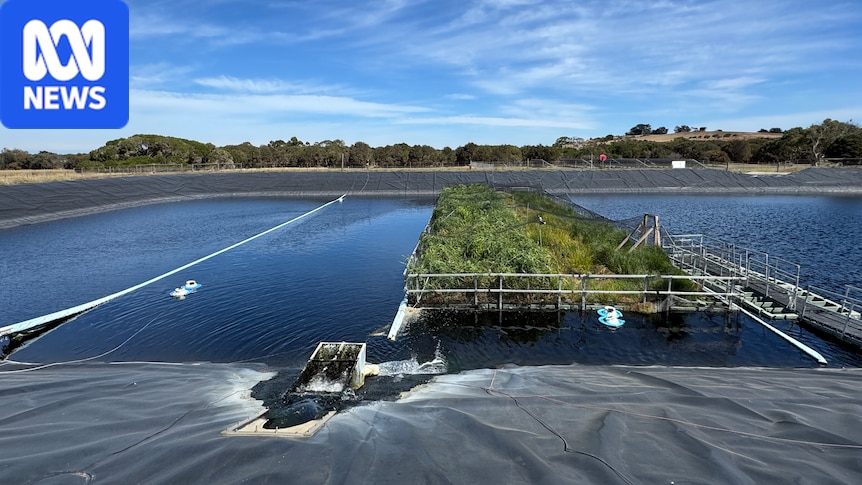
Researchers believe a floating garden of native plants on a wastewater lagoon in VIctoria’s east could help tackle greenhouse gas emissions, after it cut the lagoon’s emissions by about 30 per cent.
The floating wetland is part of a world-first study conducted by RMIT University, Westernport Water and the CSIRO on Phillip Island over two years.
The 330-square-metre platform, roughly the size of one-and-a-half tennis courts, was planted with native reeds and sedges, with their roots hanging into the wastewater below.
RMIT’s Centre for Nature Positive Solutions research fellow Lukas Schuster said the plants’ roots created habitat for microbes that could help break down organic matter and absorb nutrients and pollutants.
“Floating wetlands are, you can imagine, like buoyant platforms that basically have the wetland plants planted onto them and the roots are hanging down into the water,” Dr Schuster said.
“So they’re made to clean the water basically.”
Researchers found the floating wetland reduced carbon dioxide emissions by up to 36 per cent, methane by up to 66 per cent and nitrogen by 18 per cent compared with a control lagoon without a wetland.
Dr Schuster said wastewater treatment was a significant source of emissions globally.
“On a global scale, they produce roughly 700 million tonnes of greenhouse gases every year,” he said.
“Now we think about Victoria alone, for example, that is roughly one million tonnes of greenhouse gases every year.
“And so reducing those emissions is very tricky, but it’s a very important step that we show basically that we can reduce emissions in open lagoons.”‘
The lagoon contained about 14 million litres of wastewater, with emissions monitored continuously over two years using solar-powered sensors.
Years of research
Dr Schuster said the trial’s scale was important in testing whether floating wetlands could work in a real-world wastewater treatment setting.
“We were basically measuring the greenhouse gas emissions continuously; we were there every month deploying sensors and measuring the emissions continuously across the two years,” he said.
Researchers say the technology could be useful because floating wetlands could potentially be retrofitted into existing lagoons without major infrastructure changes.
Dr Schuster said water companies had already expressed interest in further trials.
“It’s also not only emission reduction, but also pollutant removal,” he said.
“We’re talking about perfluoroalkyl and polyfluoroalkyl substances (PFAS) removal or other pollutants in the wastewater and also maybe provide habitat for biodiversity.”
Dams to be trialled next
Researchers are now trialling similar floating wetlands in farm dams across the Bass Coast, investigating their potential to improve water quality, biodiversity and emissions.
Dr Schuster said future research would also look at making the floating platforms more sustainable, including through recycled or plant-based materials.
“It will also be super interesting to see whether we can make them a bit more sustainable,” he said.
“For example, like with recycled materials or plant-based materials rather than having actually plastic-based baskets, for the floating wetland.”
Benefits for farmers
Kernot farmer Camilla Graves has floating wetlands in two of her 26 farm dams as part of the trial.
“Dams are essential, and one thing we have been concerned about is actually the quality of the water in our dams,” Ms Graves said.
She said the floating wetlands also provide protection to ducks, which use dams for habitat, from predators.
“The floating wetlands have actually provided an opportunity for them to take some shelter where the foxes can’t get to them because the floating wetland literally is in the middle of the dam,” Ms Graves said.
She said people who were not from regional Victoria may not realise how dependent nearby agricultural communities are on water collected and stored on farms.
“Water quality is really prime to agriculture,” Ms Graves said.
She said the floating wetlands could be easily adopted by other farmers.
“Its simplicity is amazing; this concept can definitely be rolled out Australia-wide to farmers that are interested in giving it a go,” Ms Grave said.