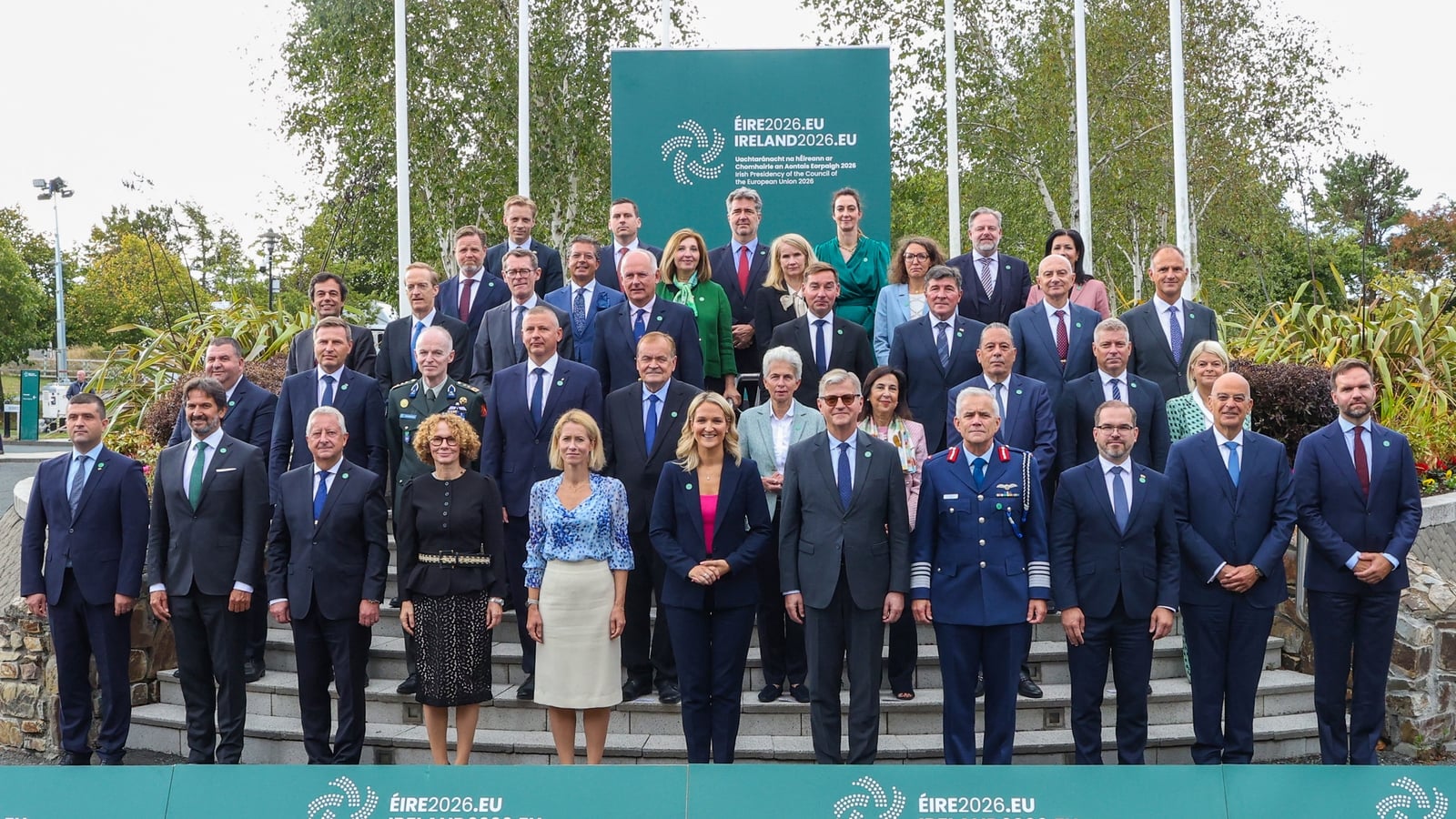
EU defence ministers have gathered in Co Wicklow for an informal meeting as part of Ireland’s hosting of the Presidency of the European Council.
There is an increased garda presence, road closures and airspace restrictions in the area.
Minister for Defence Helen McEntee is likely to discuss a range of issues with her European counterparts including EU support for Ukraine, Lebanon and maritime security.
The gathering comes after Taoiseach Micheál Martin said last week that one of Ireland’s priorities during the EU Presidency was to “unequivocally back Ukraine” as it continues to face attacks from Russia.
Ms McEntee is hosting an informal meeting of ministers from 27 EU member states – chaired by the EU High Representative for Foreign Affairs and Security Policy Kaja Kallas – before hosting a press conference this afternoon.
Ministers meeting at the Druids Glen resort will also likely focus on the latest developments in the US war against Iran, after the US this week carried out what it called targeted strikes to tackle an imminent threat from Iranian rocket launchers on Larak Island in the Strait of Hormuz.
Watch: Ireland increased defence spending by 43% in recent years – McEntee
There is a significant garda operation in place in the vicinity of Druids Glen, with gardaí advising people to follow instructions when encountering road closures.
The Irish Aviation Authority (IAA) has also put in place airspace restrictions around Dublin for the duration of the gathering, with curbs in place on the flying of drones.
A notice from the IAA states the restrictions are “for reasons of security” at the request of the Department of Justice.
Ms McEntee said there was a significant security operation in place throughout the EU Presidency although she said would not reveal exact details.
“But what I can say is that we are investing significantly to make sure that we have a new military radar system. We are investing significantly in our counter-drone technology, of which you’ll see in operation just this week.
“We’re also investing in our maritime space, and that is why I launched earlier this year a new maritime security strategy, so that we have a full, complete radar picture.”
She said Ireland had increased defence spending by 43% in recent years.
Tomorrow, EU member states’ foreign ministers will also meet in Ireland to discuss issues including transatlantic relations and the Middle East.
Ukraine’s Foreign Minister Andrii Sybiha will be among those to attend tomorrow’s meeting while the foreign ministers of Iceland, Britain, Canada, Norway and Switzerland have also been invited to join the discussion.
On Ukraine, Ms McEntee said no decisions would be taken today as it is an informal meeting but she said there was an opportunity to “unlock” issues.
“It’s an opportunity to focus on the priorities and how we progress them, so we’ll hear from our defence colleague in Ukraine this morning [on] the situation on the ground, but importantly, what is required now from the EU, the European Peace Facility needs to be unlocked, and so I hope that we will have further discussion this morning as to how we can do that.
“I believe that we can, because what Ukraine needs now at the moment is more defence capabilities. It’s more air support. That’s why our funding that we announced over the summer from Ireland would specifically go towards air capabilities. But we need much more.
“We know that we need this on a much larger scale. We also know that we need to progress the European peace loan or the European security loan as well, and that we need to unlock more of that for Ukraine as soon as possible, said Ms McEntee.
Speaking earlier, she said: “Measures at a European level have a direct impact here at home. They affect the cost of doing business, the security of our energy supply, the opportunities available to our farmers and exporters, and our ability to respond to challenges such as war, economic instability and technological change.
“The Presidency provides Ireland with an opportunity to shape these decisions and to push for solutions that deliver for people right across Ireland and the EU.”
The Irish Council for Civil Liberties yesterday wrote to Ms McEntee urging her to use Ireland’s Presidency to step up efforts to protect the International Criminal Court from the US, after the US Department of State announced it would escalate its campaign against the court, with the stated aim of “dismantling” the institution “brick by brick”.