
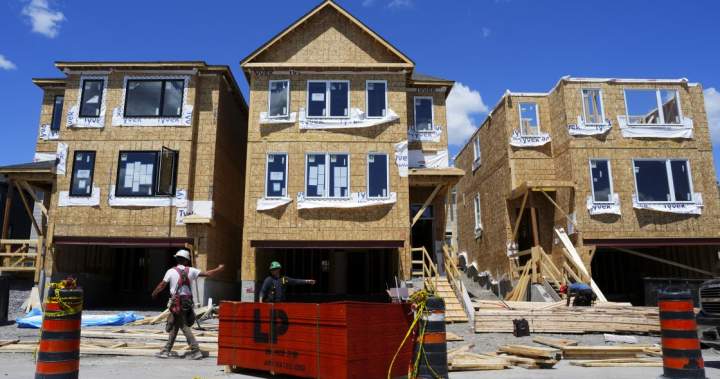
Canada needs to roughly double the rate that new homes are being built in order to restore housing affordability to pre-pandemic levels over the next decade, according to the Canada Mortgage and Housing Corporation (CMHC).
The CMHC released its fall 2026 housing supply report on Thursday, which said Canada needs to build hundreds of thousands more homes annually in order to narrow a significant long-term supply gap, with some major markets struggling more than others.
According to the report, Canada is currently on pace to build about 231,000 homes per year until 2036, but would need to build between 417,000 and 469,000 homes annually in order to narrow the housing supply gap and see home prices return to 2019 levels.
A housing supply gap is the difference between the perceived demand for homes to rent or buy and the number of homes actually available in the market.
Story continues below advertisement
“Meeting future housing demand will depend on the pace of new construction. Construction costs remain high. Presale financing conditions remain difficult for some projects. Weak condominium market conditions continue to make developers cautious about launching new projects,” says CMHC in the report.
Get daily National news
Get daily Canada news delivered to your inbox so you’ll never miss the day’s top stories.
By providing your email address, you have read and agree to Global News’ Terms and Conditions and Privacy Policy.
“At the same time, several policy measures are helping support housing supply. Government financing programs, lower or deferred development charges, and zoning reforms are improving the financial viability of some projects, particularly in purpose-built rental housing.”
“These trends suggest that housing demand will likely strengthen over time, while supply may respond more slowly. Restoring affordability will require not only more housing, but the right mix of housing to meet future needs.”
Related Videos
1:59
Nova Scotia says housing starts moving in right direction, as affordability questioned
-
Nova Scotia says housing starts moving in right direction, as affordability questioned
-
Carney promotes ‘Build Canada’ agenda at Global Progress summit
-
Municipal Matters: Encouraging signs emerging for Canada’s cities
-
Immigrant family in Kelowna facing homelessness
-
Business News: A renewed gold rush & affordability
These figures were based on expectations for both short and long term demand, CMHC says, and improved housing affordability may depend on whether Canadians are looking to rent or own their homes, and in which markets.
- Are you willing to pay more to stand up to the U.S.? What readers told us
- How much will Trump’s ban on alcohol, dairy hurt Canada?
- Jamieson Greer blames Canada for U.S. hitting back over counter-tariffs
- Costco Canada chicken product is being recalled. What to know
-
Your Money: What new counter-tariffs mean for your wallet
-
Consumer Matters: BC woman initially refused refund for scooter
-
Pain in the gas: Oil surges above $100/barrel again as Iran war reignites
-
Okanagan concerns about U.S. wine ban
Story continues below advertisement
In places like Vancouver, Toronto, Ottawa and Montreal, renters may see housing affordability relief somewhat sooner than homeowners, the CMHC report says, with recent housing construction skewed towards purpose-built rental construction, which makes up two-thirds of all apartment housing starts.
The CMHC says this poses a significant risk to overall homeownership affordability in Canada over the long term, but that outlook varies significantly by market.
The projected housing supply gap has narrowed in Toronto and Calgary, but for different reasons, with Toronto seeing lower home prices improve affordability, while construction activity has picked up significantly in Calgary in the past year.
Vancouver was arguably the least affordable major housing market in Canada during the pandemic years, and the CMHC report shows the supply gap has remained mostly unchanged year-over-year. Although Vancouver home prices have come down and new home construction rates have increased in the short term, that progress is expected to slow over the long term as the market’s rising population pushes up demand.
Meanwhile, Ottawa and Montreal are expected to see a wider housing supply gap because demand in these markets is projected to grow faster than available units or those that are expected to be starting construction.
Edmonton remains the most affordable major market in Canada, the CMHC report shows, with virtually no measurable supply gap as housing construction starts have generally kept pace with population growth.
Advertisement